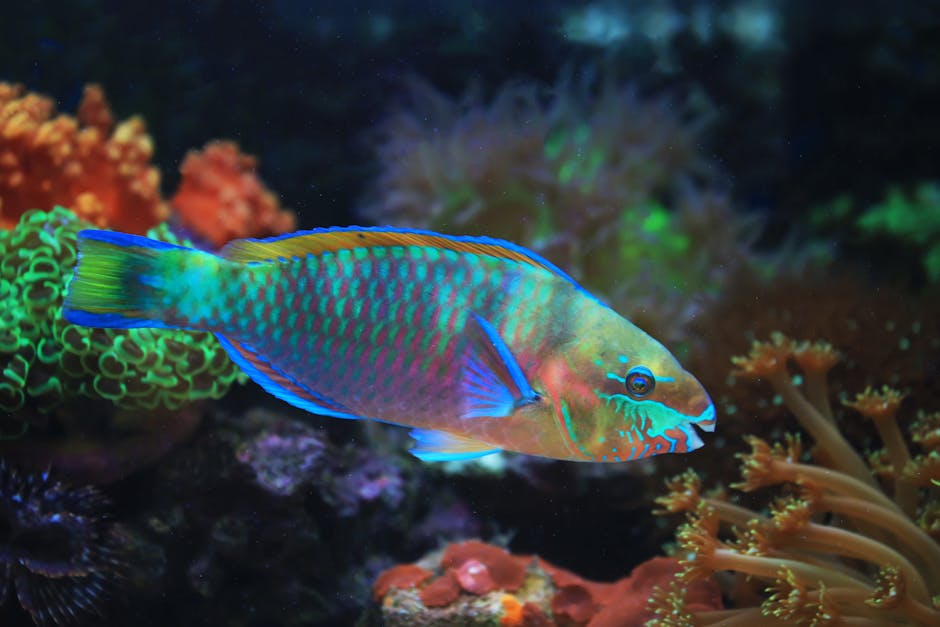
The sound is what gets you first. A loud, sharp crunch – like someone biting into a hard biscuit – that carries clearly through the water. Then you see the source: a large parrotfish, its beak-like fused teeth scraping across a coral surface, leaving a white scar and releasing a small cloud of fine white particles. Those particles are sand. The parrotfish is, in the most literal sense, making the beach.
Parrotfish are among the most ecologically important fish on the Great Barrier Reef, and among the most misunderstood. The crunching you hear is not the fish eating coral – it’s eating the algae and cyanobacteria that grow on and within the coral skeleton. The coral skeleton is collateral damage, ground up in the process and excreted as fine carbonate sand. A large parrotfish can produce up to 90 kilograms of sand per year. The white sand beaches and sandy lagoon floors of the GBR are, in significant part, parrotfish excrement. This is not a metaphor.
The GBR’s Parrotfish Species
The GBR hosts approximately 30 parrotfish species, ranging from the small and cryptic to the large and spectacular. The steephead parrotfish (Chlorurus microrhinos) and the bullethead parrotfish (Chlorurus sordidus) are among the most common on reef crests and slopes. The bumphead parrotfish (Bolbometopon muricatum) is the largest – reaching up to 1.3 metres and 46 kilograms – and one of the most impressive fish on the reef.
Bumphead parrotfish travel in schools of up to 75 individuals, moving across the reef in a coordinated grazing front that leaves a trail of white scars and sand. They’re the only parrotfish species that headbutts coral – literally ramming their reinforced foreheads into coral heads to break off chunks for processing. The sound of a school of bumpheads feeding is extraordinary: a continuous, overlapping series of crunches that sounds like a construction site.
All parrotfish are protogynous hermaphrodites – they begin life as females (the “initial phase,” typically drab brown or grey) and some individuals transition to males (the “terminal phase,” typically brilliantly coloured in blues, greens, and pinks). Terminal phase males are the most visually striking fish on the reef, and their colours change with age and social status.
Check real traveller reviews, prices, availability, departure points, and flexible booking options in one place.
Ecological Role: More Than Sand Production
Sand production is the most visible parrotfish function, but their ecological role is broader. By grazing algae from reef surfaces, parrotfish maintain the open substrate that coral larvae need to settle and grow. A reef without parrotfish quickly becomes dominated by algae, which outcompetes coral for space and light. The parrotfish are, in effect, the reef’s gardeners – constantly clearing the substrate for the next generation of coral.
This function is particularly critical after disturbance events. After a bleaching event or cyclone kills coral, the bare skeleton is rapidly colonised by algae. Parrotfish grazing keeps this algal colonisation in check, maintaining the conditions for coral recovery. Reefs with healthy parrotfish populations recover from disturbance faster than those where parrotfish have been depleted.
Parrotfish also produce the bioerosion that shapes reef structure over geological time. By grinding coral skeleton into sand, they contribute to the erosion of reef framework – a process that, balanced against coral growth, determines the net accretion or erosion of the reef over centuries. Climate change is disrupting this balance: slower coral growth due to ocean acidification, combined with continued bioerosion, is causing some reef sections to erode faster than they grow.
Sleeping in a Mucus Bubble
Parrotfish have one behaviour that deserves mention purely for its strangeness: at night, many species secrete a mucus cocoon around themselves before sleeping. The cocoon takes about 30 minutes to produce and envelops the fish completely. Its function is debated – it may mask the fish’s scent from nocturnal predators like moray eels, or it may protect against parasites. Whatever its function, finding a parrotfish asleep in its mucus sleeping bag on a night dive is one of the reef’s more surreal experiences.
I’ve been watching parrotfish for years, and I still find the crunching sound startling every time. There’s something about the audible evidence of geological process – the reef being slowly ground into beach, one bite at a time – that makes the timescale of the reef viscerally real. The parrotfish have been doing this for millions of years. The beaches they’ve made will outlast us all.
Compare top-rated tours, prices, availability, and real traveller reviews before booking. See what’s actually available for your dates and departure location.
Compare tours and check availability