The briefing was simple: don’t touch, don’t overtake, don’t get in front of it. Stay at its side. Match its pace. When it dives, let it go.
I’d heard those instructions before diving with large animals, but something about the delivery — the way the guide paused after “when it dives” — told me this was different. You can follow most animals if you want to. You don’t follow a whale shark.
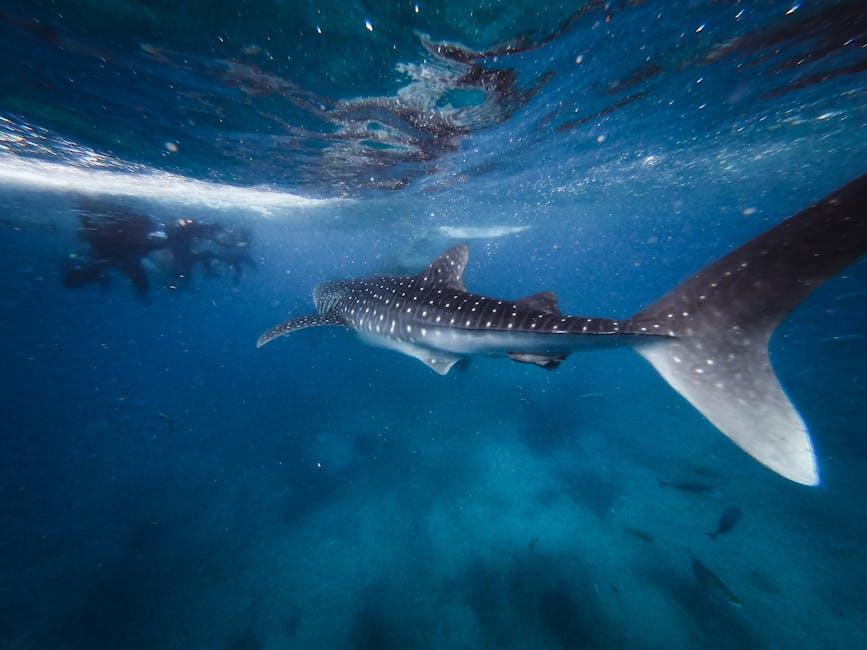
We dropped into the water off Ningaloo Reef in Western Australia and there it was. Whale sharks are difficult to size at first because your brain refuses to process what it’s receiving. The animal in front of me was approximately nine metres long — a youngster, as whale sharks go — and its sheer volume created a kind of visual gravity. Everything else in my field of vision became irrelevant. The reef, the surface, my fellow snorkellers — all of it retreated to the periphery.
I started kicking. It barely seemed to move, yet I was working hard to stay alongside it.
The Largest Fish in the Sea
Rhincodon typus — the whale shark — is the largest fish on Earth. The largest reliably measured specimen was 12.65 metres long and was tagged near Pakistan in 2001, though unverified accounts describe animals exceeding 14 metres. Female whale sharks are generally larger than males, and the animals continue growing throughout their lives, which may extend to 130 years — though our ability to accurately age whale sharks remains limited.
Check real traveller reviews, prices, availability, departure points, and flexible booking options in one place.
Despite reaching sizes that rival some baleen whales, whale sharks are filter feeders. Their diet consists primarily of zooplankton, fish eggs, small fish, and krill — some of the smallest organisms in the ocean. They feed by swimming forward with their enormous mouths open, filtering water through five pairs of large gill slits. The filtering apparatus — modified gill rakers packed tightly together — can strain particles as small as one millimetre.
At aggregation sites where food concentrations are extremely high, whale sharks will shift to active feeding: stationary “suction feeding,” hanging nearly vertically in the water with their mouths at the surface, gulping water and filtering it in rapid bursts. Watching a four-metre mouth doing this from a few body lengths away is, I will tell you plainly, one of the stranger and more magnificent things the ocean has to offer.
Understanding the Aggregations
Whale sharks are, for most of their lives, solitary and deeply mysterious. They make long oceanic migrations — tagged individuals have been tracked crossing entire ocean basins — and spend much of their time at depths of 200 metres and beyond, out of reach of divers or researchers. We still don’t know where they give birth. We have never found a pregnant female, which is remarkable given how long we’ve been looking.
But periodically, predictably, whale sharks gather in specific locations in response to food availability, and it is at these aggregations that we’ve learned most of what we know about them.
Ningaloo Reef, Western Australia is the most famous and most visited aggregation site. Between March and July each year, whale sharks congregate off the Ningaloo coast to feed on mass coral spawn and associated zooplankton. The numbers vary year to year but can reach several hundred animals. The season is reliably predictable — it follows the full moon in March, when the corals spawn — and Western Australia has built a carefully managed swim-with-whale-shark industry around it that is, by international standards, a model of how these encounters should operate.
Donsol Bay, Philippines hosts aggregations between November and June. The whale sharks — locally called butanding — feed on whale shark shrimp and other plankton concentrated in the bay.
Isla Holbox and the Yucatan Peninsula, Mexico host a remarkable aggregation each July through September, where whale sharks gather to feed on fish spawn near the surface. Numbers at this site have reached over 400 individuals in a single day — the largest known aggregation in the world.
Mafia Island, Tanzania and the Maldives both host smaller year-round populations, with the Maldives in particular supporting individual animals that have been photographically identified over many years.
How to Swim With a Whale Shark Responsibly
I want to spend some time on this because the standards vary enormously between operators and destinations, and the experience varies dramatically depending on how it’s managed.
A well-run whale shark encounter works like this: a spotter plane or boat locates the animal’s dorsal fin on the surface. The boat approaches from ahead of the shark and positions snorkellers in the water in its path. The group swims alongside at distance — typically two to three metres — without overtaking the head or positioning between the animal and the surface.
A poorly-run encounter involves too many people, boats that approach from multiple directions, operators who allow or encourage touching, and no time limit per group.
The rules that make the difference:
– Maximum group size of ten swimmers plus one guide per shark
– No flash photography, no grabbing, no riding (yes, this is still something that needs to be stated)
– No positioning in front of the animal or in its path
– Fins only — no scuba, which creates turbulence and bubbles that disturb the shark
– A “hands-off” approach from boats, which should never cut across the shark’s path
The research on stress responses in whale sharks at high-traffic sites is sobering. Animals at heavily visited aggregations have shown avoidance behaviour, reduced feeding activity, and — in the case of some sites in Southeast Asia — declining return rates. These are animals that, given the choice, will simply go somewhere else.
Identification and Individual Research
Like manta rays, whale sharks can be identified individually from the pattern of white spots behind their gill slits. The pattern is unique to each individual, stable over time, and can be photographed reliably in normal dive conditions.
The citizen science platform Wildbook for Whale Sharks — managed by the nonprofit Wild Me — holds a database of over 12,000 individually identified whale sharks from sightings contributed by researchers and recreational divers worldwide. If you swim with a whale shark, photograph the spot pattern from the dorsal fin back, and submit it. You may well be adding to a data record that stretches back fifteen or twenty years.
The data from programs like Wildbook have revealed things no individual researcher could have uncovered: trans-Pacific migrations, multi-year gaps in sightings suggesting deep-sea residency, sex ratios that change dramatically between aggregation sites (most aggregations are dominated by juvenile males; mature females remain largely unseen).
A Note on Size and Scale
I want to return to something I mentioned at the beginning: the difficulty of processing the size of a whale shark when you’re in the water with one.
I’ve spoken to divers who found the experience overwhelming, even briefly frightening — not because the animal was threatening in any way, but because its scale removed something from the encounter that you take for granted with smaller animals. There was no sense that the whale shark was registering my presence as anything significant. It moved through me (metaphorically) the way the tide moves through coral. I was an irrelevance to something very, very old and very, very large.
That’s the experience. For most people, it is profound. For some, it takes a couple of encounters to settle into. And for all of us, I think, it provides a useful recalibration — a reminder of exactly where we sit in the hierarchy of things that call the ocean home.
Compare top-rated tours, prices, availability, and real traveller reviews before booking. See what’s actually available for your dates and departure location.
Compare tours and check availability