The first seahorse I ever found underwater, I almost missed. My dive guide — a young Indonesian woman named Dewi, with the kind of eyes that see things other people don’t — stopped above a sea fan, hovered for a moment, then pointed. I looked. Sea fan. Sea fan branches. Sea fan—
Oh.
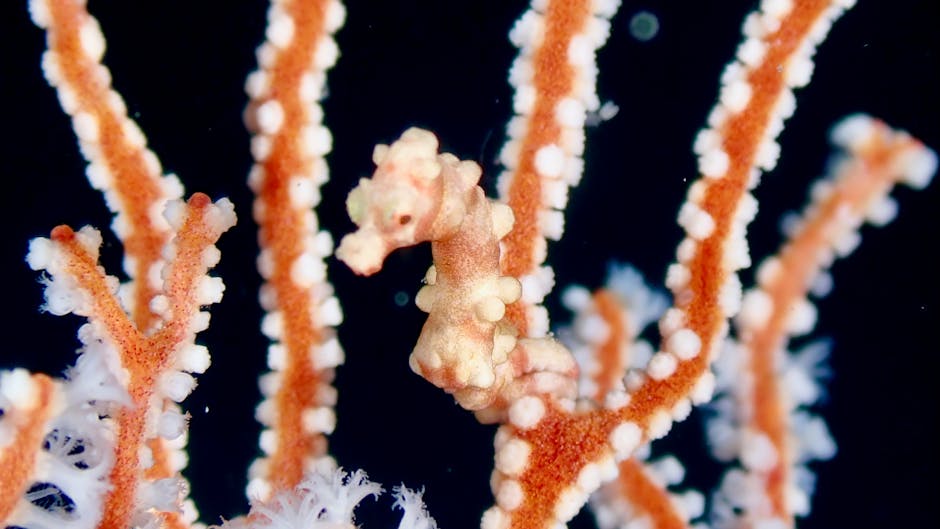
There it was. A pygmy seahorse, Hippocampus bargibanti, perhaps fourteen millimetres long, gripping a branch of the sea fan with its prehensile tail. Its body was covered in tubercles — rounded bumps — that exactly replicated the polyps of the host gorgonian in colour, texture, and spacing. It was not hiding behind the sea fan. It was, for all practical purposes, made of sea fan.
I have spent many hours underwater since that afternoon in the Lembeh Strait, but the memory of that first pygmy seahorse sits intact in me: the moment when a branch of coral became an animal.
A Fish Like No Other
Seahorses are fish. This surprises people — the upright posture, the horse-like head, the absence of scales (they have bony plates instead, called scutes), the curling tail — nothing about them says “fish” in the conventional sense. But they breathe through gills, have a dorsal fin and pectoral fins, and their swim bladder and basic body plan place them firmly within the teleost fishes, most closely related to the pipefish and sea dragons.
There are approximately 46 recognised species of seahorse in the genus Hippocampus (Greek for “horse sea-monster”), found in temperate and tropical shallow seas worldwide. They range from the dwarf seahorse (H. zosterae) of the Gulf of Mexico and Atlantic coast, which reaches about 2.5 centimetres, to the big-bellied seahorse (H. abdominalis) of southern Australia and New Zealand, which can reach 35 centimetres.
All seahorses share several features that are genuinely unusual in the fish world: the prehensile tail (used for anchoring, not locomotion), the upright posture, the bony external armour, the eyes that move independently of each other (like a chameleon), and the fact that they are among the slowest-moving fish in the ocean.
They are also, famously, the fish in which males become pregnant.
Male Pregnancy: The Full Story
The seahorse reproductive system is one of the most unusual in the animal kingdom. The female produces eggs, but she deposits them into a specialised brood pouch on the male’s abdomen. The male fertilises the eggs in the pouch and then gestates them — providing oxygen through a network of blood vessels that grows around each embryo — until they are born as fully formed, miniature seahorses.
The gestation period varies by species, from ten days in some smaller species to six weeks in larger ones. A large seahorse can give birth to over a thousand young in a single brood, though average clutch sizes are typically smaller.
The evolutionary logic behind this arrangement is not entirely understood, but one strong hypothesis is that it allows females to produce a new clutch of eggs immediately after depositing the previous one, increasing the breeding pair’s reproductive rate. In species where seahorses mate monogamously across a breeding season — as many species appear to do — both partners are simultaneously maximising their reproductive investment.
The male’s role doesn’t end with physical gestation. The brood pouch regulates the salinity of the fluid surrounding the eggs to match ambient seawater conditions, and it provides nutrients and immunological support to the developing embryos. It is, by any reasonable definition, a uterus.
Pygmy Seahorses: The Masters of Disguise
The pygmy seahorses deserve particular attention because they represent some of the most extraordinary camouflage in the ocean.
The first pygmy seahorse species — Hippocampus bargibanti — was described in 1969, but it wasn’t described from a live animal deliberately found. It was discovered by accident on a gorgonian sea fan that had been collected for museum study. When the sea fan was examined in the lab, the scientists found seahorses on it.
H. bargibanti lives exclusively on Muricella gorgonian sea fans. It is found in only two colour forms — pinkish-red with rounded pink tubercles on pink-red hosts, and yellowish with orange tubercles on yellow-orange hosts. It cannot survive on other sea fan species. The camouflage is so complete that even experienced underwater naturalists, looking at a known-occupied sea fan, often cannot find the animal initially.
Several additional pygmy species have since been described, all following the same principle of extreme host-specific camouflage:
H. denise, the tiniest, living on sea fans of multiple species and reaching only about 1.5 centimetres.
H. pontohi, the Pontoh’s pygmy seahorse, living among algae and hydroids rather than sea fans — pale white with speckling, matching its substrate precisely.
H. colemani and H. severnsi, both recently described, each tied to specific host invertebrates.
Every new species found confirms the same pattern: millions of years of evolutionary pressure toward invisibility, producing animals that are simultaneously somewhere between extremely difficult and essentially impossible to see.
Seahorse Ecology and Behaviour
Seahorses are ambush predators. They eat by rapidly extending their snouts and creating a suction force that draws small crustaceans, amphipods, and other tiny invertebrates into their mouths. The strike is extremely fast — one of the fastest movements in any fish — and the seahorse’s long tubular snout allows it to approach prey closely without triggering the prey’s escape response before the strike.
Because they lack a stomach — food passes directly from the oesophagus to the intestine — seahorses must eat almost continuously during active periods. Larger species may consume 30 to 50 small crustaceans per day.
Their locomotion is unique: they move through the water using their dorsal fin, which can oscillate up to 70 times per second, while their small pectoral fins behind the eyes provide steering. They do not use their tails for propulsion. The result is a slow, highly manoeuvrable swimming style that is perfectly adapted to moving through complex reef structures and sea grass beds, but that makes them extremely vulnerable in current or surge. During rough conditions, seahorses anchor with their tails and wait.
Seahorse pair bonding is strong in many species. Pairs conduct daily greeting rituals — brief displays of colour change and synchronised movements — and in some species, the pair remains together through multiple breeding seasons.
Finding Seahorses: A Beginner’s Guide
Seahorses are not impossible to find, but they require a change of pace and focus that many reef divers don’t naturally adopt.
The key habitats are seagrass beds, rubble zones, sea fans and gorgonians, algae patches, and coral rubble. In Australia, look for the big-bellied seahorse in seagrass beds in southern waters, the white’s seahorse (H. whitei) in estuaries and bays along the east coast, and the tiger tail seahorse (H. comes) further north and in the Coral Sea.
For pygmy seahorses, focus on sea fans in the depth range of 15 to 40 metres, particularly Muricella species in red and orange. Look carefully at branch intersections — pygmy seahorses anchor with their tails and tend to position themselves at junction points. Take your time. Look at a sea fan for two or three minutes before concluding there’s nothing there.
The moment of finding one — that shift from abstract searching to specific recognition — is unlike most things in diving. The ocean doesn’t give up its strangest creatures easily, but when it does, the reveal feels disproportionate. You have found a horse the size of a fingernail, made of coral, clinging to a fan in water thirty metres down.
That shouldn’t be possible. That it is, is one of the reasons we go.