Most Great Barrier Reef diving involves a boat. The reef is offshore, the best sites require a vessel to reach them, and the GBR dive industry is built around day trips and liveaboards. If you want to dive the ribbon reefs or Osprey Reef or the Cod Hole, you need a boat.
But not all GBR-region diving requires a boat. Queensland’s coastline, from Bundaberg to Cairns and beyond, has a collection of accessible shore dives that are excellent in their own right — different from the outer reef experience, but with their own cast of characters and, for the diver who wants to get in the water without a booking or a schedule, an immediacy that boat diving doesn’t offer.
The Jetty Dives
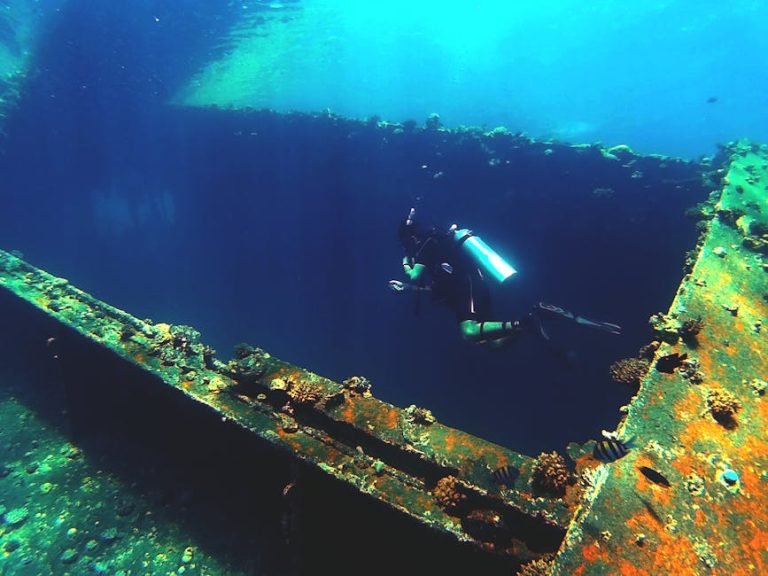
Jetties are artificial reefs. The pilings colonise quickly with corals, sponges, and the invertebrates that depend on them; the structure provides shelter that attracts juveniles of dozens of species; the low light conditions under jetty decks favour nocturnal species that are rarely seen on open reef.
The Magnetic Island jetty at Picnic Bay offers good diving accessible directly from the beach — torch corals and sponges on the pilings, wobbegong sharks resting on the sand, the occasional toadfish in the rubble. The Townsville Strand’s breakwater rocks provide similar jetty-adjacent diving — a legitimate urban dive with interesting macro life and, in season, sea snakes moving through the rocks.
Magnetic Island: Geoffrey Bay
Geoffrey Bay on Magnetic Island has one of the most accessible and reliably interesting shore dives in the GBR region. The entry is from the beach, the reef starts in shallow water, and the site is protected enough to be diveable in most conditions. Tawny nurse sharks rest under coral ledges in the early morning. Cuttlefish hunt in the seagrass. The bay’s relative protection from current makes it suitable for divers at most experience levels.
The Marine Parade in Geoffrey Bay is also one of the few places where you can reliably observe sea turtles from shore — green turtles graze on the seagrass and are encountered regularly by divers and snorkellers.
Bundaberg and the Southern GBR
The Town of 1770 — named for James Cook’s second Australian landing in 1770 — has accessible reef diving from shore at several sites along the coast north of the town. The Flat Rock site near Agnes Water offers coral and rocky reef diving in conditions that vary significantly with wind and swell, but on a calm day provides excellent visibility and interesting topography.
Bundaberg’s Woongarra Marine Park includes shore-accessible reef sites that receive significantly less dive traffic than the northern GBR, with good coral cover and a different species composition that reflects the subtropical rather than tropical character of this part of the coast.
What to Know About Shore Diving in Queensland
Conditions matter more for shore dives than boat dives. Check the Bureau of Meteorology forecast for wind and swell before any shore dive. Shore diving in Queensland often means lower visibility than outer reef diving — inshore water has higher turbidity. Expect 5–15 metres visibility on typical conditions, occasionally better.
Crocodiles are present in far north Queensland waterways. Saltwater crocodiles inhabit estuaries and coastal areas north of approximately Cardwell. Research any shore dive site north of Townsville for current advice on crocodile activity before entering the water.
The appeal of shore diving is exactly its simplicity. No booking, no waiting, no schedule. Your tank, your gear, the water. There’s a particular quality to diving alone in the morning on a site you know well, before the boat traffic starts — a quiet and intimacy with the reef that organised dive tourism doesn’t quite replicate.