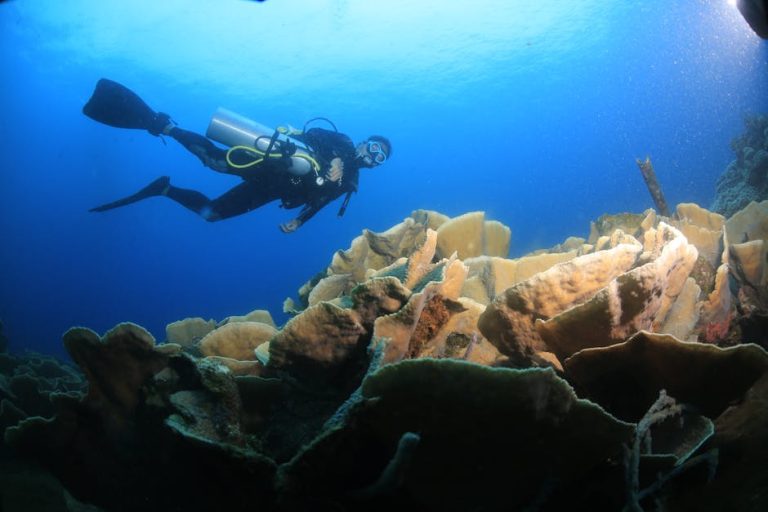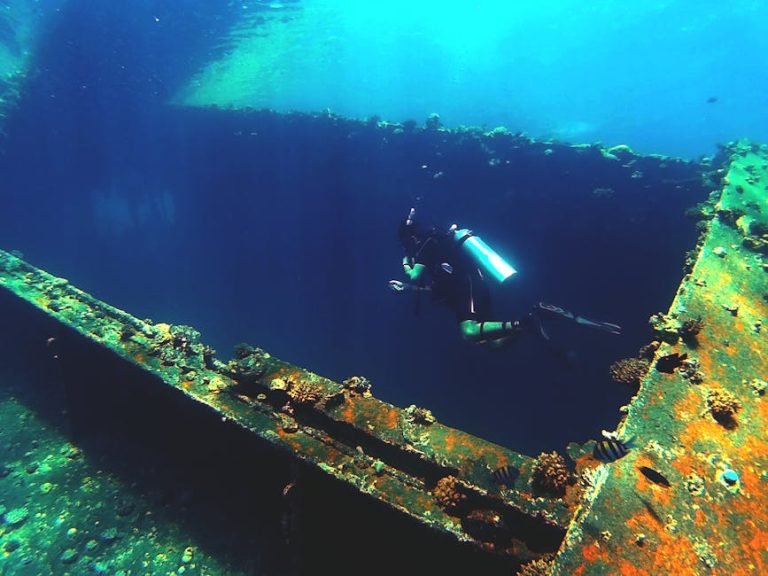
There’s a moment during a deep dive when you notice the light changing in a way that feels almost unnatural. The blues and greens that dominated the shallow reef start to compress into a single, muted tone. Your dive computer shows you’re past 40 meters, and the sun – which seemed so present just minutes ago – has become a concept rather than a reality. This is where most recreational divers turn back. This is also where the reef actually becomes interesting.
The mesophotic zone, a term marine biologists use for the twilight realm between 200 and 1,000 meters, exists in a strange middle ground. It’s deep enough that sunlight is scarce, yet shallow enough that some light still penetrates. For divers, the practical boundary sits around 40 to 60 meters, where nitrogen narcosis becomes a real consideration and air consumption accelerates. But this transition zone – the deep reef proper – holds an entirely different ecosystem from the shallow coral gardens tourists photograph.
I’ve spent time on deep reefs in the Red Sea, the Caribbean, and the Indo-Pacific, and they share a common character: stillness. The water feels heavier somehow, even though that’s mostly psychological. The currents that churn the shallows often settle into gentler flows here. Fish move differently too. They’re not the darting, territorial creatures of the reef crest. Many are larger, slower, and seem less concerned with your presence. Some have bioluminescence or unusual coloring adapted to low light. Others are species you won’t see anywhere else on the same reef.
The Physics of Pressure and Time
Going deep changes the experience of diving in ways that no amount of training fully prepares you for. Your air consumption increases dramatically – sometimes doubling or tripling compared to shallow dives. A tank that lasts 60 minutes at 10 meters might give you only 20 minutes at 50 meters. This isn’t just a number on a gauge; it shapes how you move, how long you can stay, and how you have to plan the dive.
Nitrogen narcosis is real and subtle. Most divers don’t experience it as the dramatic impairment you might read about. It’s more like a gentle fog settling over your thinking. Decisions that seemed straightforward on the surface take longer to process. You become slightly more relaxed about things you should be cautious about. The deeper you go, the more you have to trust your training and your dive computer rather than your instincts. This is why deep reef diving requires a different mindset than exploring shallow walls or coral gardens.
The decompression requirement also changes the dive profile entirely. A shallow dive is simple: go down, spend time, come up. A deep dive becomes a choreographed ascent with mandatory stops. You might spend 15 minutes at depth but another 15 minutes ascending, pausing at 5 meters for safety. This means the dive takes longer, uses more air overall, and requires patience. You can’t just decide to stay longer. The physics won’t allow it.
What Actually Lives Down There
The coral on deep reefs looks different from shallow reefs, and not just because of the light. Many deep corals are soft corals, gorgonians, and black corals rather than the hard, branching corals of shallow water. They grow slowly, sometimes taking decades to reach modest sizes. Some of the black corals you see on deep reefs might be hundreds of years old. Touching them isn’t just bad practice; it’s damaging something that won’t recover in your lifetime.
Fish diversity doesn’t decrease with depth the way you might expect. Instead, it shifts. You’ll see groupers, snappers, and jacks that are larger and more cautious than their shallow cousins. There are species of gobies, blennies, and small fish that live only in this zone. Some have adapted to the low light with large eyes or reflective tissues. Others seem to have given up on vision altogether, relying on lateral lines and other senses. Sharks appear occasionally, usually larger species that hunt in deeper water and patrol the reef edge.
Invertebrates become more prominent the deeper you go. Sponges cover much of the available surface. Sea stars, brittle stars, and crinoids are common. Octopuses hide in crevices. You’ll see nudibranchs and other mollusks that rarely appear on shallow reefs. The whole ecosystem feels more alien, less like the colorful, chaotic shallow reef and more like something from a different ocean entirely.
The Practical Reality of Access
Not every coastal destination offers good deep reef diving. You need a reef system that drops off steeply, decent water clarity, and operators experienced with deep dives. The Caribbean has excellent deep reef diving, particularly around islands like Cozumel, the Cayman Islands, and various sites in the Bahamas. The Red Sea offers deep reefs with strong currents and excellent visibility. The Indo-Pacific has deep reefs in places like the Philippines, Indonesia, and Palau, though accessibility varies widely.
Seasonality matters more on deep reefs than shallow ones. Visibility depends heavily on plankton levels and water movement. In some locations, deep reefs have better visibility in certain seasons because deeper water is less affected by surface conditions. In others, deep dives are only reasonable during calm periods. A destination that offers murky shallow diving might have crystal-clear deep water, or vice versa. You have to know the specific location and the specific season.
The dive operators you choose matter enormously. Deep reef diving isn’t something you want to do with a guide who’s merely certified for it. You want someone who dives deep reefs regularly, who knows the specific site intimately, and who has strong safety practices. This usually means paying more than you would for shallow reef dives, but it’s worth it. The difference between a rushed, uncomfortable deep dive and a smooth, well-managed one is entirely dependent on the operator’s experience and attention.
The Sensory Experience
Diving deep reefs changes how you perceive the underwater world. The silence is more complete. The colors fade in a way that’s hard to describe to someone who hasn’t experienced it. Reds disappear first, then oranges and yellows. By 30 meters, the world is mostly blue and green. By 50 meters, it’s blue and gray. Your dive light becomes essential not just for seeing but for revealing colors that have faded from the ambient light.
The temperature often drops noticeably. In tropical locations, you might drop from 28°C at the surface to 20°C or lower at 50 meters. This is why thermal protection becomes important. A thin wetsuit works fine for shallow reef diving in warm water, but on deep reefs, you’ll appreciate the extra insulation. The cold also affects your body’s nitrogen absorption, which is part of why decompression becomes more complex.
There’s a peculiar sense of isolation on deep reefs. Even with a dive partner, you feel more alone than on shallow reefs where you can see other divers, boats, and the surface. The reef wall stretches below you into darkness. The light from your torch illuminates only a small sphere around you. It’s not frightening if you’re comfortable underwater, but it’s definitely different. It demands a different kind of attention and presence.
Visiting deep reefs changes how you think about coral ecosystems. The shallow reef, for all its beauty, is just the visible part. The deep reef is where much of the actual work happens – where slow-growing corals build structure, where fish spawn and migrate, where the ecosystem extends far beyond what tourists typically see. Understanding that there’s an entire functioning world below the light adds a layer of perspective that’s hard to get any other way.