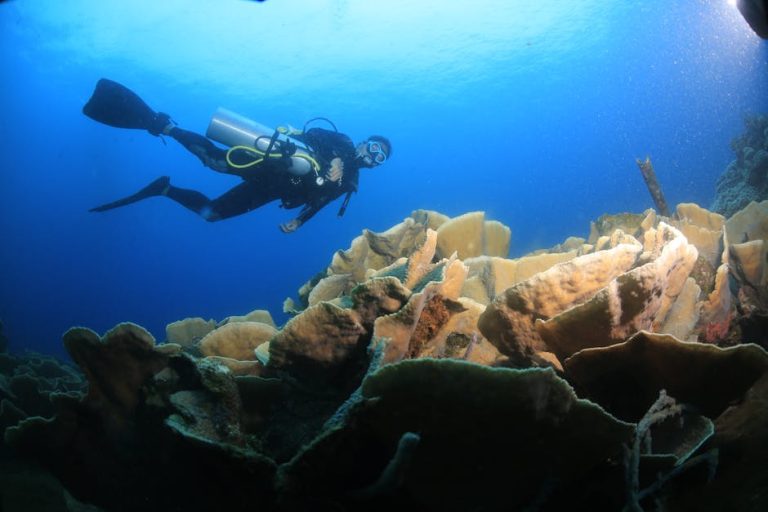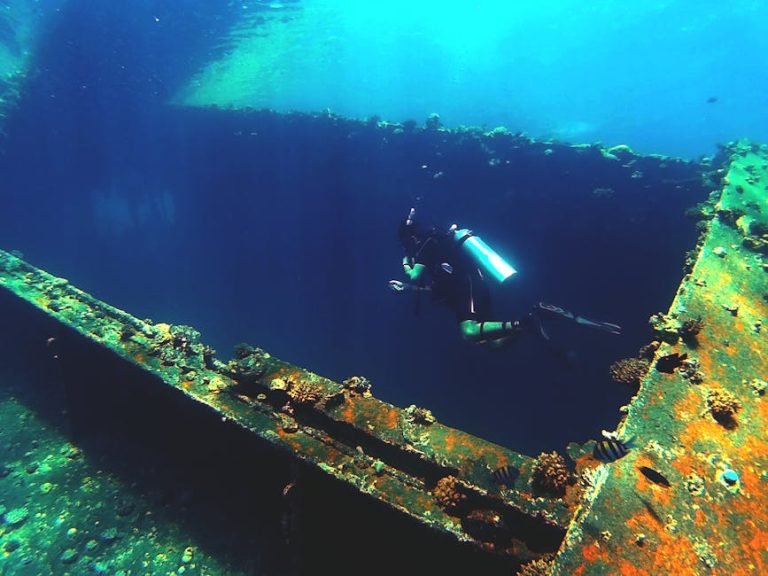
Wrecks make reefs. This was the first thing I learned about wreck diving, and it’s the thing that keeps me coming back to them.
A ship sinks. The steel corrodes slowly, the paint fades, the superstructure colonises. Within five years, the hull is covered in encrusting coral and sponge. Within twenty, it’s a reef — soft corals, gorgonians, crinoids gripping every available surface, lionfish hovering in the shelter of companionways, schools of glassfish so dense they move like a single organism through the engine room. The ocean does not leave structures empty. It fills them.
The wreck I’m thinking of is the SS Yongala, off the coast of Ayr in North Queensland, and it is — without qualification — the most extraordinary dive site I have ever been on.
The SS Yongala
The Yongala was a passenger steamship that sank in a cyclone in 1911, killing all 122 people aboard. She lies in 14 to 29 metres of water, intact and upright, 109 metres long. For decades after she sank, her location was unknown. She was found by fishermen in 1943 and dived seriously from the 1970s onward.
What makes the Yongala extraordinary is the density of marine life. Because she sits on a sandy plain with no other reef structure for kilometres in any direction, she has accumulated every organism that needs a hard substrate to attach to within her immediate vicinity. The result is a concentration of biomass that experienced divers — divers who’ve been to the Coral Triangle, the Red Sea, the Coral Sea — consistently describe as among the finest they’ve encountered anywhere.
Enormous bull sharks circle the hull. Giant Queensland grouper — humphead groper weighing over two hundred kilograms — inhabit the interior. A resident sea snake, known to the guides as “the Yongala snake,” has been seen on almost every dive at the site for years. Marble rays, eagle rays, and cowtail rays rest on the sand around the hull. A school of several thousand big-eye trevally perpetually surrounds the midship section, so dense that swimming into them involves physically pushing through silver bodies.
I have done the Yongala four times. On each visit, the wreck has been different — different species dominant, different light quality, different behaviour. It is, even after dozens of dives in dozens of countries, still the first dive I recommend to anyone asking where to dive in Australia.
Types of Wreck Diving
Wreck diving divides broadly into two categories: non-penetration diving, where you swim around the exterior of the wreck and through open doorways or broken sections with a clear line of sight to open water; and penetration diving, where you enter fully enclosed spaces — corridors, engine rooms, holds — where ambient light is not sufficient to navigate and where an exit is not directly visible.
Non-penetration wreck diving is accessible to all certified divers and accounts for the majority of wreck diving done worldwide, including most diving on the Yongala. You can spend an entire dive exploring the exterior of a large wreck — hull, superstructure, deck equipment, propeller — without ever entering an enclosed space.
Penetration diving is a specialty that requires specific training, a dedicated wreck diving certification, and appropriate equipment: primary and backup torches, a penetration reel (to lay a guideline from the entry point into the wreck), and the discipline to stay within the no-decompression limits while managing overhead environments. Penetration diving is not inherently dangerous, but the margin for error is smaller than in open water, and the consequences of running low on air or losing visibility inside a wreck are more serious. Take the course before you do it.
Other Notable Australian Wrecks
While the Yongala is the standout, Australia has a genuinely excellent wreck diving inventory.
HMAS Brisbane, scuttled as an artificial reef off the Sunshine Coast in 2005, is a former Royal Australian Navy destroyer that now sits in 28 metres of water. She’s large enough to take multiple dives to explore properly and is penetrable in several areas. The marine life is still developing compared to the Yongala’s century of accumulation, but the structural diving is excellent.
HMAS Swan, scuttled off Dunsborough in Western Australia in 1997, is a 113-metre frigate in 30 metres of water. She’s considered one of the best dive sites in Western Australia, with good visibility and increasing marine life density.
The wreck fields of Truk Lagoon (now Chuuk, Federated States of Micronesia) are not Australian, but they’re the most-discussed wreck diving destination among Australian divers: a lagoon containing the remains of over fifty Japanese ships sunk during Operation Hailstone in 1944, many of them still carrying cargo — trucks, aircraft, ammunition, and human remains. Truk is a regular destination for Australian liveaboard operators and is, for wreck divers, the equivalent of what Fakarava is for shark diving enthusiasts: a pilgrimage.
The Feeling of a Wreck
I want to try to articulate something about the experience of diving a wreck that goes beyond the marine life and the photography.
Wrecks carry weight. Not metaphorical weight — the physical presence of old steel in dark water, the sense of interrupted function, of a thing that was made to do something and now does a different thing entirely. You swim past a porthole and think about who looked through it. You fin along a companionway and understand that you’re in a space designed for people walking upright in air and sunlight.
The ocean has claimed it, and in claiming it, turned it into something alive. Both of those facts are present simultaneously on every wreck dive I’ve done.
That’s not something you get from a coral reef, however magnificent. It’s specific to wrecks. Seek it out.