Most people, on their first reef dive, look past the coral.
This is understandable. The reef is full of movement — fish darting, current swaying sea fans, a turtle ghosting through the blue. The coral is just the backdrop. The stage. The thing everything else lives on.
But the coral is the story. Everything else is a consequence.
What Coral Actually Is
Here is the fact that surprises most people: coral is an animal. Each tiny coral polyp is a living animal, related to anemones and jellyfish — a cnidarian with a cylindrical body, a ring of tentacles, and a gut that opens at one end. In most reef-building species, the polyp secretes a calcium carbonate skeleton beneath itself, and it is the accumulated skeletons of billions of polyps over thousands of years that builds a reef.
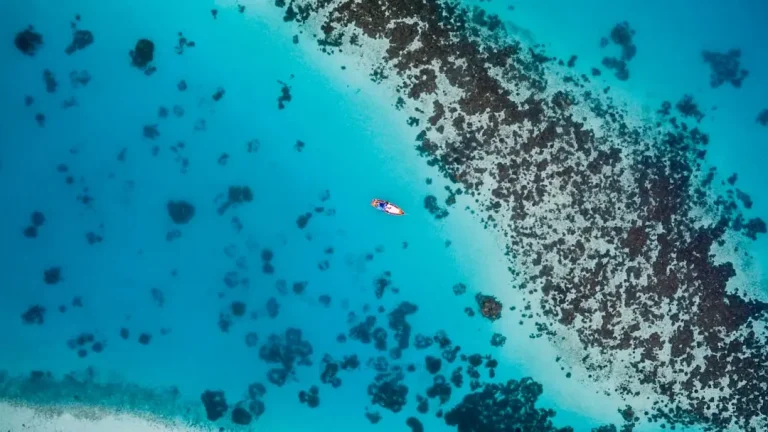
The Great Barrier Reef is the largest biological structure on Earth. It is roughly the size of Italy. It is made of animal skeletons. That is worth sitting with for a moment.
Individual coral polyps range in size from about one millimetre to a centimetre across. Many are nocturnal — they extend their tentacles at night to catch zooplankton drifting in the current, retracting to the protection of the skeleton during the day. But feeding on zooplankton, while important, is not how reef-building corals get most of their energy.
The Zooxanthellae: Coral’s Internal Solar Panels
The secret to reef coral’s success — the reason it can build structures of the scale and complexity it does — is a symbiotic relationship with photosynthetic algae called zooxanthellae (pronounced zo-zan-THELL-ee, formally Symbiodiniaceae). These single-celled dinoflagellates live within the tissues of the coral polyp, and they are the coral’s primary energy source.
The zooxanthellae photosynthesise using sunlight that penetrates the shallow, clear water of reef environments. They convert light energy into organic compounds — sugars and lipids — and pass up to 90% of what they produce to their coral host. In return, they receive shelter and access to the carbon dioxide and nitrogen compounds produced by the coral’s metabolic processes.
This relationship is the foundation of reef productivity. It’s why coral reefs are simultaneously among the most nutrient-poor waters in the ocean and among the most biologically productive ecosystems on Earth — the nutrients are cycled internally, within the coral-algae partnership, rather than imported from outside.
It is also why coral bleaching is so catastrophic.
Understanding Bleaching
When coral is stressed — typically by elevated water temperature, but also by changes in salinity, increased UV radiation, or disease — the coral-zooxanthellae relationship breaks down. The coral expels its zooxanthellae. The tissue, now lacking the algae that give it colour, becomes transparent, revealing the white calcium carbonate skeleton beneath. The coral turns white. It has bleached.
A bleached coral is not dead. It is alive and severely stressed. If the stressor is removed quickly and the water temperature returns to normal, the coral can reabsorb zooxanthellae and recover. This recovery takes months, and a coral that has bleached and recovered remains more susceptible to subsequent bleaching.
If the stressor persists — if the water stays too warm for too long — the coral starves. Without zooxanthellae, it has no primary energy source. The colony weakens, becomes susceptible to disease, and eventually dies. The skeleton remains, but it turns from white to brown-green as algae colonise it. A reef covered in dead, algae-covered skeletons is visually and functionally very different from a living reef.
The Great Barrier Reef experienced mass bleaching events in 1998, 2002, 2016, 2017, 2020, and 2022. The events of 2016 and 2017 — back-to-back in consecutive years, affecting 91% of surveyed reefs — were unprecedented in the reef’s recorded history. The most recent surveys show that some areas have partially recovered, while others have not. The trajectory depends entirely on whether ocean temperatures stabilise.
Coral Reproduction: Two Strategies
Coral reproduces both sexually and asexually, and both strategies have shaped the reefs we dive on.
Asexual reproduction — through budding, where new polyps grow from existing ones, or through fragmentation, where broken colony pieces settle and grow independently — is how coral colonies grow and spread within a reef. It produces genetically identical individuals and is the source of the dense, continuous reef structures we swim through.
Sexual reproduction happens through spawning — the simultaneous release of gametes (eggs and sperm) into the water column. On the Great Barrier Reef, the mass coral spawn is one of the most extraordinary biological events in the ocean: hundreds of coral species releasing billions of gametes in a coordinated annual event triggered by water temperature, day length, and the lunar cycle. The spawn typically occurs between October and December, around the full moon, and produces slicks of coral spawn visible at the surface across thousands of square kilometres.
The gametes fertilise in the water, develop into free-swimming planula larvae, and settle on suitable substrate to found new colonies. The settlement process is selective — larvae respond to chemical cues from crustose coralline algae that signal suitable substrate — and success rates are low. Of the billions of larvae produced, a small fraction survives to found viable new colonies.
Coral Growth Rates
Reef-building corals grow slowly by most biological standards. Massive corals — dome-shaped Porites and Goniastrea species — grow approximately one centimetre per year, which means that a massive coral colony a metre in diameter is roughly a century old. Branching corals (Acropora species) grow faster, sometimes five to ten centimetres per year, which is why they can rebuild faster after disturbances but also why they’re more vulnerable to physical damage.
This slow growth rate has significant implications for reef recovery timelines. A reef severely damaged by bleaching, cyclone, or crown-of-thorns starfish outbreaks may take 10 to 15 years to visually recover, assuming conditions are right and disturbances don’t recur. Under current climate projections — which suggest mass bleaching events occurring every six to eight years rather than every 25 to 30 — the recovery window is shorter than the disturbance interval for large areas of the reef.
This is the arithmetic of reef loss. It doesn’t happen all at once. It happens in increments, across decades, in a way that each individual event can seem manageable while the cumulative trajectory moves steadily downward.
Reef Builders: The Major Coral Families
For a diver learning to read a reef, a few families are worth knowing:
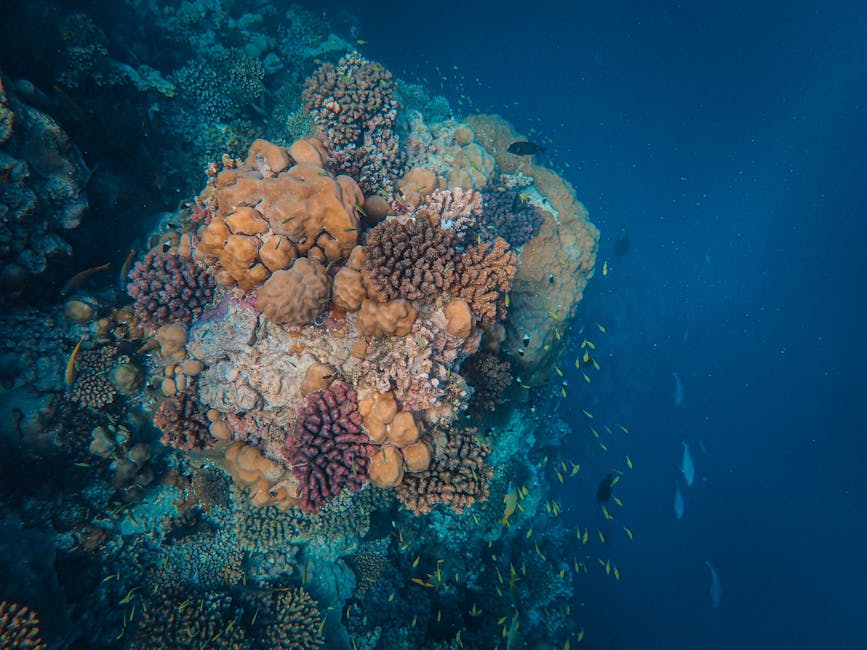
Acropora — the dominant reef-building genus in the Indo-Pacific. Branching, table, and plating forms, often in vivid greens, blues, and pinks in shallow water. Fast-growing and structurally complex; Acropora tables and thickets are critical habitat for hundreds of fish and invertebrate species.
Porites — massive, rounded, slow-growing, extraordinarily old. A single large Porites colony can be 500 years old. They record temperature history in their calcium carbonate skeletons the way trees record climate in their rings — a Porites core from the Great Barrier Reef can tell you the sea surface temperature in 1700.
Faviidae (now split into several families including Mussidae and Lobophylliidae) — the brain corals and similar massive forms. Recognisable by the convoluted surface pattern created by their elongated, grooved polyp rows.
Fungiidae — the mushroom corals, unusual in being solitary rather than colonial. A single large mushroom coral polyp can reach 30 centimetres in diameter. They are mobile — uniquely among corals, they can move.
Dendrophylliidae — non-photosynthetic cup corals that don’t rely on zooxanthellae and can therefore grow in deep, dark environments. Often encountered on wall dives, under ledges, or at depths where Acropora and Porites can’t survive.
Looking at Coral With New Eyes
The next time you’re underwater on a reef, try this: stop at a coral head — a medium-sized Porites dome, say — and look at it at close range. Look at the surface texture, the tiny individual polyp mouths. This colony in front of you is several hundred years old. It has survived cyclones. It has survived previous bleaching events. It has been building, millimetre by millimetre, for centuries.
It is an animal. Not a rock, not a plant. An animal, in its millions, that made this.
The fish are beautiful. The turtles are magnificent. But none of them — not a single one — would be here without this.