I’ve been bitten by a wobbegong. Not badly – a reflex snap when I accidentally put my hand on what I thought was a patch of reef rubble – but enough to leave a clear impression of just how fast a fish that appears to be doing absolutely nothing can move when motivated. The wobbegong was, I should say, entirely in the right. I was the one who wasn’t paying attention.
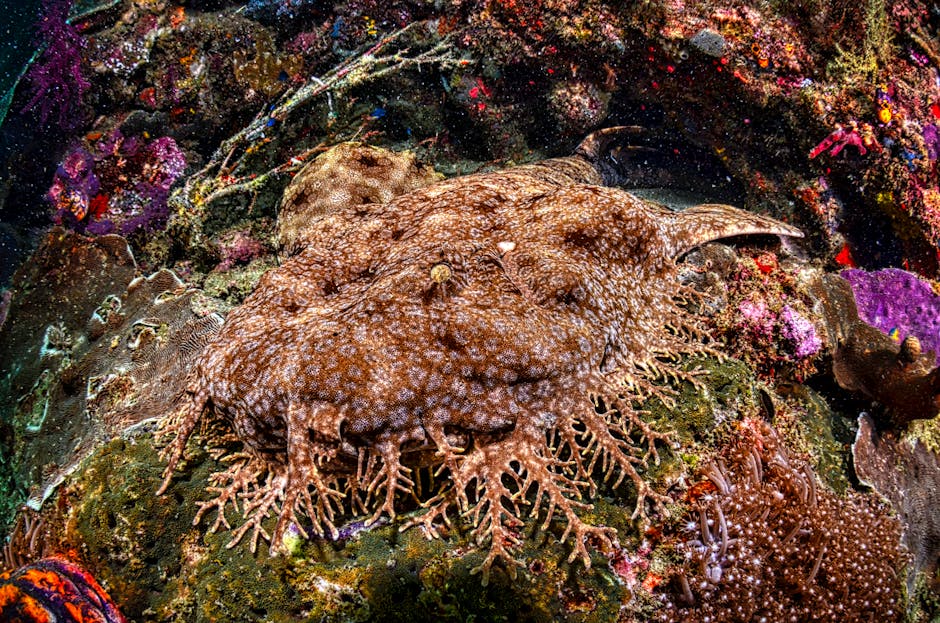
Wobbegong sharks are the great overlooked predators of the GBR. While divers scan the blue water for reef sharks and the sandy bottom for leopard sharks, the wobbegong is right there – on the reef, under a ledge, draped over a coral head – invisible because it looks exactly like the substrate it’s resting on. The camouflage is extraordinary: a flattened body covered in a complex pattern of browns, greys, and creams, fringed with dermal lobes around the head that break up the outline and mimic the texture of encrusting organisms. A wobbegong on a reef is not hiding. It’s simply indistinguishable from its surroundings.
The GBR’s Wobbegong Species
Three wobbegong species are commonly encountered on the GBR: the spotted wobbegong (Orectolobus maculatus), the ornate wobbegong (Orectolobus ornatus), and the tasselled wobbegong (Eucrossorhinus dasypogon). The tasselled wobbegong is the most spectacular – its head is fringed with elaborate branching lobes that look like a coral growth, and its pattern is so complex that even knowing it’s there, you can lose it against a reef background.
All three species are members of the family Orectolobidae – the carpet sharks – a group that also includes the nurse shark and the whale shark. They’re bottom-dwelling ambush predators, spending most of their time motionless on the reef substrate, waiting for prey to come within range. When prey does come within range, the strike is explosive – wobbegongs can lunge forward by their own body length in a fraction of a second, engulfing fish, cephalopods, and crustaceans in their large, forward-facing mouths.
Their teeth are designed for gripping rather than cutting – long, thin, and recurved, ideal for holding struggling prey. This is why wobbegong bites, while not dangerous in the way that large shark bites are, are difficult to disengage – the teeth lock in, and pulling away makes the situation worse. The correct response to a wobbegong bite is to push toward the shark, not pull away, which is counterintuitive enough that most people get it wrong.
Behaviour and Ecology
Wobbegongs are largely nocturnal hunters, though they’ll take opportunistic prey during the day. During daylight hours they rest in sheltered locations – under ledges, in caves, in the branches of large coral formations – often in groups. Finding three or four wobbegongs piled on top of each other under a ledge is not unusual; they’re apparently tolerant of conspecifics in a way that many sharks are not.
Their home ranges are small compared to most sharks. Tagging studies have shown that individual wobbegongs typically remain within a few hundred metres of a preferred resting site for months at a time, moving at night to hunt and returning to the same location by day. This site fidelity makes them reliable subjects for long-term observation – if you find a wobbegong at a particular spot, there’s a good chance it’ll be there next time you dive the site.
Wobbegongs are ovoviviparous – the eggs develop inside the female and the young are born live. Litter sizes of up to 37 pups have been recorded, which is large for a shark. The pups are miniature versions of the adults, fully camouflaged from birth, and they disperse immediately after being born. There’s no parental care, but then, a wobbegong pup that looks exactly like a piece of reef from the moment it’s born doesn’t need much.
The Overlooked Predator
Wobbegongs rarely appear in the shark conservation conversation, which is dominated by the more charismatic pelagic species – white sharks, hammerheads, tiger sharks. But they face the same pressures: habitat degradation, bycatch in demersal fisheries, and targeted fishing for their meat and skin (wobbegong leather is used in some luxury goods markets).
Their cryptic nature makes population assessment difficult – you can’t count animals you can’t see – and their data-deficient status on the IUCN Red List reflects genuine uncertainty about their conservation status rather than an absence of concern.
I’ve developed a habit, on every GBR dive, of looking more carefully at the reef substrate before I put my hands anywhere. It’s a habit born of that one reflex snap, and it’s made me a better diver – more attentive, more aware of what’s actually there versus what I’m assuming is there. The wobbegong taught me that. It was an expensive lesson, but a useful one.