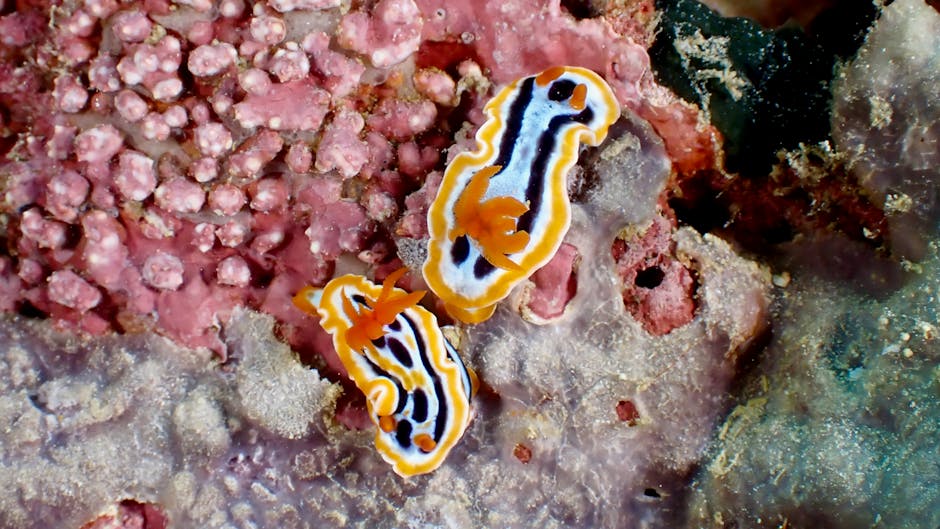
The first nudibranch I ever really looked at was a Chromodoris willani – about four centimetres long, white with black lines and electric blue margins, moving across a patch of reef rubble with a slow, muscular undulation. I’d been diving for three years at that point and had been walking past nudibranchs the whole time, not knowing what I was looking at. A dive guide pointed this one out, and something shifted. I’ve been looking for them ever since.
Nudibranchs are gastropod molluscs – sea slugs, technically – that have lost their shells over evolutionary time and compensated with an extraordinary array of chemical defences and the colours that advertise them. The name means “naked gills”: the feathery or branching structures on their backs are their respiratory organs, exposed to the water rather than enclosed in a shell. They are, by any reasonable aesthetic standard, among the most beautiful animals on the reef.
The Diversity of GBR Nudibranchs
The Great Barrier Reef hosts over 600 described nudibranch species, with new species still being discovered regularly. They range in size from a few millimetres to over 30 centimetres (the Spanish dancer, Hexabranchus sanguineus, is the largest and one of the most spectacular). They occupy every reef habitat from the intertidal zone to depths beyond recreational diving limits.
The major groups on the GBR include the dorid nudibranchs (Doridida), which have a ring of gills on their back and are often the most colourful; the aeolid nudibranchs (Aeolidida), which have finger-like projections called cerata covering their backs; and the dendronotid nudibranchs, which have branching projections along their sides. Each group has distinct feeding habits, defence mechanisms, and ecological roles.
Chromodoris and Hypselodoris are the genera most likely to catch a diver’s eye – their patterns of white, blue, purple, and yellow are vivid enough to be visible from several metres away. But the aeolids, with their forests of cerata in orange, red, and white, are equally spectacular up close, and the dendronotids have a structural complexity that rewards examination with a macro lens.
Chemical Warfare and Honest Advertising
Nudibranchs are soft-bodied, slow-moving, and apparently defenceless. They survive because they’re toxic, and their colours advertise the fact. This is aposematism – warning coloration – and it works because predators learn, usually after one unpleasant experience, to avoid brightly coloured prey.
The chemistry is sophisticated. Dorid nudibranchs sequester toxic compounds from their prey – sponges, bryozoans, and other sessile invertebrates – and store them in their own tissue. Different species sequester different compounds, and the diversity of nudibranch colours reflects the diversity of their chemical arsenals. Some species go further: aeolid nudibranchs that feed on hydroids and anemones can sequester the stinging cells (nematocysts) from their prey and store them in the tips of their cerata, effectively borrowing their prey’s weapons for their own defence.
Some nudibranch species are mimics – non-toxic species that have evolved to resemble toxic ones, gaining protection without the metabolic cost of producing or sequestering toxins. Identifying mimics from models requires close examination and, often, laboratory analysis – the colours can be nearly identical.
Finding Them
Nudibranchs reward slow, attentive diving. They’re found on the reef substrate – on sponges, on coral rubble, on the undersides of ledges, on the surface of the specific prey species they feed on. Many species are cryptic despite their colours, because they match the colour of their food source: a nudibranch that feeds on a purple sponge is often purple itself, and finding it requires looking at the sponge rather than past it.
Night dives are particularly productive for nudibranch observation. Many species are more active after dark, moving across the reef surface to feed and mate. The Spanish dancer is almost exclusively nocturnal – finding one in daylight is unusual, but at night they’re sometimes common on outer reef slopes, their red and white bodies undulating through the water column in the characteristic swimming motion that gives them their name.
I carry a macro lens on every dive now, and I budget time at the end of every dive to slow down and look at the small stuff. The nudibranchs are always there, if you know how to look. And once you’ve seen a Chromodoris willani moving across a reef in full colour, you’ll never walk past one again.