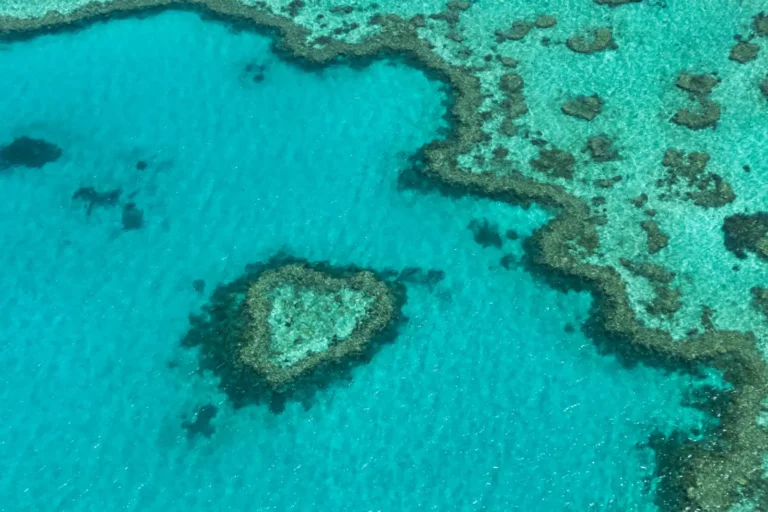
One Tree Island sits in the southern Great Barrier Reef, about 60 kilometers northeast of Gladstone on the Queensland coast. It’s a small coral cay, barely a kilometer across, and it functions as something between a field station and an island outpost. The University of Sydney operates a research facility there, and at any given time, a handful of scientists and support staff live on the island while studying the reef systems that surround it. For most travelers, the island remains largely unknown – it’s not a tourist destination in the conventional sense, and access is restricted to researchers, their families, and the occasional visiting academic.
The island itself is unremarkable in appearance. White sand, sparse vegetation, a few buildings, and the constant sound of waves. What makes it significant is what happens beneath the water and what the people who live there are trying to understand. The reef around One Tree Island is part of one of the world’s most complex marine ecosystems, and researchers have been documenting its changes for decades. This continuity of observation is rare. Most reef monitoring happens in short bursts – a few weeks of fieldwork, then researchers leave. At One Tree Island, the work is continuous, which means scientists can track seasonal patterns, long-term shifts in coral health, and how the reef responds to environmental stress.
The Reality of Island Research Life
Living on a coral cay is not a romantic experience, despite what the setting might suggest. The island has no natural freshwater sources, so all drinking water arrives by boat or is collected from rainfall. Power comes from generators. Internet is slow and unreliable. The nearest substantial town is Gladstone, which is a working port city, not a tourist hub. Supply runs happen on a schedule, and if you run out of something essential, you wait until the next delivery. People who work there understand this before they arrive.
The rhythm of the island is dictated by weather and tide. During the wet season, which runs roughly from November through March, the sea can become rough enough to prevent boat access for days or weeks at a time. This isn’t a minor inconvenience – it means researchers can become temporarily stranded, and resupply becomes uncertain. The dry season, from May through September, offers more stable conditions, though even then the sea can turn quickly. Most intensive fieldwork happens during the calmer months, which is when the island population tends to be highest.
The actual work involves long hours in the water. Researchers dive or snorkel to monitor coral colonies, count fish populations, collect water samples, and document the physical state of the reef. This is methodical, repetitive work. You visit the same monitoring sites regularly, measure the same corals, photograph the same sections of reef. The value emerges over years and decades, not in individual dives. A single researcher might spend five years at the island, collecting data that will be analyzed and compared with observations from ten years prior or ten years in the future.
What the Reef Reveals
One Tree Island’s research station has documented significant changes in the reef over the past several decades. Coral bleaching events, shifts in fish populations, changes in water temperature and chemistry – all of these have been recorded in detail. The data from this station has contributed to broader understanding of how coral reefs respond to warming oceans and other environmental pressures. The work is not alarmist or promotional; it’s simply the accumulated observation of what is happening in one specific place over time.
The reef around the island is still productive and diverse, but it’s not static. Travelers who visit reef areas often expect to see a certain image of coral – vibrant, dense, teeming with fish. The reality is more nuanced. Some sections of reef are healthy and colorful. Others show signs of stress or recovery. The diversity is still there, but the composition changes. Fish populations shift. Coral species that were abundant become less so. These changes are what researchers at One Tree Island are documenting in precise detail.
Access and Practical Constraints
The island is not open to casual visitors. Access is restricted to people affiliated with the research program. This is partly practical – the island has limited accommodation and resources – and partly necessary for research continuity. Unexpected visitors would disrupt the work and strain the island’s supplies. If you’re interested in visiting, you would need to be affiliated with a university or research institution, or invited as a guest of someone working there.
The nearest point of departure is Gladstone, which has an airport and is accessible by car from Brisbane, about four hours south. From Gladstone, reaching the island requires a boat journey of several hours. The boat trip itself can be rough, depending on conditions. Many people who work at the station experience motion sickness on the way out. The isolation is real, and it’s not something people choose lightly.
For travelers interested in reef ecosystems and marine research, there are other options in the region. The Great Barrier Reef Marine Park Authority manages numerous reef sites that are open to visitors. Heron Island, also in the southern reef, operates as a resort and research station and does accept tourists. Lady Elliot Island, further north, is another accessible option. These islands offer glimpses of reef ecology without the restriction of a working research facility, though the research component is less intensive.
Why This Place Matters
One Tree Island represents a particular kind of scientific commitment. It’s not flashy or photogenic in the way tourism marketing prefers. There are no luxury facilities, no sunset dining experiences, no Instagram moments. What exists instead is continuity of observation and a genuine attempt to understand how a complex ecosystem changes over time. The scientists who work there are not trying to prove a point or promote a narrative. They’re collecting data, year after year, in the same place, watching what happens.
The island also illustrates something about how marine research actually happens. It’s not conducted from laboratories or universities alone. It requires people to spend extended periods in remote locations, working in challenging conditions, collecting information that will be analyzed and debated and combined with observations from other places. The work is methodical and often unglamorous. It’s also essential for understanding what’s happening to the world’s reefs.
For travelers exploring the Queensland coast, One Tree Island remains largely invisible. You might pass near it by boat without knowing what it is. The research happening there continues regardless of whether tourists are aware of it. That’s perhaps the most honest thing to say about the place – it exists for a purpose that has nothing to do with visitor experience, and it functions well precisely because of that clarity of purpose.