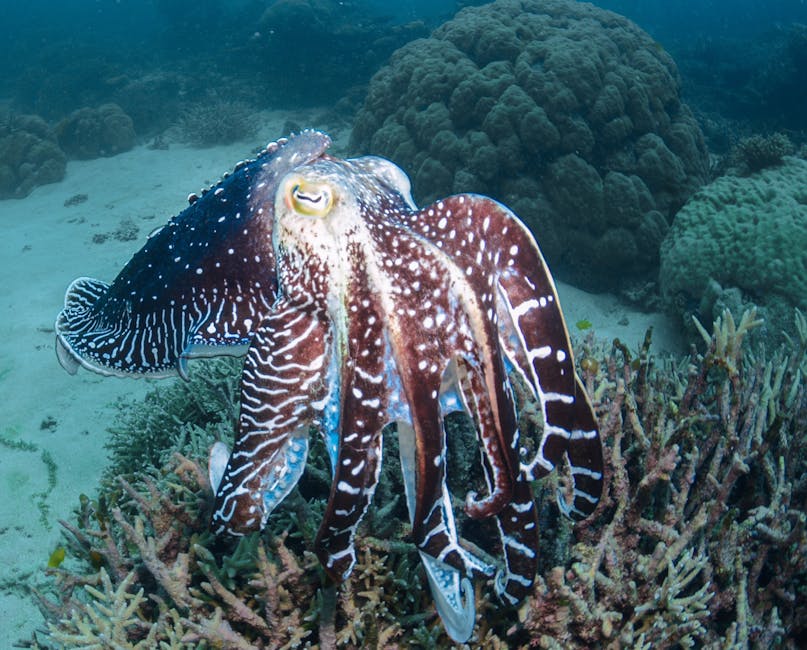
I once watched a broadclub cuttlefish spend 20 minutes hunting a crab. The cuttlefish approached from downwind of the crab’s position – or rather, downcurrent, since we’re underwater – moving in a slow, hypnotic undulation, its colour shifting continuously to match the substrate beneath it. When the crab moved, the cuttlefish froze. When the crab settled, the cuttlefish advanced. The whole sequence had the quality of chess – deliberate, strategic, patient. The crab didn’t stand a chance.
Cephalopods – the group that includes octopus, cuttlefish, and squid – are the reef’s most cognitively complex invertebrates, and by some measures among the most cognitively complex animals on the reef, full stop. They have large brains relative to their body size, sophisticated sensory systems, and behavioural flexibility that continues to surprise researchers who’ve been studying them for decades. They are also, in the case of cuttlefish and octopus, extraordinarily beautiful.
The Broadclub Cuttlefish
The broadclub cuttlefish (Sepia latimanus) is the largest cuttlefish species on the GBR, reaching up to 50 centimetres in mantle length. It’s found on reef slopes and sandy areas adjacent to reef, typically at depths of 5-30 metres, and it’s the species most likely to approach divers with apparent curiosity rather than retreating.
The colour-changing ability of cuttlefish is produced by three layers of specialised cells in the skin: chromatophores (pigment cells that expand and contract under muscular control), iridophores (cells that produce structural colour through light interference), and leucophores (cells that reflect light). The combination allows cuttlefish to produce patterns of extraordinary complexity and speed – a cuttlefish can change its entire body pattern in less than a second.
The patterns serve multiple functions: camouflage, communication, and prey capture. During hunting, cuttlefish produce a hypnotic flickering pattern – waves of colour moving across the body – that appears to disorient prey. During mating, males produce elaborate displays on one side of their body while simultaneously displaying female colouration on the other side, allowing them to court a female while appearing female to rival males watching from the other direction. It’s a level of social deception that seems almost implausible in an invertebrate.
The Day Octopus
The day octopus (Octopus cyanea) is the most commonly encountered octopus on GBR reef flats and shallow reef areas. Unlike most octopus species, it’s active during the day, hunting crabs, shrimp, and small fish across the reef surface. It’s a master of camouflage – not just colour matching, but texture matching, raising papillae on its skin to mimic the rough surface of coral or rock.
Day octopus are tool users. They’ve been documented collecting coconut shell halves and carrying them across the reef floor for later use as portable shelters – behaviour that requires planning for a future state, which is a cognitively demanding task. They also use rocks and shells to barricade the entrance to their dens, selecting appropriately sized objects and arranging them deliberately.
Their problem-solving ability in laboratory settings is well documented – they can open jars, navigate mazes, and learn by observation. But what’s more interesting, to me, is their behaviour in the wild: the way a day octopus will assess a diver from the entrance of its den, decide whether to retreat or hold position, and adjust its camouflage in real time based on the diver’s movements. There’s something going on in there that deserves more respect than “invertebrate” usually implies.
The Blue-Ringed Octopus: Beauty and Danger
The blue-ringed octopus (Hapalochlaena species) is the reef’s most dangerous small animal. It’s tiny – typically 5-10 centimetres – and when resting, it’s a drab brown that blends perfectly with reef rubble. When threatened, it displays iridescent blue rings that pulse with colour – one of the most striking warning displays in nature.
The warning is genuine. Blue-ringed octopus produce tetrodotoxin – the same toxin found in pufferfish – in quantities sufficient to kill an adult human. There is no antivenom. The toxin causes paralysis, and the only treatment is artificial respiration until the toxin clears the system, which can take hours. Deaths are rare but documented.
The practical advice is simple: don’t pick up small octopus from reef rubble, and if you see blue rings, back away. The blue-ringed octopus is not aggressive – it bites only when handled or cornered. The deaths that have occurred have almost all involved people picking the animal up, usually not knowing what it was.
I find cephalopods endlessly fascinating, and I’ve spent more bottom time watching cuttlefish hunt than I can justify on any rational basis. There’s something about an animal that thinks – that plans, that deceives, that plays – that demands attention in a way that passive filter feeders don’t. The reef has plenty of beauty. The cephalopods have something rarer: personality.