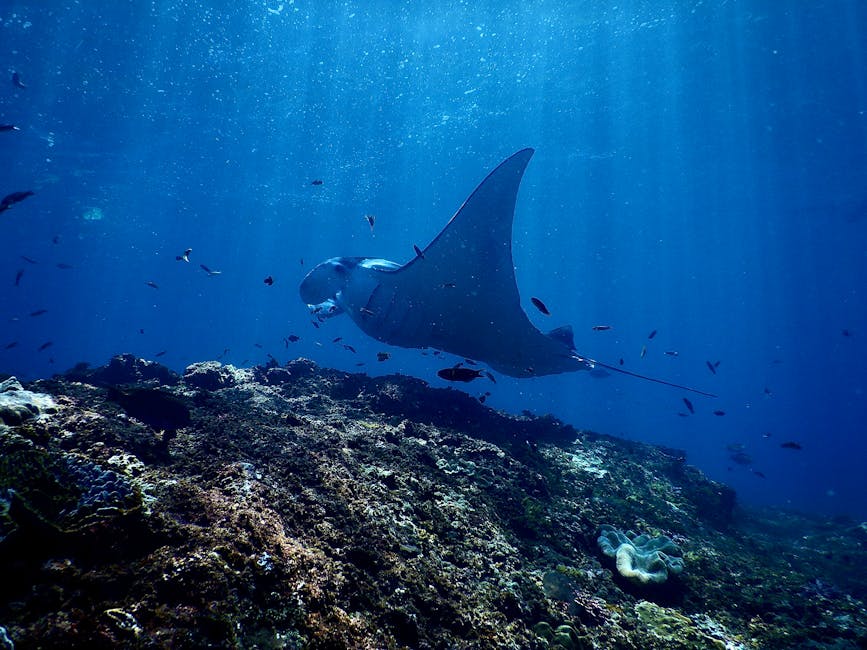
The first manta ray I ever saw underwater came from below. I was hovering at about 12 metres on the outer wall of Lady Elliot Island, looking down into the blue, when a shape resolved out of the depth – a diamond, three metres across, moving with a slow, banking grace that made everything else on the reef look effortful. It passed beneath me close enough that I could see the individual denticles on its skin, the pale underside with its distinctive spot pattern, the cephalic fins curled loosely at the front of its head. Then it banked again and was gone, back into the blue it came from.
Reef manta rays (Mobula alfredi) are the smaller of the two manta species – the oceanic manta (Mobula birostris) is larger and more pelagic – but “smaller” is relative. Reef mantas reach up to 5.5 metres in wingspan and can weigh over a tonne. They’re filter feeders, consuming zooplankton and small fish by swimming open-mouthed through concentrations of prey, their cephalic fins unfurling to funnel water into their cavernous mouths. They are, by any measure, extraordinary animals.
The Lady Elliot Population
Lady Elliot Island, at the southern tip of the GBR, hosts one of the most studied reef manta populations in the world. Researchers from the Project Manta team at the University of Queensland have been photo-identifying individual mantas at Lady Elliot since 2007, building a catalogue of over 1,000 individuals identified by their unique spot patterns on the underside.
What the long-term data reveals is a population with complex social structure and strong site fidelity. Individual mantas return to Lady Elliot year after year, visiting the same cleaning stations, following the same seasonal routes. Some individuals have been in the catalogue for over 15 years. The population has a clear social hierarchy, with larger, older females dominant at cleaning stations – smaller males and juveniles wait their turn.
Cleaning stations are central to manta behaviour at Lady Elliot. The mantas visit specific coral bommies where cleaner wrasse remove parasites from their skin, gills, and mouths. A manta at a cleaning station adopts a characteristic posture – hovering nearly motionless, cephalic fins unfurled, mouth slightly open – that signals its readiness to be cleaned. The wrasse respond immediately, working methodically across the manta’s body surface. A cleaning session can last 20-30 minutes.
Check real traveller reviews, prices, availability, departure points, and flexible booking options in one place.
Intelligence and Social Behaviour
Manta rays have the largest brain-to-body ratio of any fish, and there’s growing evidence that this reflects genuine cognitive complexity. They pass the mirror self-recognition test – a standard measure of self-awareness – at rates comparable to dolphins and great apes. They show what appears to be play behaviour, repeatedly performing somersaults and barrel rolls in areas with no obvious feeding or cleaning function. They form long-term social bonds with specific individuals.
Research at Lady Elliot has documented what appears to be cultural transmission of behaviour – younger mantas learning cleaning station locations and migration routes from older individuals, rather than discovering them independently. If confirmed, this would represent one of the few documented examples of social learning in a fish species.
Manta rays are also among the longest-lived elasmobranchs – the group that includes sharks and rays. Individuals at Lady Elliot have been tracked for over 15 years with no signs of senescence, and maximum lifespan is estimated at 40 years or more. A manta ray you encounter today may have been swimming these waters since before you were born.
Conservation Status and Threats
Reef manta rays are listed as vulnerable on the IUCN Red List. Their primary threats are targeted fishing (for their gill plates, which are sold in traditional Chinese medicine markets despite having no demonstrated medicinal value) and bycatch in tuna and other pelagic fisheries. They’re also vulnerable to boat strike – their surface-feeding behaviour brings them into contact with vessel traffic, and propeller injuries are documented in populations worldwide.
The GBR population is protected within the Marine Park, and Australia has been a leader in manta ray conservation – banning targeted fishing and implementing vessel speed restrictions in key aggregation areas. The Lady Elliot population appears stable, and recent surveys suggest possible population growth. But the species remains vulnerable globally, and the gill plate trade continues in markets where enforcement is weak.
I’ve been back to Lady Elliot four times since that first manta encounter. Each time, I look for the same thing: that shape resolving out of the blue, that slow banking turn, that moment of contact between two very different kinds of animal. It hasn’t got old. I don’t think it will.
Compare top-rated tours, prices, availability, and real traveller reviews before booking. See what’s actually available for your dates and departure location.
Compare tours and check availability