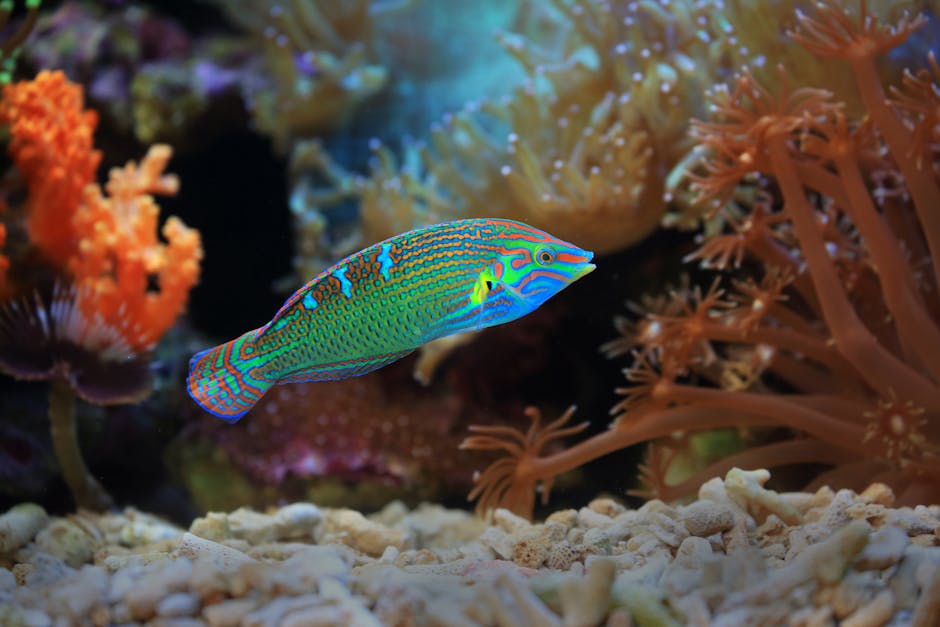
The cleaner wrasse is about 10 centimetres long, electric blue with a black stripe, and it runs what amounts to a medical clinic on the reef. It sets up at a specific location – a cleaning station, usually a prominent coral head – and larger fish queue up to be serviced. Grouper, parrotfish, even moray eels that would normally eat a fish this size hold still while the wrasse picks parasites, dead tissue, and food debris from their gills, mouths, and skin. Both parties benefit. The wrasse gets a meal; the larger fish gets cleaned.
I’ve hovered at cleaning stations for longer than I care to admit, watching the queue form and dissolve, watching the wrasse work with what looks like professional focus. It’s one of those reef behaviours that seems almost too organised to be real. But it is real, and it’s been running on coral reefs for millions of years.
The Foundation: Coral and Zooxanthellae
The most important symbiosis on the reef is the one that makes the reef possible. Hard corals host within their tissue millions of microscopic algae called zooxanthellae, which photosynthesise sunlight and provide the coral with up to 90% of its energy. Without this partnership, coral reefs as we know them couldn’t exist – the nutrient-poor tropical waters of the GBR don’t contain enough food for corals to survive on filter feeding alone.
This is a mutualistic symbiosis – both partners benefit. The coral provides the algae with shelter, carbon dioxide, and the nitrogen and phosphorus compounds they need to photosynthesise. The algae provide the coral with sugars and oxygen. The partnership is so tight that the two organisms have co-evolved over hundreds of millions of years, and disrupting it – as thermal stress does during bleaching events – is catastrophic for both.
Cleaning Stations: The Reef’s Healthcare System
Cleaning stations are found throughout the GBR, typically at prominent coral structures where fish can easily locate them. The cleaner wrasse (Labroides dimidiatus) is the most common cleaner fish, but cleaner shrimp – particularly the banded coral shrimp (Stenopus hispidus) – perform similar services, often from crevices in the reef.
The relationships at cleaning stations are surprisingly sophisticated. Client fish adopt specific postures to signal their readiness to be cleaned – mouths open, fins extended, sometimes hovering at unusual angles. Experiments have shown that cleaner wrasse will preferentially clean client fish that are waiting, rather than those that arrive later, suggesting a capacity for social memory and queue management that seems almost implausible in a 10-centimetre fish.
Remove the cleaner wrasse from a reef section, and the effects are measurable within weeks – client fish show increased parasite loads, reduced body condition, and in some studies, reduced reproductive success. The cleaning station is not a luxury; it’s infrastructure.
Clownfish and Anemones: The Famous Partnership
The clownfish-anemone relationship is the reef’s most recognisable symbiosis. Sea anemones are predators – their tentacles carry stinging cells that paralyse small fish and invertebrates. Clownfish are immune to these stings, protected by a mucus coating that prevents the nematocysts from firing.
The clownfish lives within the anemone’s tentacles, gaining protection from its own predators. In return, the clownfish chases away butterflyfish that would otherwise eat the anemone’s tentacles, and its waste provides the anemone with nitrogen-rich fertiliser. Some research suggests that the clownfish’s movement through the anemone’s tentacles also improves water circulation, increasing the anemone’s oxygen supply.
On the GBR, 10 species of clownfish are found in association with 10 species of host anemone. The relationships are specific – not every clownfish species will associate with every anemone species – and the specificity has been shaped by millions of years of co-evolution.
Coral and Crabs: Unexpected Defenders
Several species of small crabs live within coral colonies, particularly in branching Acropora corals. These coral guard crabs (Trapezia species) feed on coral mucus and small food particles, but they also actively defend their host coral against predators – including crown-of-thorns starfish.
Experiments have shown that Acropora colonies hosting guard crabs have significantly higher survival rates when crown-of-thorns starfish are present. The crabs pinch the starfish’s tube feet, apparently causing enough irritation to drive them away. It’s a small-scale defence against a large-scale threat, but at the level of individual coral colonies, it matters.
The Web of Dependencies
What makes reef symbioses so ecologically significant is their interconnectedness. Remove one partner, and the effects ripple outward in ways that are often unpredictable. The depletion of giant triton snails – collected for the shell trade – may have contributed to crown-of-thorns outbreaks by removing a predator. The loss of sharks from overfished reefs changes the behaviour of mid-level predators, which changes the grazing pressure on algae, which changes the competitive balance between coral and algae on the reef surface.
The reef is not a collection of individual organisms. It’s a web of dependencies, and the web is only as strong as its weakest connections. I keep coming back to the cleaner wrasse at its station, working the queue with unhurried precision. It doesn’t know it’s holding the reef together. It’s just doing what it does. And somehow, that’s enough.