The Great Barrier Reef’s southern end rarely appears in dive brochures. The imagery from Cairns and Port Douglas — the bright colours, the warm water, the tropical abundance — has become so synonymous with GBR diving that the reef’s southern reaches, from the Capricorn-Bunker Group to the Swain Reefs, feel like a different place entirely.
They are, in certain ways. The water is cooler — 22°C in winter at Lady Elliot Island rather than 27°C at Osprey Reef. The coral communities are subtly different, the species mix shifts toward the subtropical, and the tourism infrastructure is sparser. Instead of the saturation of dive operators that characterises Cairns, the southern GBR has a handful of operators with deep knowledge of specific areas and a visitor base that tends toward the serious and the repeat.
What the southern GBR offers in return is diving of extraordinary quality, lower diver traffic, and specific encounters — manta rays at Lady Elliot, loggerhead turtles nesting at Heron, the reef shark populations of the Swain Reefs — that equal or exceed anything available on the more celebrated northern reef.
Lady Elliot Island
Lady Elliot Island sits at the southernmost tip of the GBR Marine Park, 80km northeast of Bundaberg, and has been a manta ray aggregation site for as long as diving records exist in the region. The mantas — oceanic manta rays and reef manta rays both — are present year-round, with concentrations peaking between June and September when cooler, nutrient-rich water sustains their plankton prey most abundantly.
The island has a small eco-resort with a dive operation, and diving directly from the island’s beaches and jetty is possible on many sites. The water is not tropical-clear — the nutrient richness that brings the mantas reduces visibility to 10–20 metres depending on conditions — but watching a three-metre manta make pass after pass over a cleaning station is not a visibility-dependent experience.
Heron Island
Heron Island, part of the Capricorn-Bunker Group, is a coral cay surrounded by reef that begins within 50 metres of the beach. It is the only true island resort on the GBR where you can walk into the water and be on reef immediately.
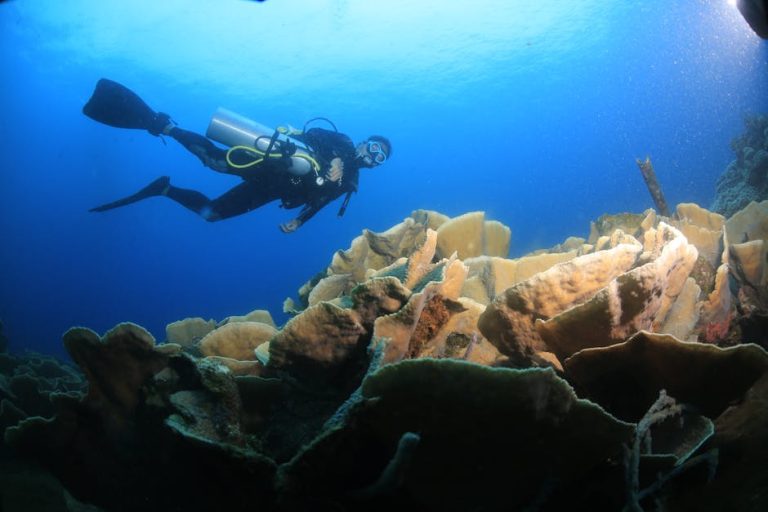
The Heron Island Bommie — a coral pinnacle rising from 23 metres — is consistently listed among the GBR’s best dive sites, with large fish, multiple shark species, and extraordinary coral architecture. The island’s resident turtle population produces reliable in-water encounters, with green turtles and loggerheads nesting seasonally on the beach.
The Swain Reefs
The Swain Reefs are the southern GBR’s wilderness area — a complex of reefs east of Mackay that receive almost no recreational dive traffic due to their distance from port. The few liveaboard expeditions that reach the Swains describe diving consistent with the Coral Sea: extremely high fish biomass, shark populations that haven’t experienced significant pressure, and coral in a condition that reflects the lower human impact on this remote section of the barrier.
Getting There
The southern GBR’s inconvenience is real. Lady Elliot Island requires a small-aircraft flight from Bundaberg or Hervey Bay. Heron Island requires a helicopter from Gladstone or a two-hour catamaran ferry. The Swain Reefs require a liveaboard of at least five days.
They are also access to parts of the system that the standard GBR tourist experience never reaches. The diver who has seen Lady Elliot’s mantas and Heron Island’s turtles and the shark populations of the Swains has seen a different Great Barrier Reef from the one in the brochures — broader, stranger, and in some ways more affecting for the effort it took to get there.