Townsville is the largest city in North Queensland and the most underrated reef destination in Australia. I say this knowing that it will strike most people who’ve been to Cairns as a puzzling claim. Cairns has the infrastructure, the international flights, the developed reef tourism industry. Townsville has the Yongala.
The SS Yongala is a passenger steamship that sank in a cyclone in 1911, killing all 122 people on board, and it lies in 14 to 29 metres of water 110 kilometres southeast of Townsville. It is, by the consistent assessment of experienced divers who have dived it and compared it with the finest reef diving in the world, one of the best dive sites on Earth. Not the best wreck in Australia. One of the best dive sites, full stop.
Townsville is where you go to dive the Yongala. Everything else — Magnetic Island, the Museum of Tropical Queensland, the strand, the reefs accessible on day trips — is good supplementary material. The Yongala is the reason.
The SS Yongala: What Makes It Extraordinary
The Yongala lies on a featureless sandy plain with no other reef structure for kilometres in any direction. This isolation, combined with a century of marine colonisation, has produced a concentration of biomass that experienced divers consistently find overwhelming. Every surface of the 109-metre hull is covered in coral and encrusting organisms. The water column around the wreck is dense with fish — schools of several thousand big-eye trevally permanently surrounding the midship section, humphead groper of 200 kilograms inside the structure, bull sharks circling the hull at depth.
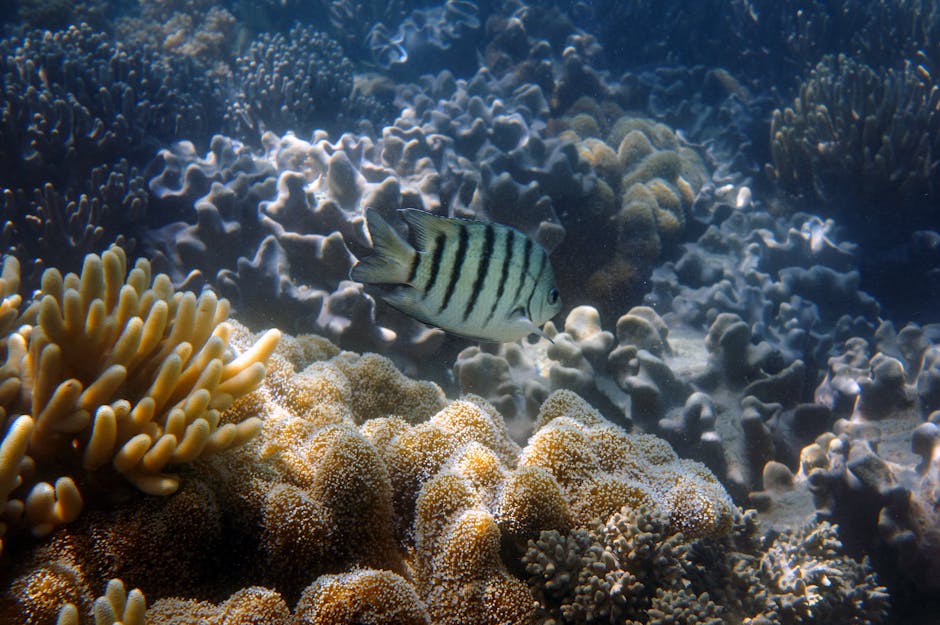
The marine life list at the Yongala reads like something assembled for maximum effect: leopard sharks, eagle rays, marble rays, cowtail stingrays, sea snakes (including a resident olive sea snake reliably present on almost every dive at the site for years), loggerhead and green turtles, large Spanish dancers at night. The site performs this consistently and has been performing it for decades.
Access to the Yongala is from Townsville or from the town of Ayr, 40 kilometres closer to the site. Most operators run two dives per visit — the site is deep enough (maximum 29 metres at the keel) that a single dive doesn’t begin to exhaust it. The current at the site can be significant and the visibility variable, but the Yongala in moderate conditions is still extraordinary.
Magnetic Island: A Different Pace
Magnetic Island sits eight kilometres from the Townsville waterfront, accessible by a 25-minute fast ferry that runs multiple times daily. It’s a continental island of 52 square kilometres, two-thirds of which is national park, with four small towns and a character that has resisted the resort development that has altered most of its comparable Queensland islands.
The island has koalas. This is not the first thing most divers care about, but it’s worth mentioning because the koala population in the Forts Walk area — an old World War II military installation on the island’s northern headland — is one of the most accessible and dense wild koala populations in Queensland, visible from the track with regularity at dawn and dusk.
The Forts Walk is the best walk on the island: a 2.4km trail through hoop pine forest to the headland gun emplacements, with the Coral Sea visible through the trees on both sides and the island’s character — quiet, green, genuinely wild in its national park sections — fully expressed along its length. In the late afternoon, the light on the surrounding water from the headland viewpoints is the kind of light that makes you understand why people choose to live on islands.
The fringing reef around Magnetic Island is Townsville’s accessible snorkelling. The clearest sites — around Geoffrey Bay and Florence Bay on the eastern shore — have coral coverage that has been affected by bleaching but still supports good fish diversity and reliable turtle encounters. It’s not Agincourt. It’s a pleasant half-day in the water from a ferry ride.
Townsville’s Marine Infrastructure
Townsville is home to the Australian Institute of Marine Science (AIMS) — the primary federal research institution for Great Barrier Reef science — and to the James Cook University marine science program, one of the most significant reef research institutions in the world. The city has a relationship with reef science that shapes its character in ways that aren’t immediately obvious to visitors.
The Reef HQ Aquarium, operated by the Great Barrier Reef Marine Park Authority, is the world’s largest living coral reef aquarium — a facility with genuine scientific and educational credentials that goes considerably beyond the standard tourist aquarium model. The coral tank, which houses living reef ecosystems rather than a collection of individual species, gives visitors an immersive reef experience that is surprisingly close to being in the water.
The Museum of Tropical Queensland, on the Strand, houses the Pandora collection — artefacts recovered from HMS Pandora, which sank on the outer Great Barrier Reef in 1791 while returning to England with survivors of the Bounty mutiny. The museum is small but good, and the Pandora exhibition provides a historical dimension to the reef that connects it to the broader Pacific history of the eighteenth century.
Townsville as a Base
For divers, Townsville makes most sense as a Yongala base: fly in, dive the wreck on consecutive days, take a day on Magnetic Island, and fly out. This is a three to four-night trip and it’s an excellent one.
For visitors combining reef diving with Queensland tourism more broadly, Townsville’s central position on the Queensland coast — roughly equidistant between Cairns and the Whitsundays — makes it a logical stopping point on a north–south itinerary rather than a specific destination. The city is well connected to both directions by air and road.
The strand — the Townsville waterfront — is a well-maintained linear park with a beach, an outdoor pool, restaurant precinct, and views toward Magnetic Island that constitute the city’s public face and its best daily-life asset. Walk it in the early morning, when the island is backlit by the rising sun over the Coral Sea, and you’ll understand why people who move to Townsville tend to stay.