The thing that surprises most people about their first liveaboard is how quickly the boat becomes home.
Not immediately. The first afternoon, you’re navigating a new space with too many strangers in it, figuring out where your wetsuit goes and whether the top bunk in your cabin is going to be a problem and whether you’ll eat enough at dinner to manage the overnight crossing without feeling sick. There’s an administrative quality to the first few hours that has nothing to do with the ocean.
Then the shore disappears. The boat settles into its passage rhythm. The sun drops and the sky does what it does over open water at dusk — the colours are different from anything you see over land, wider and more saturated. You eat dinner with people you’ll know well in four days. And somewhere in there, without quite noticing when, the boat becomes the context and everything else recedes.
This is the first liveaboard experience. By the time you board your return flight, you will be making plans for the next one.
What a Liveaboard Actually Is
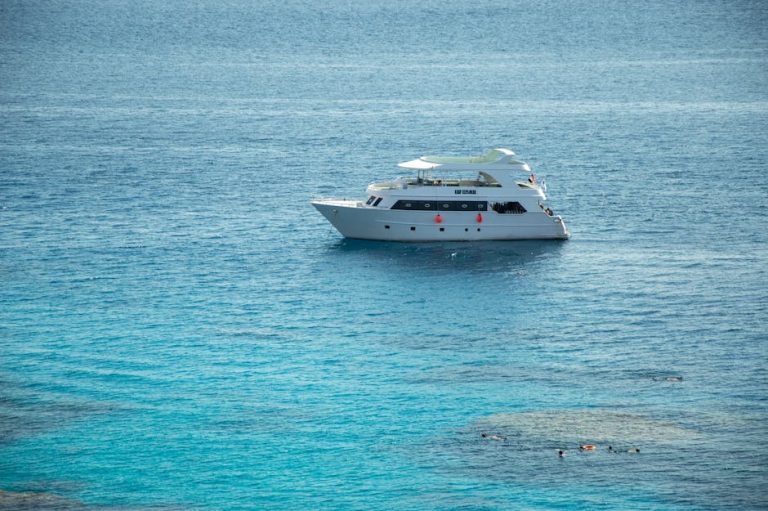
A liveaboard dive vessel is, at its most functional definition, a dive platform that you sleep on. This distinguishes it from a day-trip operation (you go out, you dive, you come back) and from a resort (you sleep on land and dive from a boat based there). The liveaboard takes you to the diving and keeps you there, typically for four to ten days.
The practical advantage is access. The Great Barrier Reef is 2,300 kilometres long. A day-trip boat from Cairns can reach perhaps the nearest 80 kilometres of it. A liveaboard running seven days can cover the ribbon reefs of the far north, the Coral Sea atolls 350 kilometres offshore, the Swain Reefs in the south. The reef that liveaboard divers see is not the same reef that day-trippers see. It’s not even close.
The less obvious advantage is time. Four dives a day for seven days is twenty-eight dives. Each dive is on a site where you may be the only divers in the water. The site has not been dived by the morning trip, the afternoon trip, and the sunset trip. It’s been dived by you. The marine life is less conditioned to human presence, more likely to behave naturally.
Choosing Your First Liveaboard
The Australian market has three distinct liveaboard zones, each with its own character and its own access to different reef systems.
Cairns and Port Douglas are the launching points for the majority of Australian liveaboard operations. From Cairns, the destinations are the Coral Sea atolls (Osprey, Bougainville, Holmes — three to five day trips), the Ribbon Reefs and Cod Hole in the far northern GBR (three to four days), and various combinations of outer reef and Coral Sea on longer itineraries. The Cairns liveaboard industry is the most developed in Australia — most vessel types and price points are represented, departures are frequent, and the infrastructure for getting you and your gear on board is well-practised.
The Whitsundays support a smaller liveaboard market, primarily sailing-based, that combines the island-hopping sailing experience with reef diving. These are generally smaller vessels — catamarans and monohulls — with fewer divers and a more intimate atmosphere. Itineraries typically cover the Whitsunday island group and Bait Reef.
Exmouth (Ningaloo) has a small but growing liveaboard presence focused on the whale shark season from March to July, supplemented by reef diving year-round. Ningaloo liveaboards offer the combination of whale shark swims and genuine reef diving in one trip that’s otherwise only possible by combining multiple day trips from shore.
For a first liveaboard in Australian waters, I recommend a Coral Sea trip departing from Cairns. The diving is world-class, the itinerary is well-established, the support infrastructure is professional, and arriving at Osprey Reef after an overnight crossing and dropping into clear blue water above a shark-populated wall is as good a first-liveaboard experience as exists anywhere.
What to Pack
The packing list for a liveaboard is shorter than most people expect, because space is limited and because the things you actually use are fewer than you think you’ll need.
The dive gear takes most of the space. Your regulator, BCD, wetsuit, mask, fins, and any accessories (computer, torch, surface marker buoy) are the weight and bulk items. Most liveaboards provide tanks, weights, and weight belts. Some provide BCDs and wetsuits for additional cost; most experienced liveaboard divers prefer their own.
Non-dive gear: lightweight clothing (the boat is casual; you will wear the same three items for a week and nobody will care), any prescription medications, seasickness tablets, sunscreen (reef-safe), a light fleece or jacket for cool evenings at sea, and considerably less toiletry than you’d bring to a hotel. Cabin space is limited. The surface interval is not spent getting dressed.
What to leave behind: anything you’d bring to a beach resort that doesn’t also apply on a boat. Hair dryers, formal clothing, elaborate skincare routines. The boat will launder your wetsuits. The ocean will launder everything else.
Managing Seasickness
I’ll address this directly because it’s the concern that keeps genuinely interested people off liveaboards, and the concern is manageable.
Motion sickness on a dive vessel depends on the conditions of the crossing (overnight passages are often the roughest section), the vessel type (catamarans are generally more stable than monohulls at sea, though the characteristic motion is different), and your individual susceptibility.
The pharmacological options: Stemetil (prochlorperazine) prescribed by a doctor, taken the evening before and the morning of the crossing; over-the-counter Kwells (hyoscine hydrobromide) or Travel-Calm; ginger tablets for milder susceptibility. Important note: some seasickness medications cause drowsiness, which affects diving safety. Check with your diving medical physician about which options are appropriate to use with scuba. Dimenhydrinate and some other antihistamine-based medications are not recommended for divers.
The non-pharmaceutical approaches that genuinely help: staying on deck during rough conditions rather than in the cabin (horizon visibility significantly reduces motion sickness), keeping something light in your stomach (emptiness worsens sickness), staying hydrated, and positioning yourself midship and low in the vessel where movement is least.
Most people who are anxious about seasickness have a much better experience than they expected. And almost everyone, regardless of how rough the crossing was, reports that once they’re in the water — once the first dive begins — the seasickness is entirely irrelevant.
The Social Experience
A liveaboard is a forced social situation in the most productive sense. You are on a boat with ten to thirty people, sharing meals, sharing surface intervals, sharing the experience of seeing something extraordinary underwater and needing to tell someone about it.
The people you encounter on liveaboards are a self-selecting group: they’ve made a deliberate effort to be there, they care about diving, and they’re in an environment that systematically removes the usual barriers to conversation. By day two, you know everyone on the boat. By day four, you’ve been planning a future trip to Papua New Guinea with someone you met on Tuesday.
This is, in my experience, consistent. The social dimension of liveaboards is a genuine part of their value — not incidental to the diving but entwined with it. The conversations that happen on the dive deck after an extraordinary dive, over dinner when someone shows photographs of what they saw at the Cod Hole, on the back deck at midnight watching stars over the Coral Sea — these are part of what you’re paying for and part of what you carry home.
Go. Take the overnight crossing. Be slightly uncomfortable for the first twelve hours. The reef on the other side is worth it.