Let me tell you about the worst dive of my life that turned out to be the best.
I was doing a channel dive at Fakarava Atoll in French Polynesia — the south pass, Tetamanu, which has a reputation among serious divers as one of the finest shark dives in the world. The plan was simple: drift in the current through the pass, watch grey reef sharks patrol the channel walls. What the briefing had mentioned as an aside — almost as a footnote — was that during certain tidal conditions, the sharks gathered in what’s called a “shark wall”: a dense aggregation of several hundred grey reef sharks holding position in the current.
We hit the shark wall.
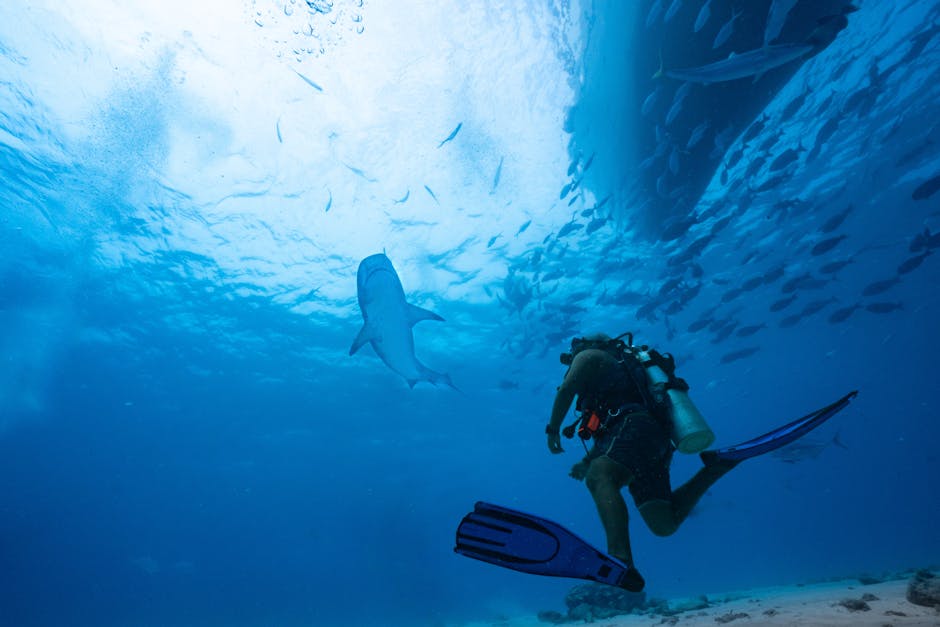
I have three hundred dives. I have dived Papua New Guinea, the Coral Sea, the Red Sea, Micronesia. What I saw in that channel was beyond anything in my experience. Hundreds of grey reef sharks — dense, layered, stacked in the water column from the sandy bottom to within five metres of the surface — moving with the collective coherence of a murmuration. The current held us in place. They moved around us without acknowledgement, without aggression, without the slightest indication that we represented anything requiring a response.
I wasn’t frightened. I was overwhelmed. There’s a difference.
The Reality Behind the Fear
Sharks kill approximately five to ten people per year globally. Unprovoked shark attacks — meaning encounters where the shark bit a human without human provocation — result in roughly 70 to 100 incidents annually worldwide, the majority of them non-fatal.
For context: coconuts kill approximately 150 people per year. Cows kill more Americans annually than sharks kill globally. Mosquitoes are responsible for over 700,000 human deaths per year through the diseases they transmit.
I’m not citing these numbers to be dismissive of shark attacks, which are genuinely traumatic events for those who experience them. I’m citing them because the fear response that sharks trigger — the visceral, cinematic, disproportionate fear — has consequences. It shapes policy. It generates calls for shark culls whenever an attack occurs, regardless of evidence that culling reduces attack frequency (it doesn’t, meaningfully). It makes it politically difficult to defend shark conservation even as shark populations collapse globally.
The fear is real, but it is not well-calibrated to the actual risk. And the actual risk to sharks from humans — roughly 100 million sharks killed annually, through directed fishing, bycatch, and finning — is an emergency that receives a small fraction of the attention given to the five to ten deaths that go the other way.
The Ecological Role of Apex Predators
Marine biologists use the term “trophic cascade” to describe the way apex predators regulate entire ecosystems through their effects on prey species. Remove the predator, and the prey population expands, overgrazing vegetation or outcompeting other species in ways that destabilise the whole system.
The classic example in terrestrial ecology is wolves in Yellowstone: the reintroduction of wolves in 1995 didn’t just reduce elk numbers — it changed elk behaviour, reduced overgrazing in riparian areas, allowed vegetation to recover, which changed water flow, which changed river morphology. The whole landscape shifted because one apex predator was returned.
In marine systems, sharks play an equivalent role. A reef without sharks is not a reef with fewer sharks. It’s a different reef, with different species compositions, different coral cover, different fish community structure. Studies of reef systems where sharks have been heavily fished — many reefs in the Caribbean, parts of the Indo-Pacific — document cascading changes in the ecosystem that extend far below the predator trophic level.
We cannot understand what a healthy reef looks like if we’ve never seen one with a full complement of sharks.
Species Divers Encounter Most Often
Whitetip reef shark (Triaenodon obesus) — the most common shark species on Indo-Pacific coral reefs. Relatively small (up to 2.1 metres), slender, and distinguished by the white tips on the dorsal and upper caudal fins. Largely nocturnal feeders that rest communally on the sand or under ledges during the day. They are unfailingly calm around divers and are, for most people, the first shark species they encounter underwater.
Grey reef shark (Carcharhinus amblyrhynchos) — the species I encountered at Fakarava. Mid-sized (typically 1.5 to 1.9 metres), found throughout the Indo-Pacific in lagoons and outer reef environments. More active and faster-moving than whitetips, with a distinctive dark trailing edge on the tail. In areas with low fishing pressure and regular diving activity, they are essentially indifferent to divers.
Blacktip reef shark (Carcharhinus melanopterus) — identified by the black tips on all fins, including the pectoral fins. Common in very shallow water, often in lagoons and reef flats where the water barely covers its dorsal fin. Frequently encountered by snorkellers rather than divers. Nervous and fast-moving; will generally leave the area if approached directly.
Bull shark (Carcharhinus leucas) — the species responsible for the majority of serious attacks on humans, largely because of its preference for shallow, murky coastal water and its tolerance for freshwater environments. Large (females can exceed 3 metres and 300 kilograms), powerfully built, and genuinely more unpredictable than reef species. Encountered on reef dives most often in the Coral Sea and around the northern GBR.
Tiger shark (Galeocerdo cuvier) — large, heavily built, with distinctive vertical bar markings that fade in adulthood. The most generalist predator of the large sharks — it will eat almost anything — and responsible for a significant proportion of attacks on humans. Genuine encounters on reef dives are uncommon but possible; the shark diving operations at Tiger Beach in the Bahamas and at Beqa Lagoon in Fiji are dedicated tiger shark experiences.
Wobbegong sharks (Orectolobidae) — a family of carpet sharks found primarily in Australian and New Guinea waters. Flattened, camouflaged, sedentary ambush predators. They don’t chase prey; they wait for prey to come to them. Most bites attributed to wobbegongs in Australia result from divers accidentally placing a hand or foot on one. They blend extraordinarily well into reef substrate and require active attention to spot.
Diving With Sharks: Practical Considerations
The most important thing I can tell you about diving with sharks is that your body language matters. Sharks read posture and movement. A diver who holds still, breathes slowly, and moves deliberately through the water is not presenting any signals that trigger a feeding or defensive response. A diver who is erratic, who ascends and descends rapidly, who thrashes with fins — those are signals that correspond to distressed prey.
Slow your breathing. Reduce your bubble frequency. Move smoothly and predictably. Face the shark when it approaches, don’t turn away.
The second thing: reef sharks, in my experience, are in charge of the encounter. You don’t approach them; you make yourself available and wait to see whether they approach you. If they’re circling tightly, if the fins are dropped and the back is arched — the recognised warning posture of the grey reef shark — give the animal space and exit the area calmly. These behaviours are communication. Listen to them.
A Word on Shark Feeding Dives
Shark feeding operations — where dive operators put food in the water to attract sharks for diver viewing — are common in the Pacific and Caribbean and generate strong opinions. The arguments against them centre on the conditioning of wild animals to associate humans with food. The arguments for them are partly economic (the operations generate revenue that supports conservation) and partly research-based (aggregations of known individual sharks at feeding sites provide population data that would otherwise be impossible to gather).
My view, for what it’s worth: a well-run feeding operation where sharks are not handled, where feeding is supplemental rather than the primary driver of animal nutrition, and where the operator invests in conservation and research, is defensible. The alternative — a reef with no sharks because they’ve all been finned — is not.
The shark wall at Fakarava is possible because Fakarava’s lagoon is a UNESCO biosphere reserve and one of the most protected marine areas in French Polynesia. The sharks are there because the fish are there, the fish are there because the reef is healthy, and the reef is healthy because people decided it was worth protecting.
That’s the chain. It goes all the way to the bottom.