There are dives you forget almost immediately — pleasant, uneventful, a way to pass an afternoon underwater. And then there are dives that restructure something in you, that make you resurface as a slightly different person. My first encounter with a reef manta ray was the second kind.
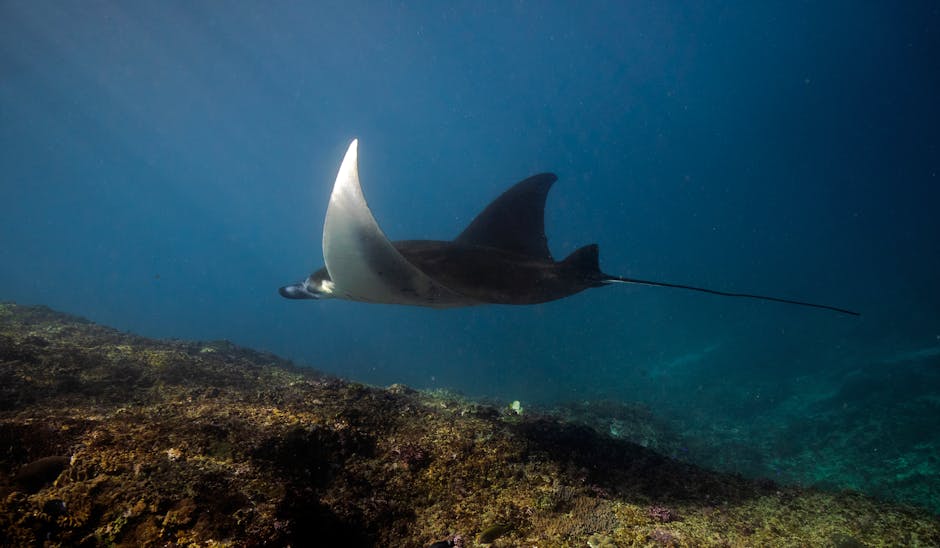
I was diving Lady Elliot Island, at the southern tip of the Great Barrier Reef. Visibility was exceptional — twenty-five metres at least, water so clear it had a pale turquoise tint even at depth. I was finning along the reef edge when I became aware of a shadow above me. Not an alarming shadow. A slow, vast, deeply calm shadow. I looked up and saw the underside of a manta ray — perhaps three and a half metres from wingtip to wingtip — gliding not two metres above my head.
It was not looking at me. It did not seem to acknowledge me at all. It simply moved through the water in the way that large, ancient things move: with a kind of unhurried authority that makes everything around them feel small and fast and nervous by comparison.
I stopped finning. I hung there. I watched it pass.
It was, and remains, one of the finest moments of my life in the ocean.
Two Species, Two Scales
There are two recognised species of manta ray. The reef manta (Mobula alfredi, formerly Manta alfredi) is the one most divers encounter — typically two to four metres across, found in warmer coastal and offshore waters throughout the Indo-Pacific, the Red Sea, and parts of the Atlantic. The oceanic manta (Mobula birostris, formerly Manta birostris) is significantly larger, sometimes reaching seven metres across, and lives a more pelagic life, roaming open ocean in ways that are still not fully understood.
Both species were reclassified from the genus Manta into Mobula in 2017, grouping them with the devil rays — a controversial but molecularly supported decision that changed the taxonomy without changing the animal.
Both species share the manta’s defining characteristics: the flattened, diamond-shaped body, the distinctive cephalic fins (the rolled “horns” on either side of the head that unfurl to funnel plankton toward the mouth during feeding), and the long, whip-like tail. Unlike stingrays, mantas have no stinging spine. They are entirely harmless to divers, and in my experience, frequently curious.
Feeding Behaviour: The Barrel Roll
Watching a manta feed is one of the more extraordinary things available to a diver. When plankton concentrations are high — particularly near the surface during certain tidal and lunar conditions — mantas perform what’s known as a barrel roll: a continuous forward somersault that keeps them cycling through the densest layer of zooplankton. They lock into the roll and just keep spinning, mouth agape, cephalic fins wide open, gulping water and filtering out the tiny organisms that fuel a body that can weigh over a tonne.
At Lady Elliot, I’ve watched groups of five or six mantas barrel-rolling simultaneously in the shallows just after dawn, their white bellies flashing as they turned. From below, it looked like a slow fireworks display.
The feeding behaviour is linked closely to lunar cycles and tidal patterns. New and full moons tend to bring strong tidal flushing, which concentrates plankton along reef edges and in specific bays. If you’re planning a trip specifically to see manta feeding behaviour, it’s worth researching the lunar calendar and asking local operators which tidal state produces the best conditions.
Cleaning Stations
Away from feeding, the most reliable way to observe mantas for extended periods is at cleaning stations. These are specific spots on the reef — often prominent coral heads or exposed ridges in areas of current — where small fish like wrasse and angelfish set up permanent “service stations,” removing parasites and dead tissue from larger marine animals.
Mantas visit these sites regularly, sometimes daily. They approach slowly and then hover — almost motionless in the current — while the cleaner fish work over their gill plates, their skin, and sometimes the inside of their mouths. A manta at a cleaning station is about as cooperative a photographic subject as the ocean offers. They seem genuinely to enjoy the process, holding position far longer than they need to, sometimes with their eyes half-closed.
The best cleaning stations I’ve encountered for mantas include: the outer reef bommies at Lady Elliot Island; the channel diving at Komodo National Park in Indonesia; Hanifaru Bay in the Maldives (which requires a permit); and Bat Islands off Costa Rica’s Guanacaste coast for oceanic mantas.
Individual Recognition and Intelligence
One of the things that makes mantas particularly compelling to researchers and divers alike is their individuality. Like human fingerprints, the pattern of spots and blotches on a manta’s underside (the ventral surface) is unique to each individual. Citizen science programs like Manta Matcher — run by the Marine Megafauna Foundation — allow divers to submit photographs and contribute to long-term population studies.
Mantas have the largest brain-to-body ratio of any fish. They demonstrate behaviours consistent with self-awareness — one of the only fish species to have passed versions of the mirror test, though the methodology remains debated. They have been observed exhibiting what appears to be play behaviour, socialising in groups outside of feeding contexts, and revisiting the same individuals over many years.
Researchers following individual reef mantas at sites in the Maldives and Hawaii have documented animals returning to the same locations for over a decade. One female manta at a Maldives cleaning station, known to researchers by her spot pattern, was photographed consistently across a fifteen-year study period. These are not simple animals.
Conservation Status
Both manta species are listed as Vulnerable on the IUCN Red List, with the oceanic manta considered Endangered. The primary threats are targeted fishing (manta gill plates are sold in Chinese medicine markets as a treatment for various conditions, despite having no documented medicinal properties) and bycatch in gillnet and longline fisheries.
Mantas reproduce slowly: females typically produce one pup every two to five years, following a gestation period of approximately twelve months. A population that’s been reduced by fishing cannot recover quickly. In regions where mantas have historically been hunted — parts of Indonesia, the Philippines, Sri Lanka — populations remain depleted decades after hunting has ceased.
The economic argument for conservation is, unusually, a very strong one. A study by the Australian Institute of Marine Science calculated that a single reef manta ray generates over a million Australian dollars in tourism revenue over its lifetime. As a dead animal sold for its gill plates, it’s worth a few hundred dollars. The numbers are not close.
Diver Ethics and Best Practice
I want to say something here about diver behaviour around mantas, because I’ve seen it go wrong.
Mantas are not afraid of divers in the way smaller reef fish are, but that doesn’t mean they’re indifferent to our presence. A manta that aborts a cleaning station visit because five divers have swarmed the coral head and blocked the cleaner fish’s access is a manta that hasn’t been cleaned. If it happens repeatedly at the same site, the animal may stop visiting altogether.
The protocols are simple: approach from the side, not head-on. Don’t position yourself between the manta and the cleaning station. Keep horizontal — divers who hover vertically, kicking their fins downward and creating turbulence, stress animals and disturb reef. And never touch. Manta skin is delicate, and human hands carry oils, bacteria, and sunscreen that can damage the mucus layer that protects the animal from infection.
Give them space. Watch from a respectful distance. Let them come to you. On more dives than I can count, giving a manta that kind of space has resulted in the animal approaching me, slowing down, and passing close enough that I could have reached out and touched it. I didn’t. That’s the whole point.