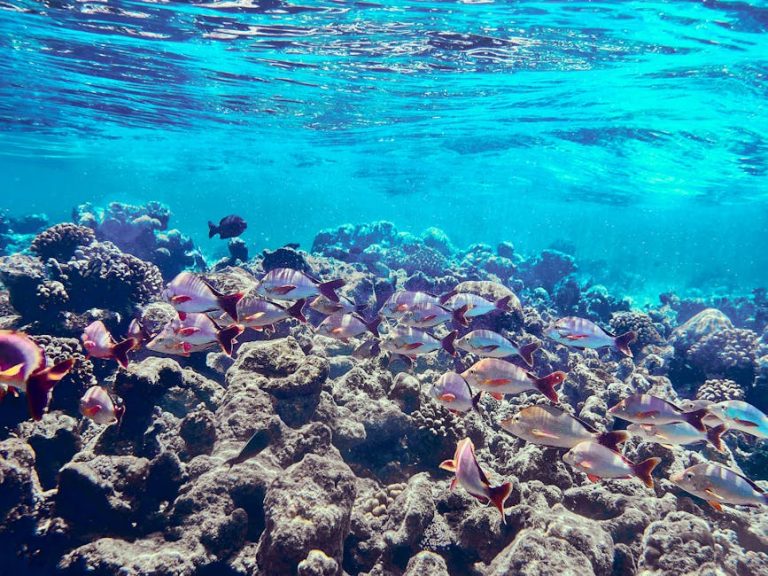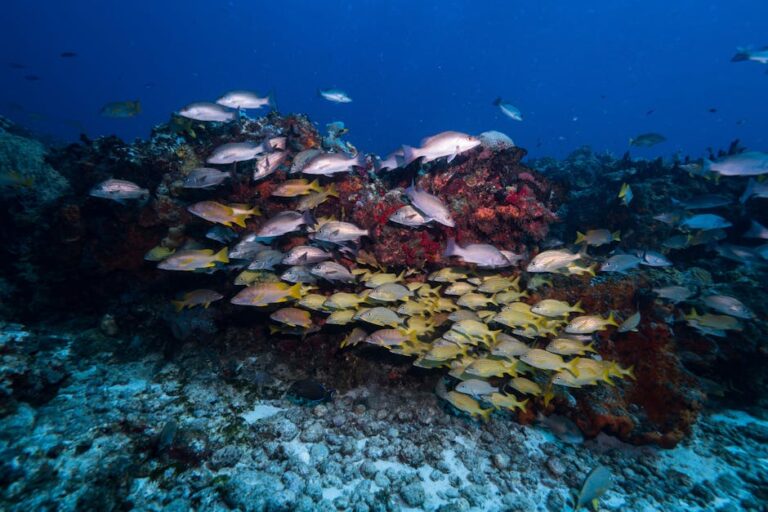
Coral reefs like the Great Barrier Reef are wonderfully diverse and productive habitats, important to both tourism and fisheries. Large predatory fish such as those seen here with the diver, perform important ecological roles on coral reefs, and important as a source of food to many millions of people in tropical regions.
Photo: Ove Hoegh-Guldberg, Centre for Marine Studies, The University of Queensland
Increasing heat stress from global climate change coupled with declining calcification rates due to ocean acidification may mean that coral dominated reefs may become a distant memory. High latitude reefs such as this one in Western Australia illustrate the struggle between coral and seaweeds.
Photo: Ove Hoegh-Guldberg, Centre for Marine Studies, The University of Queensland

The combination of local (over-fishing, declining water quality) and global (global warming and ocean acidification) can often reduce coral reefs to nothing more than a slimy rubble heap. Often, it is difficult to get coral reefs to grow back in these places.
Photo: Ove Hoegh-Guldberg, Centre for Marine Studies, The University of Queensland
Free copyright is granted for use of these images in conjunction with ARC Centre of Excellence news stories