Queensland has a wildlife watching problem, and the problem is embarrassment of riches. The marine environment offers turtles, dugongs, whale sharks, manta rays, dolphins, and humpback whales depending on the season. The rainforest has cassowaries, tree-kangaroos, and the most species-dense bird assemblage in Australia. The eucalypt country has koalas, wallabies, and the echidnas and platypuses that constitute two of the five surviving monotreme species. The wetlands have saltwater crocodiles.
The problem is not finding wildlife in Queensland. The problem is allocating enough time to do it properly.
Sea Turtles
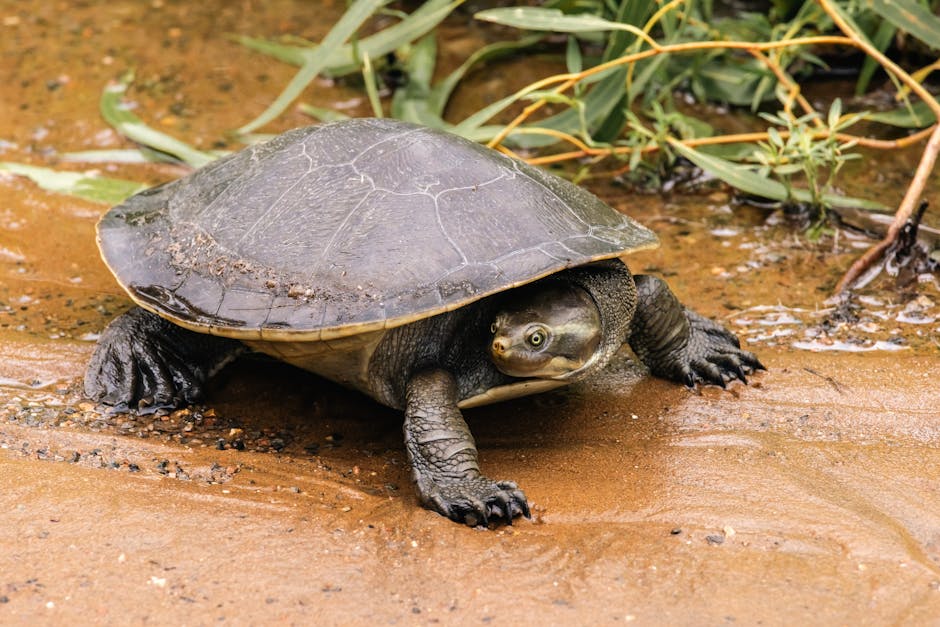
Queensland’s coastal and reef waters support all six species of sea turtle that occur in Australian waters. The loggerhead, green, hawksbill, flatback, olive ridley, and leatherback all occur here, though the loggerhead and green are by far the most commonly encountered.
The nesting aggregations that make Queensland sea turtle watching significant are:
Raine Island, in the far northern GBR, is the world’s most important green turtle nesting site — up to 60,000 females in a single season. Access is restricted to researchers; public visitation is not possible. This is the correct management decision.
Mon Repos Conservation Park, near Bundaberg, is the most accessible major sea turtle nesting site in Australia. The flatback, loggerhead, and green turtles all nest on Mon Repos beach between November and March. The Queensland Parks and Wildlife Service runs guided turtle watch programs — evening tours that accompany arriving nesting females and, later in the season, hatchling releases. The program is exceptional in its management: small groups, red-light torches, expert interpretation, a genuine commitment to minimising disturbance while maximising visitor understanding.
Booking is essential and opens months before the season. The Mon Repos turtle experience is one of the finest managed wildlife encounters in Queensland.
Lady Elliot and Heron Island both have resident green and loggerhead turtle populations visible to snorkellers and divers year-round, with nesting visible from the beach in season. Both have been covered elsewhere.
Dugongs
The dugong (Dugong dugon) is a large, slow, herbivorous marine mammal that grazes seagrass beds in shallow tropical and subtropical coastal waters. Queensland’s dugong population — approximately 10,000 animals — is one of the largest in the world. They are not easy to find on purpose; most encounters happen when you’re doing something else, typically snorkelling or kayaking near seagrass beds.
The Ningaloo coast in Western Australia and Moreton Bay near Brisbane are the most accessible locations for reliable dugong encounters. At Ningaloo, the seagrass beds between the beach and the reef are feeding habitat for resident dugongs, and kayaking above them in calm conditions produces encounters with a regularity that no Queensland location quite matches for ease of access.
Humpback Bay in the Whitsundays — a large embayment with extensive seagrass beds on Whitsunday Island’s southern shore — is the Queensland site most likely to produce dugong encounters for visitors on sailing charters, though sightings are opportunistic rather than reliable.
Whale Watching
Humpback whales migrate through Queensland waters between June and November, moving north along the Queensland coast from their Antarctic feeding grounds to breeding areas in the waters north of the GBR, then south again with calves in spring. The migration passes close enough to the Queensland coast that whale watching from headlands is possible at several locations.
The organised whale watching industry is concentrated in Hervey Bay, in the Wide Bay region, where the sheltered waters of the bay provide a stopover point for humpbacks on the southward migration. From August through October, the bay reliably holds large numbers of humpbacks — individuals resting and socialising before the deep-water passage south — and the whale watching trips from Hervey Bay consistently produce close-range encounters with breaching, lob-tailing, and the close approaches of curious whales that have been called “friendlies” by the industry for decades.
The humpbacks at Hervey Bay are among the most interactive wild whale encounters available anywhere in the world. This is not an exaggeration — the combination of sheltered water, the specific behaviour of southward-migrating humpbacks that stop to rest, and decades of low-disturbance encounter protocol has produced a whale population that approaches vessels with apparent curiosity and spends extended periods at the surface near watching boats.
Cassowaries
The southern cassowary (Casuarius casuarius johnsonii) is a large, flightless bird — adult females can exceed 1.6 metres tall and 70 kilograms — with a keratin casque on its head, wattles in vivid blue and red, and the capacity to deliver a serious injury if threatened. It is also critically important to the Wet Tropics rainforest as a seed disperser: many large-seeded rainforest trees depend almost entirely on cassowaries to carry their seeds away from the parent tree and deposit them in a viable germination site.
Finding cassowaries requires knowing where they are in sufficient concentration for an encounter to be probable rather than merely possible. The Mission Beach area, between Cairns and Townsville, has the highest density of cassowary sightings reported by visitors — the bird’s tolerance for fragmented forest and road margins in this area has produced a semi-habituated population that appears with regularity near roads and paths.
The Cape Tribulation area in the Daintree also has a reliable cassowary population. Sightings are most likely in the early morning and late afternoon when the birds are most active, and most commonly near fruiting trees.
If you see a cassowary: observe from a distance, do not approach, do not attempt to feed it, and do not position yourself between the animal and an escape route. The cassowary’s response to a perceived threat is not flight — it’s a forward kick with claws that can cause serious wounds. They are not aggressive in the sense of seeking confrontation, but they defend their space, their chicks, and their food resources with efficient physicality.
Platypuses
The platypus (Ornithorhynchus anatinus) is, by any objective measure, one of the most biologically improbable animals in existence: a venomous, electroreceptive, egg-laying mammal that hunts invertebrates underwater and is related to nothing else alive in an easily legible way. It occurs in freshwater streams throughout eastern Australia and is entirely worth the effort of finding.
The best platypus viewing in the Cairns region is at Yungaburra, on the Atherton Tablelands, where Peterson Creek has a resident population viewable from the roadside bank at dawn and dusk. The creek walk at Yungaburra is a standard stop for wildlife-focused visitors to the tablelands.
The Broken River in Eungella National Park, west of Mackay, is the most reliable platypus viewing location in Queensland — a mountain stream with a resident population visible from a dedicated viewing platform with regularity at dawn and dusk. The platform, maintained by the park, produces platypus sightings on approximately 90% of appropriate visits. It is not a zoo; it is a wild creek with a viewpoint, and the platypus hunting below the surface in the clear water is entirely natural. It is also, by my assessment, one of the finest wildlife experiences in Queensland for the simple reason that the animal remains completely extraordinary no matter how many times you’ve seen it explained in a textbook.
Saltwater Crocodiles
The saltwater crocodile (Crocodylus porosus) is the world’s largest living reptile — males can exceed six metres — and it is a genuine hazard in northern Queensland waterways, particularly in rivers, estuaries, and coastal areas north of Rockhampton. Crocodile safety in Queensland is not a theoretical concern.
The relevant rules, stated plainly: don’t swim in waterways north of Rockhampton unless the location is explicitly designated safe; don’t stand at the water’s edge in crocodile country at night; don’t clean fish at the water’s edge; don’t camp within five metres of the water. These rules are enforced by the animals, not by signage.
For wildlife watching, Hartley’s Crocodile Adventures near Palm Cove north of Cairns has a resident population of saltwater crocodiles and runs daily feeding and demonstration programs. It’s a legitimate wildlife encounter experience rather than a purely commercial show — the animals are large, clearly wild in character, and close enough at feeding that the physical scale of a large saltwater crocodile becomes clear in a way that photographs never convey.
Wildlife watching in Queensland rewards early mornings, patience, and the willingness to stay still. Every category of animal discussed here has been found by someone who stopped moving, waited, and let the landscape produce it. The landscape is willing to oblige.