Tourism is both one of the most powerful economic arguments for protecting the Great Barrier Reef and one of the most direct sources of damage to it. The GBR generates approximately $6.4 billion annually and supports 64,000 jobs. It is also subjected to the physical, chemical, and disturbance impacts of nearly two million visitor-days on the reef each year.
These two things are not in simple conflict. Well-managed tourism — operators with genuine environmental credentials, visitors behaving appropriately in the water, and the political and economic weight of tourism revenue directing policy toward reef protection — can be part of the solution rather than purely a component of the problem.
Sustainable reef tourism is not an idealistic abstraction. It is a set of specific choices that individual visitors can make, and that collectively produce a different version of reef tourism from the alternative.
Choosing Operators That Contribute to Conservation
The Advanced Ecotourism certification from Ecotourism Australia is the most meaningful independent credential available for Australian reef operators. It requires demonstration of active environmental management, staff training, visitor education, and contribution to conservation outcomes — not merely compliance with minimum regulations.
Questions worth asking any reef operator before booking:
What do they do about crown-of-thorths starfish? Responsible operators train staff to identify COTS outbreaks and report them to the GBRMP authority. Some participate in active removal programs. An operator who doesn’t know what crown-of-thorns is has revealed something about their environmental engagement.
What is their reef-safe sunscreen policy? Operators who provide reef-safe sunscreen or require its use demonstrate practical commitment to reef chemistry. Operators who don’t know or don’t care are supplying a different signal.
Do they contribute to monitoring programs? Many operators participate in Reef Check, Eye on the Reef, or other citizen science programs that collect data on reef health. Participation requires training and active data collection — it’s not a nominal commitment.
What is their marine wildlife interaction policy? Documented policies on approach distances for turtles, sharks, rays, and marine mammals, and briefings that cover these policies before every dive or snorkel, indicate operators who take the quality of wildlife encounters seriously rather than merely tolerating them.
The Carbon Dimension
Getting to the Great Barrier Reef from Sydney, Melbourne, or Brisbane involves a domestic flight — approximately 0.1 to 0.2 tonnes of CO2 equivalent per passenger depending on the route and aircraft. Getting there from London or Tokyo produces significantly more. The reef’s primary long-term threat is ocean warming driven by CO2 emissions, which creates an uncomfortable irony at the heart of reef tourism.
The response to this is not, I think, to avoid visiting the reef. The economic and political case for reef protection is strengthened by the reef’s demonstrated value to visitors, and that value is best demonstrated by visitors who actually go rather than those who stay home on principle. The response is to make the travel as low-carbon as practically possible (direct flights where available, accommodation that offsets, carbon offset purchases), to visit in a way that creates lasting investment in conservation, and to bring the experience home as advocacy.
The visitor who returns from a reef trip having been moved and informed, who then supports reef conservation funding, who engages with the policy environment around emissions and water quality, and who brings their children back to the reef — that visitor’s contribution to the reef’s future may be positive even after accounting for the flight.
In-Water Behaviour
The specific behaviours that matter most underwater have been covered in the snorkelling conservation article and the diving articles. The summary:
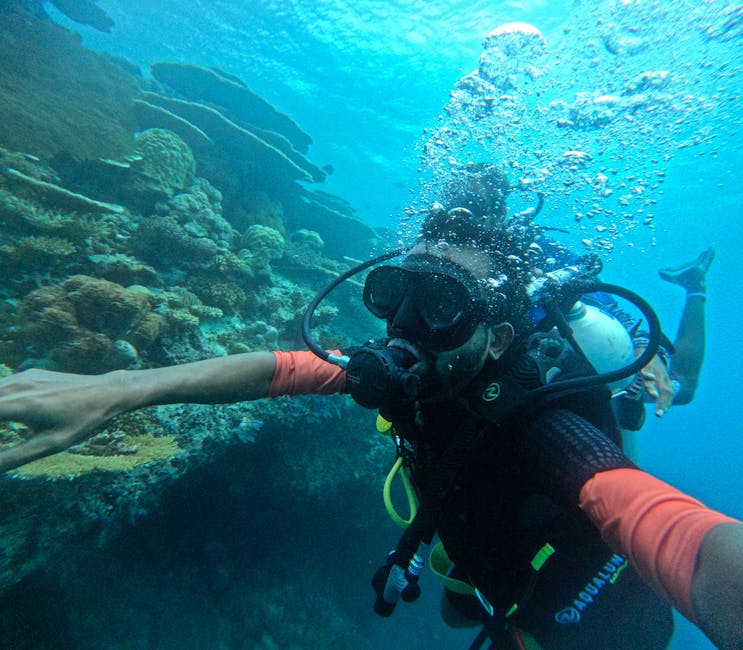
Horizontal body position, away from the reef. No touching, no standing on coral. Reef-safe sunscreen or rash vest coverage. No feeding of marine life. No collecting — shells, coral fragments, sand dollars, anything. Approach marine animals from the side, not from above. Reduce fin turbulence near the reef by switching to slow, controlled kicks or hovering by buoyancy rather than fin work.
These behaviours are not complicated. They require sustained attention rather than advanced skill. A diver or snorkeller who practices them consistently causes measurably less damage than one who doesn’t, and on a reef receiving a million visitors per year, the aggregate difference is significant.
The Water Quality Connection
Reef visitors who want their tourism to contribute to conservation outcomes rather than only extract from them have a specific and significant lever beyond their in-water behaviour: support for improved water quality in the GBR catchment.
Agricultural runoff — primarily nitrogen, phosphorus, and sediment from sugarcane and cattle grazing in the GBR catchment — is the most significant water quality stress on the inshore and mid-shelf reef. It drives crown-of-thorns outbreaks, stimulates algal growth that competes with coral for substrate, and reduces the light available to coral in turbid conditions.
The Great Barrier Reef Water Science Taskforce, the reef management programs of the Queensland and federal governments, and the farming industry programs that incentivise best-practice land management all operate on funding that is partly driven by public and political will. Visitors who care about the reef they visited are potential advocates for the catchment management policies that affect it.
Supporting Reef Science
The research institutions that generate the knowledge required to manage the reef — the Australian Institute of Marine Science, the ARC Centre of Excellence for Coral Reef Studies, James Cook University’s marine programs — are funded by government and private sources. Their funding levels affect what they can monitor, what they can model, and what management advice they can generate.
Reef HQ in Townsville and the various AIMS and GBRMPA visitor engagement programs provide direct public access to reef science. Supporting them through entry fees, donations, and the political advocacy of informed citizens who have visited the reef and understand its importance is a concrete contribution beyond the visit itself.
The Visitor’s Responsibility
The argument of this article is simple: reef tourism is not ethically neutral, but it is not irredeemably harmful either. The version that matters — the version the reef needs — is tourism that generates economic support for protection, behavioural norms that minimise physical impact, and informed visitors who become ongoing advocates.
You can be that visitor. The choices are mostly not difficult and not expensive. The guide above has told you what they are. The rest is showing up and paying attention.
The reef is one of the most extraordinary things on Earth. It deserves visitors who treat it accordingly.