I want to tell you about a section of reef that I have watched change over twelve years of repeat visits, because it’s the clearest example I know of how individual snorkeller behaviour, multiplied across thousands of visits, produces a cumulative effect that is impossible to attribute to any single person and impossible to ignore in aggregate.
The site is a shallow coral garden on an inner GBR platform reef — I’ll keep it vague — accessible from a day-trip platform and visited by several hundred snorkellers on peak days. In 2012, when I first snorkelled it, the Acropora table corals in the 2 to 4 metre zone were large, intact, and forming overlapping layers that created complex shelter for fish communities below them. In 2018, the tables were noticeably reduced. Not from bleaching — the area had partially escaped the 2016 event. From breakage. The broken edges of coral tables, where snorkellers with poor fin control had kicked through the branching structure, were visible on a significant fraction of the colonies.
By 2023, the table coral community had a noticeably different character. The large, intact tables that had been the site’s defining feature were mostly gone or fragmented. Smaller, younger colonies were growing from the rubble, but the structural complexity that had taken decades to develop was absent.
None of the people who broke those corals meant to. Most of them didn’t know they had.
The Physics of Snorkeller Impact
Coral is structurally strong in compression and weak in shear — it can withstand considerable weight pressing down on it but breaks readily from sideways force. A fin tip moving laterally through branching Acropora exerts exactly the kind of force the coral can’t handle. The break is clean, the coral fragment falls to the sandy bottom, and the snorkeller, face down, looking at something interesting elsewhere, never sees it happen.
This is the fundamental problem with snorkeller reef impact: it’s invisible to the person causing it. You’re looking at the reef in front of you while your fins are behind you, and the connection between your fin movement and what happens to the reef structure in your wake is entirely absent from your experience.
The solution is not more care about the reef in front of you. It’s more awareness of the space behind and below you, which requires thinking about your fin position rather than only your direction.
Specific Behaviours That Protect the Reef
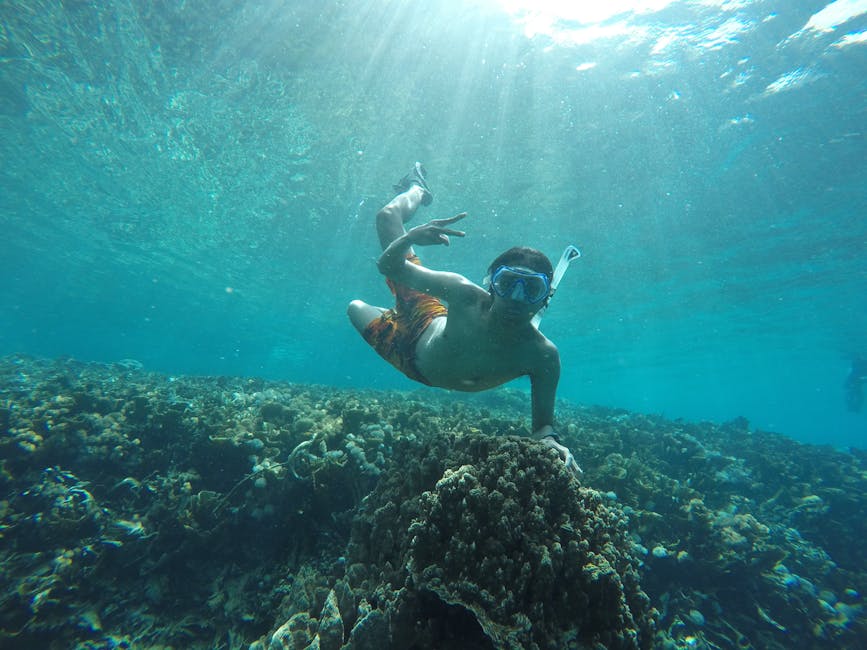
The horizontal body position. This is the most protective snorkelling posture and simultaneously the most efficient. When your body is horizontal and your fins are just below the surface, your fin tips are in open water, not near the reef. The common alternative — a slightly diagonal posture with the head high and the feet low — puts your fins deep in the water column, where they’re much more likely to contact reef structure as you swim over it.
The slow kick. Fast, energetic fin kicking creates turbulence that extends several fin-lengths behind you. Slow, deliberate strokes minimise the disturbed water zone. In the vicinity of coral — particularly when you’re hovering over a specific section to look at something — switch to minimal, controlled movements or stop kicking entirely and use your arms to adjust position.
Standing up. This one is simple and almost entirely avoidable: don’t stand on the reef. This seems obvious but the number of snorkellers I’ve observed standing on coral when they want to adjust their mask, clear their snorkel, or take a rest is consistent enough to be worth stating plainly. If you need to stand up, find sand. Coral that has been stood on is dead coral. Branching coral under the weight of a person breaks at the base. Massive coral under repeated foot contact has its tissue killed by the pressure and the bacteria transferred from human skin.
Sunscreen. Oxybenzone and octinoxate — two of the most common UV-filtering chemicals in conventional sunscreen — are toxic to coral at concentrations that accumulate at popular reef sites. The mechanism involves disrupting coral reproduction, increasing coral bleaching susceptibility, and causing developmental abnormalities in juvenile coral. At Lady Elliot, Heron Island, and an increasing number of Queensland operators, reef-safe sunscreen (mineral-based, using zinc oxide or titanium dioxide) is provided or required. Use it, or wear a rash vest and eliminate the issue entirely.
Feeding fish. Don’t. Feeding fish bread, chips, or other food changes their natural behaviour, creates nutritional deficiencies, and in some cases causes direct harm. It also habituates fish to human presence in ways that can produce aggressive behaviour — I’ve been charged by large wrasse that had been conditioned to expect food from snorkellers and became agitated when none appeared. The fish that seems to be performing for you is actually doing something quite different.
What You Can Do That Actually Helps
The most valuable thing most snorkellers can do for reef conservation, beyond minimising their own impact, is generate the kind of economic and political support that makes conservation possible.
Choose operators with genuine environmental credentials. The Advanced Ecotourism Australia certification is meaningful. Operators who invest in staff training, who brief snorkellers properly on reef interaction, who participate in monitoring programs, and who advocate for water quality and climate policy are using their commercial presence to support reef health rather than extract from it.
Report what you observe. Most major operators have mechanisms for guests to report unusual sightings: crown-of-thorns starfish aggregations, coral bleaching, unusual marine life encounters. This citizen science data contributes to management decisions and population monitoring programs that academic researchers cannot cover at the necessary scale alone.
Support reef science funding. The organisations doing the fundamental work — the Australian Institute of Marine Science, the ARC Centre of Excellence for Coral Reef Studies at James Cook University, the Great Barrier Reef Marine Park Authority — are funded by government and private sources, and their funding levels are variable. Being aware of this, caring about it, and communicating it as a voter matters.
The Optimistic Case
I want to be clear that the reef degradation I described at the opening of this article is not the only story available.
I’ve snorkelled sections of the GBR that have visibly recovered from past disturbances. I’ve seen young coral colonies, pale pink and white, establishing on substrate that was bare rubble three years ago. I’ve been on reefs where the snorkeller briefing was so thorough and so well-received that I observed, over the course of a day, several hundred people in the water without a single fin contact with coral.
The reef’s resilience is real. It functions in the presence of human visitors when those visitors behave well and when the broader conditions — water quality, ocean temperature — allow it. The changes necessary for that situation to be stable are large in policy terms and small in personal terms. The personal terms are: float horizontal, kick slow, use mineral sunscreen, don’t stand on coral, don’t touch the animals.
Start there. Do it every time. Every person who does makes the reef slightly more able to be the place you came to see.