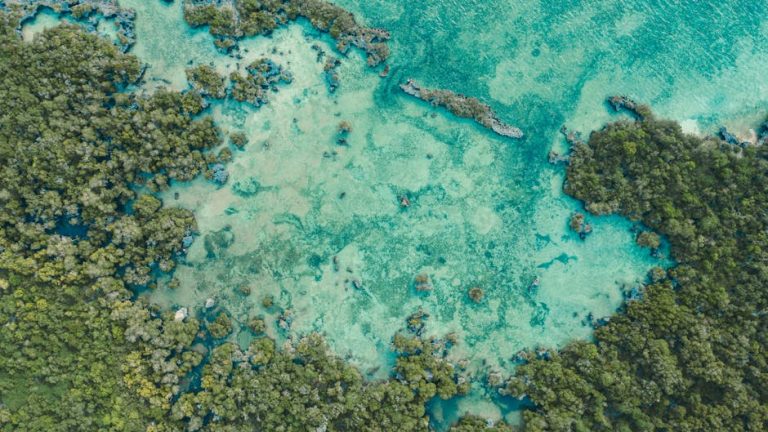
There’s a stretch of Queensland coast, roughly halfway between Cairns and Townsville, where the reef comes closer to shore than almost anywhere else on the GBR, where the rainforest comes down to meet the beach, and where the tourist infrastructure is deliberately minimal. The locals have fought hard to keep it that way.
Mission Beach is a loose collection of small communities — Bingil Bay, Mission Beach village, Wongaling Beach, South Mission Beach — spread across 14 kilometres of largely undeveloped beachfront. The beach itself, when you see it for the first time, is arresting: long, curved, grey-gold sand backed by coconut palms and rainforest, with the Coral Sea in front and, on clear days, the Dunk Island silhouette in the middle distance.
The Reef from Mission Beach
The Outer Reef at this latitude is 50km offshore, accessible on day trips with Calypso Snorkel and Dive, who run small-boat operations to sites that the Cairns day-trip market never reaches. On a typical day on the outer reef from Mission Beach, you might share the site with one other boat. On the outer reef from Cairns in peak season, you share it with twenty. The reef is the same reef. The experience is different.
Cassowaries
Mission Beach has the highest density of southern cassowaries of any accessible location in Australia. These prehistoric-looking birds — large, flightless, with a brilliant blue neck and a bony casque on the head — wander through gardens, cross roads, and occasionally appear on the beach. They are listed as endangered, and Mission Beach’s position at the edge of remaining cassowary habitat makes encounters common enough that local accommodation providers give guests cassowary encounter briefings alongside the beach safety information.
I’ve seen cassowaries perhaps twenty times over various visits to Mission Beach. Each time, the scale of the bird — an adult stands 1.8 metres and weighs 60 kilograms — and the quality of its indifference to my presence produces the same mild astonishment. The Licuala fan palm forests around Mission Beach village are the best place to look, early morning, along the walking tracks through the palms.
White Water Rafting
The Tully River, 40 minutes south of Mission Beach, runs through one of Australia’s wettest catchments and produces world-class grade-four whitewater rafting year-round. The combination of a morning on the Tully rapids and an afternoon on Mission Beach produces a day that covers about as much of Queensland’s natural range as a single day can.
Practical Notes
Mission Beach is accessible by bus from Cairns (2.5 hours) or by driving the Bruce Highway south. The town has no traffic lights, one main supermarket, and a small cluster of restaurants around the beachfront. The stinger risk is significant during the wet season — stinger suits are available at most accommodation and are strongly recommended from October through May.