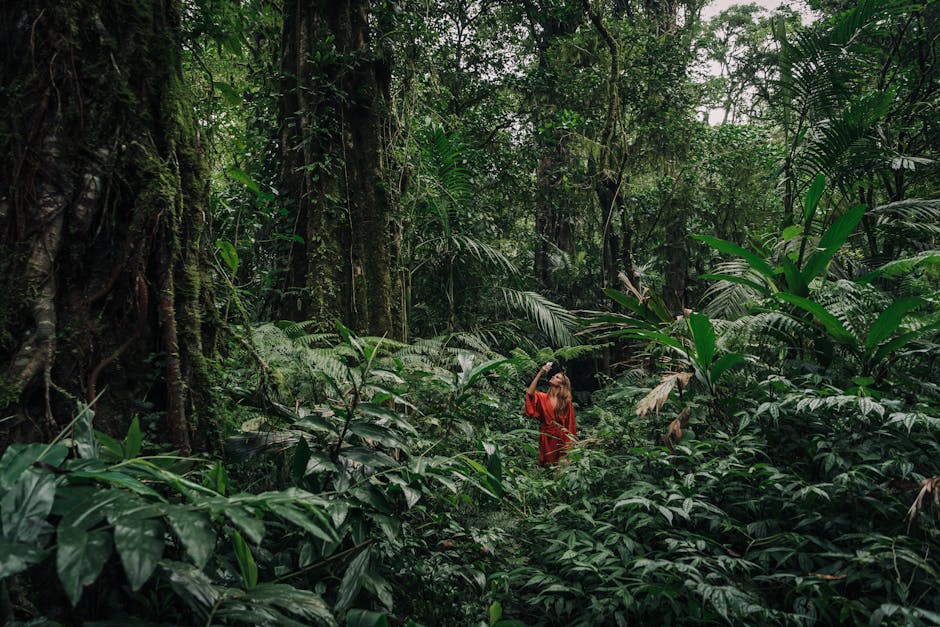
The Wet Tropics of Queensland covers about 900,000 hectares of rainforest along the northeastern coast between Cooktown and Townsville, and it is older than the Amazon. That sentence sounds like a promotional claim. It isn’t. The Wet Tropics contains plant families whose evolutionary lineages predate the flowering plants — families that were present on the supercontinent Gondwana when Australia was still attached to Antarctica. Walking through it, you are walking through 135 million years of botanical continuity.
I find this easier to believe in the rainforest than in almost any other landscape I’ve been in. The density of the vegetation, the layered canopy, the particular quality of silence broken by bird calls that have no equivalent in the temperate world — it has the feeling of somewhere that has been doing this for a very long time.
The Daintree: Starting Point
The Daintree National Park, north of the Daintree River crossing 110 kilometres north of Cairns, is the most accessible section of the Wet Tropics for visitors based in Cairns or Port Douglas. The drive from Port Douglas to Cape Tribulation — crossing the Daintree River by cable ferry, then following the single sealed road through the forest to the coast — takes about 90 minutes and delivers you to the point where the rainforest and the reef share a coastline.
The Jindalba Boardwalk at Cape Tribulation is the short walk (1.2km, forty minutes, entirely flat) that introduces the forest. It loops through lowland rainforest on a raised timber boardwalk — an important design choice that protects the shallow root systems of rainforest trees, which grow in a thin layer of nutrient-poor soil and are easily compacted by foot traffic. In forty minutes you’ll see lawyer cane, fan palms, strangler figs in various stages of host tree consumption, and if you’re patient and quiet, the birds that move through the forest understory.
The Dubuji Boardwalk, accessible from the Cape Tribulation beach car park, is shorter still (1.2km) and passes through a mangrove system at the interface of the forest and the ocean. This ecotone — where the forest meets the tidal saltwater — is ecologically extraordinary and visually distinctive: the knee-root and pencil-root structures of mangrove trees rising from the intertidal mud, the specific light quality of a canopy over tidal water.
Mount Sorrow Ridge Track
For visitors who want something genuinely demanding, the Mount Sorrow Ridge Track is the Daintree’s most rigorous walk: 7.2 kilometres return, 600 metres of elevation gain, technical in sections. The track begins near the Thornton Beach rest area and climbs through lowland rainforest into montane forest, then to a ridge viewpoint that gives the kind of view — forest canopy extending to the coast, the reef visible beyond the beaches — that the easier walks don’t reach.
The climb is steep enough that most visitors take four to five hours for the return trip. The descent is harder on the knees than the ascent. Start early — the track is best done in the cooler morning hours and before the afternoon heat, which in the Daintree between October and March is substantial. Bring more water than you think you need.
The montane forest at higher elevation has a different character from the lowland: mossy, cloud-affected, with tree ferns in the gully sections and the specific cool-air quality of elevation gained through tropical forest. The cassowary population in the Daintree is concentrated in the lowland sections; you’re unlikely to see one on this track but the signs — the three-toed footprints in the mud, the large scats full of fruit seeds — are present.
Mossman Gorge
The Mossman Gorge Circuit (2.4km, one hour, easy) is the most accessible rainforest walk in the region: a sealed path from the Mossman Gorge Centre (run by the Kuku Yalanji Traditional Owners, entry by shuttle bus from the centre) that loops through the gorge forest above the Mossman River. The river is swimmable in the calm pools below the gorge proper — cold, clear, with a granite bottom and the deep green of overhanging forest reflected in the surface.
The Kuku Yalanji guided tours, offered from the Mossman Gorge Centre, cover the cultural significance of the gorge and its plants that the self-guided walk doesn’t reach. If you’re in the region for more than a day trip, the guided tour is worthwhile — the Kuku Yalanji relationship with this forest extends tens of thousands of years, and walking through it with that context produces a different experience from walking through it as a nature tourist.
Mount Bartle Frere
Mount Bartle Frere, at 1,622 metres, is the highest peak in Queensland. The summit track is one of the most demanding day or overnight hikes in the Wet Tropics: 15 kilometres return from the Josephine Falls trailhead, gaining 1,600 metres of elevation through multiple distinct vegetation zones — lowland rainforest, montane cloud forest, subalpine heath at the summit.
The summit is frequently in cloud and the approach requires a creek crossing that becomes impassable in heavy rain. The track is technically demanding in its upper sections and disorienting in fog — which is the normal condition of the upper mountain. Navigation experience is useful. The summit register has entries from people who turned back below the cloud and entries from people who pushed through and emerged above it into the specific clarity of tropical summit sky.
I’ve been to the summit once. The day happened to be clear and the view — the Atherton Tablelands to the west, the Coral Sea to the east, the forest canopy covering everything between — was the kind of view that makes a difficult climb feel entirely justified. I would do it again without hesitation, with the qualification that I would check the weather more carefully and start at first light.
Wildlife in the Wet Tropics
The Wet Tropics has four species of tree-kangaroo (the only macropods that live in trees), the southern cassowary (Casuarius casuarius johnsonii) — a large, flightless bird with a casque on its head and claws capable of serious injury, which is also a critical seed disperser for the forest — and a cast of endemic birds that draw dedicated birders from across the world.
The cassowary is the one most visitors most want to see and the one that’s most likely to cause injury if approached incorrectly. The protocol: don’t approach, don’t feed, don’t get between a female and her chicks or a male and his chicks (males raise the young). If a cassowary approaches you, back away slowly. They are curious animals and occasionally approach humans, which is not an invitation. The Wet Tropics is cassowary country; behave accordingly.
Josephine Falls, near the Bartle Frere trailhead, is worth the stop regardless of whether the mountain is the objective. The falls cascade through a series of natural granite slides and pools — swimming is possible in the main pool at the base, which has the specific cold-water-in-hot-climate quality that makes rainforest swimming one of the finer experiences in Queensland. On a warm afternoon after a rainforest walk, it’s close to perfect.