Palau made a decision in 2020 that I think about regularly when I’m underwater on any reef anywhere in the world. The government declared the entire exclusive economic zone — 600,000 square kilometres of Pacific Ocean — a fully protected marine sanctuary. No commercial fishing. No fish exports. The ocean around Palau, to its 200-mile limit, is protected.
This decision was made by a small island nation of approximately 18,000 people, with a fishing industry that had employed hundreds of people and generated significant revenue. The government did it anyway, on the basis that the reef is worth more intact — economically, ecologically, culturally — than exploited.
The diving in Palau reflects this decision in ways you can measure underwater.
The Palauan Archipelago
Palau is an archipelago in the western Pacific, approximately 800 kilometres east of the Philippines and 1,500 kilometres south of Japan. It comprises over 500 islands — mostly small, forested, surrounded by reef — concentrated in a roughly 200-kilometre chain from north to south, with the main diving areas around the southern island cluster called the Rock Islands.
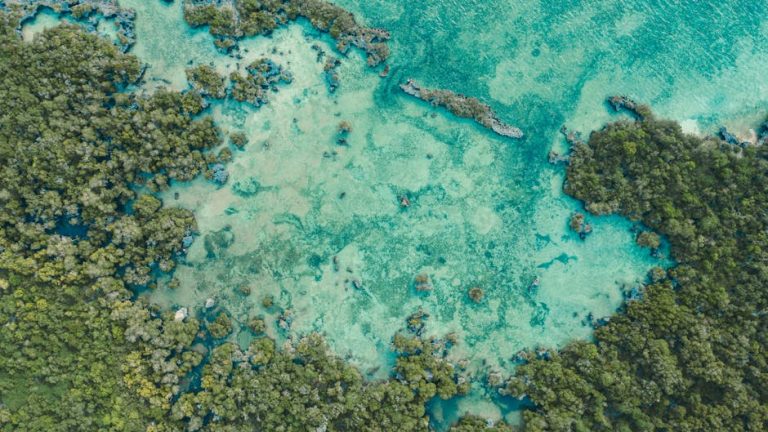
The Rock Islands are a UNESCO World Heritage Site: 445 mushroom-shaped limestone islands rising from the blue water, their underwater limestone bases eroded by wave action and marine organisms into the narrow waist that gives them their distinctive shape from above. The water in the channels between the islands, sheltered from the open Pacific, is extraordinarily clear — visibility of 30 to 40 metres is normal.
Blue Corner: The Standard of Comparison
Blue Corner is the site that divers who have been to Palau mention first, and it has been mentioned first for decades — it first appeared in diving publications in the 1970s and has maintained its reputation without interruption since.
The site is a submerged plateau on the outer reef edge of the Rock Islands, positioned to intercept the current that flows along the reef wall. In strong current, the protocol involves hooking a reef hook — a blunt hook attached to your BCD by a short line — into a section of dead coral at the plateau edge, and hanging there as the current presses you horizontal, watching the reef. The fish come to you.
What comes: grey reef sharks in numbers that constitute the densest reef shark aggregation I’ve encountered outside the very remotest Coral Sea sites. White-tip reef sharks resting on the plateau. Napoleon wrasse of impressive size. Schools of barracuda that arrive in tight formation and dissolve into individual fish and reform continuously. Eagle rays, occasionally in groups of several. In certain seasons, hammerhead sharks in the deeper blue water below the plateau edge.
Blue Corner in strong current, with a group of divers hooked in and watching the sharks circle, is the most specifically exhilarating reef dive I know. Nothing exactly like it exists elsewhere.
Jellyfish Lake
On the island of Eil Malk in the Rock Islands, a landlocked marine lake is connected to the ocean only by channels through porous limestone. Over thousands of years, the jellyfish trapped in the lake — Mastigias papua etpisoni — have evolved in the absence of predators to lose most of their stinging capability. The lake contains approximately ten million of them.
Snorkelling through Jellyfish Lake is an experience that operates in a completely different register from reef diving. The jellyfish move toward the sunlit side of the lake during the day, following the light, and the snorkeller moves through a golden, translucent, pulsing mass of animals that drift around and past and through your outstretched hands. They’re soft, warm, harmless. The sensation is somewhere between peculiar and transcendent.
Access is managed strictly — numbers per day are limited, scuba diving is prohibited (the deeper water contains hydrogen sulphide that would be released by divers), and a landing fee applies. The fee and the permit system maintain the lake’s integrity. Pay it.
German Channel: Mantas
German Channel is a dredged passage through the reef created by the Germans in the early colonial period to allow shipping access to a phosphate mining operation. The channel has become one of the most reliable manta ray cleaning stations in the Pacific — the current through the channel consistently brings plankton, and the cleaning stations on the channel walls are active year-round.
The manta encounters at German Channel are sustained and close. The animals hover above the cleaning stations in the channel current, and the diver who positions correctly and remains still can observe the cleaning cycle for extended periods. It’s the same quality of encounter as Lady Elliot Island at its best, with the added character of the Palauan reef community surrounding it.
Palau in Context
Palau is a difficult flight from Australia — typically routing through Tokyo, Guam, or Manila, with total journey times of 12 to 18 hours depending on connections. It is not a casual destination from an Australian east coast base.
What it offers in exchange for the logistics: diving of consistent world-class quality, across a variety of site types (current dives, wall dives, wreck dives from World War II — Palau was the site of significant naval combat and the wrecks are numerous and well-colonised), in an ocean environment managed with the specific intent of maintaining its ecological integrity.
The September to November period produces the clearest visibility and the most reliable calm conditions. The peak season from July through September sees the most visitors but also the best weather. December through April can bring rougher conditions but the diving remains good on the sheltered sites.
Stay at least a week. Blue Corner, Jellyfish Lake, German Channel, and the various wreck sites each deserve multiple visits. Palau is the kind of place where seven days produces an adequate introduction and a strong reason to return.
The reef hook will be waiting for you. So will the sharks.