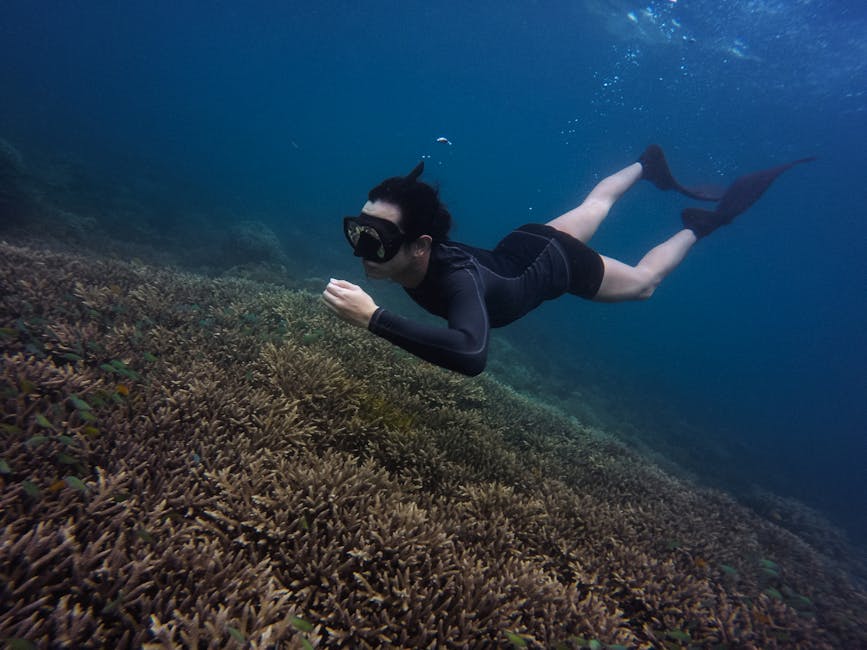
Night snorkelling is the reef experience most people don’t know they can have.
Scuba divers talk about night diving as if it’s an advanced activity requiring significant training and nerve. Snorkelling at night is considerably more accessible than that — you need a waterproof torch, a rash vest, and the willingness to put your face in dark water — and what you find when you do it is a reef so different from the daytime version that experienced snorkellers consistently describe their first night session as the most surprising reef experience they’ve had.
I did my first night snorkel from the beach at Heron Island, in the lagoon, at around 9pm on a calm autumn night. The water was flat, warm, and completely black beyond the reach of my torch beam. Within two minutes, I had found a Spanish dancer nudibranch the size of my hand, glowing deep red in the torch light. Within five minutes, a spotted eagle ray passed below me, its wing edges luminescent in the torchlight. I floated there for an hour and came out with the slightly shaken feeling of someone who has just been informed that a world they thought they understood is significantly larger than they thought.
Why the Reef Changes at Night
The shift between the reef’s day and night communities is one of the most dramatic ecological transitions in the natural world, and it happens over about twenty minutes at dusk.
The day shift — parrotfish, surgeonfish, wrasse, butterflyfish, damselfish — retreats to shelter. Parrotfish wedge themselves into crevices and produce a mucus cocoon around their bodies that may protect them from predators or parasites while they sleep. Wrasse bury themselves in the sand. The reef, from the surface, goes still.
Then the night shift arrives. Octopuses emerge from their dens and begin hunting across wide areas of reef and sand. Lobsters and crabs move freely across open substrate they would never risk during the day. Moray eels leave their crevices and swim in the water column with a sinuous motion that is startling in open water. The corals themselves change: polyp tentacles extend across the entire surface of hard coral colonies, transforming what appears smooth and rocky during the day into something soft, textured, alive.
And in the water column above the reef, creatures you’d never see during daylight: small squid hunting in groups, drawn to the surface by the plankton that rises on nightly vertical migration. Tiny shrimp with eyes that glow red-orange in a torch beam, drifting in clouds. The occasional small cuttlefish pulsing with chromatic displays as it hunts.
What You Need
A torch. This is the non-negotiable item. It needs to be genuinely waterproof (rated to at least one metre, preferably deeper), reasonably bright — at least 500 lumens — and reliable. I carry a backup torch in a pocket when night snorkelling, which is probably excessive for calm lagoon snorkelling but has saved two sessions from ending early.
The torch serves two purposes: it illuminates what you’re looking at, and it restores the colours that are absent at night without artificial light. Below the surface at night, your torch beam shows the same saturated colours you see on a shallow reef in sunlight — the vivid reds and oranges that water absorbs rapidly in natural conditions are fully restored. A flame-coloured nudibranch at night, in a torch beam, looks different from — and arguably more spectacular than — the same animal in daylight.
Everything else is the same as day snorkelling: mask that fits, fins, a wetsuit or rash vest for warmth (water feels cooler at night, partly because you’re not warmed by sunlight from above), and ideally a float belt or vest that removes the effort of staying at the surface.
Choosing the Right Conditions
Night snorkelling is best in calm conditions. Chop and surge, difficult in daylight, are significantly more disorienting at night when you cannot see what the water is doing beyond your torch beam. Choose calm, sheltered sites: lagoons, protected bays, areas behind reef structure that block swell.
The tidal state matters. High tide, or a rising tide, is generally better for night snorkelling than low tide for two reasons: more water over the reef means more swimming space and less chance of contact with coral, and the incoming flow tends to bring cleaner, clearer water onto the reef.
Moonlight is your friend and your enemy simultaneously. A full moon provides enough ambient light to see your surroundings without the torch — which is atmospheric and pleasant. It also means the plankton bloom that attracts squid and the small fish that attract larger predators to the surface is less concentrated, because plankton rise more in darker conditions. The best bioluminescence — if that’s part of what you’re hoping for — occurs on moonless nights.
Bioluminescence
In certain conditions — warm water, high plankton density, calm conditions, darkness — the disturbance of water by movement triggers bioluminescence: the production of cold blue-green light by dinoflagellates and other organisms that flash when mechanically disturbed.
Snorkelling through bioluminescent water at night is genuinely one of the more magical experiences the ocean offers. Every movement of your hands, every fin stroke, every bubble from your exhale glows briefly. Fish moving through the water leave bioluminescent trails. A turtle, if you’re lucky enough to have one pass below you, appears briefly outlined in cold blue light.
Bioluminescence is unpredictable. It occurs in Australian tropical waters most commonly in late summer, in sheltered bays with high plankton productivity. It’s not guaranteed and cannot be reliably sought out — it finds you when conditions are right.
Safety Considerations
Night snorkelling requires a little more awareness than the daytime version.
Stay close to shore in unfamiliar conditions. The inability to see the full reef topography around you means you can drift further than intended without noticing. Check your position relative to the shore or the boat regularly by lifting your head and looking around.
Avoid night snorkelling alone. This rule is essentially absolute. A snorkeller who gets into difficulty at night — cramp, disorientation, equipment failure — is far harder to locate and assist than during the day. Two people minimum, preferably with a light attached to each person’s back or snorkel so you’re visible to each other at the surface.
Be aware of the marine life that uses the same shallow areas at night. Stingrays rest on sandy areas that are accessible to snorkellers, and they are harder to see in torch-lit water than in natural daylight. The shuffle walk — sliding feet along the sand bottom rather than stepping — applies equally at night.
Cone shells are active at night. They’re stunning to observe with a torch beam; don’t handle them regardless of how beautiful they are.
Everything else about night snorkelling is simply the daytime version, conducted in the dark, with a torch, in the company of a completely different community of animals. The reef is more than twice as large as most people think it is, because most people have only seen half of it.
Go at night. Bring two torches. Stay close to your companion. Watch what happens when the day shift goes home.