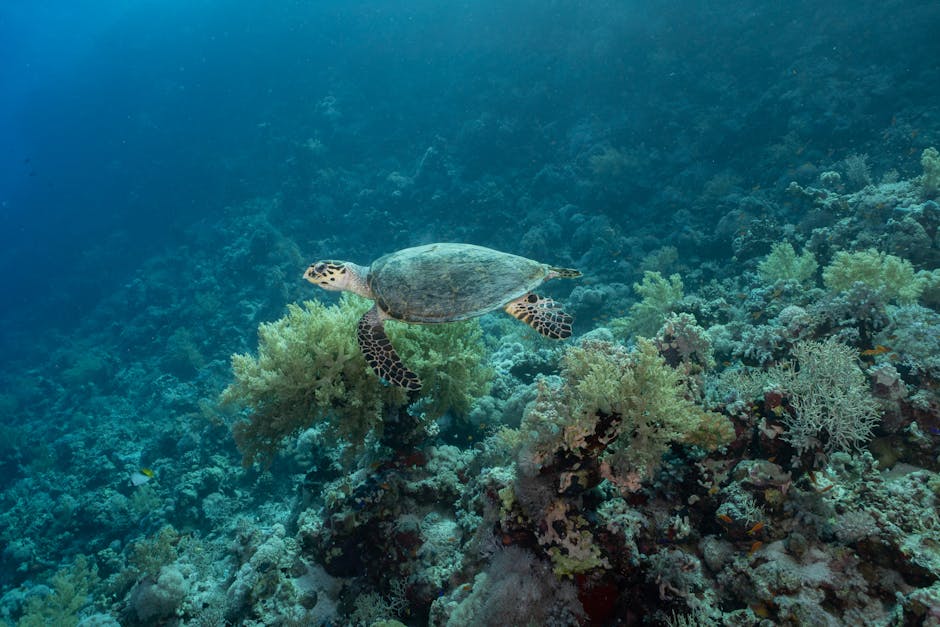
I spent an entire dive once watching a hawksbill turtle eat a sponge.
This sounds like it might be a dull dive. It wasn’t. The turtle worked methodically along a section of reef wall, using its narrow, pointed beak to excavate sponge from crevices, pulling out chunks and chewing them with a patience that I found, for reasons I can’t fully articulate, deeply compelling. It wasn’t hunting in any dramatic sense. It was grazing, maintaining something — its own nutrition, yes, but also, as I later understood better, the reef’s structural balance.
Hawksbill turtles are one of the only animals on Earth that eat sponges in quantity. Sponges, left unchecked, grow over and smother coral. By eating sponges, hawksbills prevent one of the reef’s most aggressive space competitors from dominating the substrate. The turtle I was watching was not just eating. It was gardening.
That’s what a coral reef is, fundamentally: an interlocking system of gardeners.
Primary Production: Where the Energy Comes From
All energy in a coral reef ecosystem originates from two sources: sunlight captured by photosynthesis, and organic matter imported from the surrounding ocean.
The photosynthetic producers are the zooxanthellae algae living within coral tissues, the crustose coralline algae that cement the reef structure, the turf algae covering available substrate, the seagrass beds in adjacent shallow water, and the phytoplankton in the water column. These organisms convert solar energy into organic compounds — carbohydrates, lipids — that become the foundation of the food web.
Primary consumers — the herbivores — are the animals that eat these producers directly. On a coral reef, the dominant herbivores are parrotfish, surgeonfish, rabbitfish, and sea urchins, all of which graze algae from the reef surface and play a critical role in preventing algae from overgrowing and smothering coral. Parrotfish in particular are extraordinary reef engineers: their beak-like, fused teeth scrape algae from the surface, and in the process they ingest carbonate material from the reef structure itself. They excrete this material as fine white sand — the brilliant white sand of tropical beaches and lagoons is, to a significant degree, parrotfish excrement. A single large parrotfish can produce hundreds of kilograms of sand per year.
The Middle Trophic Levels
Secondary consumers — animals that eat the primary consumers — include the smaller predatory fish: wrasse that prey on invertebrates, small grouper that ambush reef fish, lionfish that hover over the reef and strike small fish with extraordinary speed, large triggerfish that prey on sea urchins. These animals regulate herbivore populations and prevent any one grazing species from becoming dominant.
This middle level of the food web is the most species-rich on any tropical reef. The GBR’s 1,625 fish species are mostly concentrated here — the enormous diversity of reef fish that makes coral reef diving so visually compelling is primarily an expression of the number of different ecological niches available in the complex three-dimensional structure of a coral reef. Each niche — a specific food source, a specific shelter type, a specific depth — supports its own specialist, and millennia of evolution has filled those niches with extraordinary precision.
Apex Predators and Their Role
At the top of the food web sit the apex predators: the sharks, large grouper, barracuda, and other animals that hunt the mid-trophic predators and larger fish. Their role in the reef ecosystem is more important than their numbers suggest.
The concept of a trophic cascade — where changes at the apex of a food web produce effects that ripple all the way down to the bottom — is well-documented in coral reef systems. Studies comparing reefs with intact shark populations to reefs where sharks have been fished out consistently find that the shark-depleted reefs have different fish community compositions, higher densities of mid-level predators, altered herbivore populations, and in some cases reduced coral cover as a downstream consequence of changes in the grazing regime.
The removal of a single species from the apex can restructure an entire ecosystem. This is not theoretical. It’s been observed directly on reefs throughout the Caribbean and Indo-Pacific where shark populations have been reduced by decades of targeted fishing.
Cryptic Communities: The Invisible Majority
The fish and turtles and sharks are the visible part of a reef community. The invisible part is, by numbers of individuals and species, far larger.
The cryptic invertebrate community — the sponges, worms, crustaceans, echinoderms, molluscs, and cnidarians living in the rubble, under ledges, within the coral structure itself — represents the majority of reef biodiversity. A single large coral head can harbour hundreds of species of invertebrate within and beneath it: boring sponges dissolving calcium carbonate from the inside of living coral, polychaete worms extending filter-feeding tentacles from tubes, small crabs maintaining permanent residency in specific coral branches, cleaning shrimps operating stations that serve fish coming to have parasites removed.
The coral structure is not just a substrate. It is habitat organised through millennia of co-evolution into something resembling a city — every surface occupied, every architectural niche utilised.
What Happens When the Reef Is Damaged
A bleached or degraded reef doesn’t just look different. It functions differently. The specific pathways of energy flow change when key species are removed or when the coral structure that provides habitat is compromised.
The clearest example: when branching Acropora corals die after bleaching, the small fish species that shelter within them — tiny damsels, juvenile wrasse, cardinal fish — lose their refuge. Predation pressure on these species increases immediately. Within months of a major bleaching event, fish diversity surveys on affected reefs begin to show declines in the specialist species.
As the fish community changes, the grazing regime changes. Different species of herbivore feed differently — some graze algae selectively, others non-selectively — and changes in herbivore community composition affect which algae dominate the bare substrate left by dead coral. On reefs where herbivore populations are also depleted by fishing, macroalgae can establish rapidly on dead coral skeletons and prevent coral larvae from settling, locking the reef into a degraded state.
Recovery requires not just the physical return of coral cover but the reassembly of the whole functional community. Fish, invertebrates, algae, and coral need to return in the right proportions and the right relationships. This process takes years to decades under the best conditions.
Why the Food Web Matters to Divers
Understanding the trophic structure of a reef changes what you see when you’re underwater. The parrotfish grazing on the reef top isn’t scenery — it’s a critical ecosystem service, the engine of reef renewal. The hawksbill eating sponges is not engaging in an arcane dietary preference — it’s maintaining the competitive balance between reef-builders and reef-suppressors. The grey reef sharks circling the outer wall are not dangerous neighbours to be avoided — they are the structural element that keeps everything below them in its proper proportion.
A reef is not a collection of species. It’s a system of relationships.
The more you understand those relationships, the more you see when you’re in the water, and the more clearly you understand why all of it — from the sharks at the top to the zooxanthellae at the base — needs to stay intact.