Osprey Reef is three hundred and fifty kilometres from the Queensland coast, and getting there requires a night crossing of open ocean on a liveaboard. I’ve done that crossing four times. Each time, I’ve woken to the same thing: blue water in every direction, no land visible anywhere, and a ring of breaking white foam on the horizon that resolves, as we approach, into the reef’s outer edge.
From the water, Osprey looks like what it is: an isolated atoll rising from the abyssal depths of the Coral Sea. The wall on its eastern face drops from two metres at the surface to beyond diving depth in one continuous vertical face. In good visibility — and visibility at Osprey in June is routinely 40 metres — you can see the wall curving away below you until it fades into deep blue.
I have dived a lot of places. Osprey is in the top five.
What the Coral Sea Is
The Coral Sea is the body of water bounded by the Queensland coast to the west, the Great Barrier Reef to the west and south, the Solomon Islands and Vanuatu to the north and northeast, and New Caledonia to the east. It’s a deep ocean basin — average depth around 2,400 metres — dotted with a series of isolated submerged seamounts, reefs, and atolls that rise from the seafloor to break the surface.
These structures — the Coral Sea atolls — were never connected to the Australian mainland and were never part of the continental shelf. They developed independently, from volcanic or carbonate foundations, over millions of years. Because they are remote, isolated, and historically difficult to access, they have been subject to far less human disturbance than the inshore reefs of the GBR. The result is reef ecosystems that more closely resemble pre-human baselines than anything accessible by day trip.
The major diving destinations in the Coral Sea are Osprey Reef, Bougainville Reef, Holmes Reef, and the Marion Reef system. All are accessible only by liveaboard from Cairns, on trips typically lasting five to seven days.
Osprey Reef: The North Horn
The site that defines Osprey for most divers is the North Horn — a promontory at the northern tip of the atoll where the reef wall meets open ocean and current-driven upwelling concentrates marine life in exceptional density.
The shark diving at the North Horn is simply exceptional. A resident population of grey reef sharks — typically 30 to 50 individuals visible on any given dive — is supplemented by silvertip sharks that patrol the wall just below the coral line, occasional hammerheads in the blue water beyond the reef edge, and, for divers who time their trips right, oceanic whitetips moving through from open ocean. Liveaboard operators have been conducting supervised shark interaction dives at the North Horn for decades, and the sharks are habituated to divers without being fed or conditioned in ways that alter their natural behaviour.
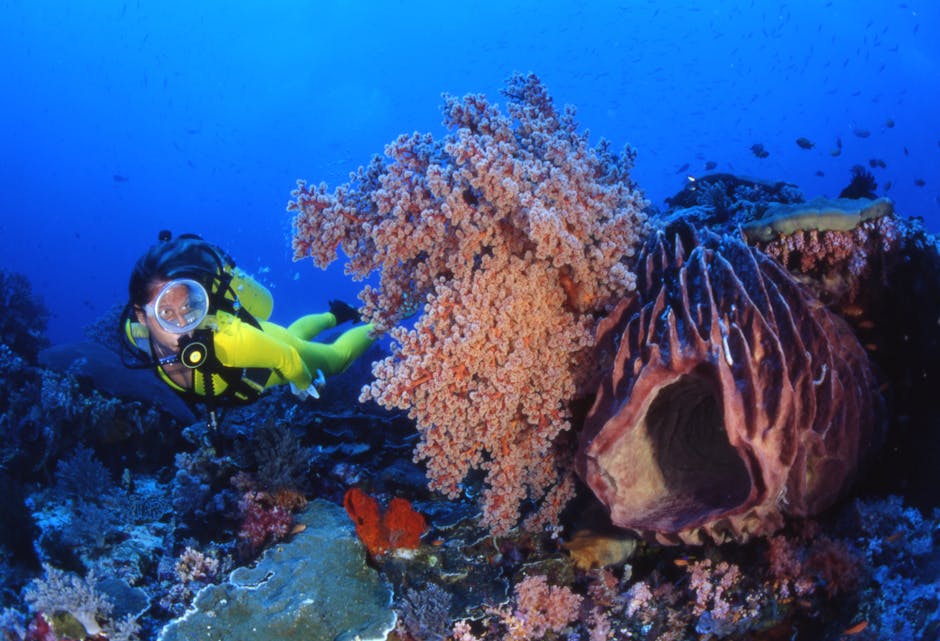
The wall diving on Osprey’s eastern and southern faces is, if anything, more impressive than the North Horn to me. The soft coral coverage — Dendronephthya species in orange, red, and white, sea fans of enormous size, black coral trees at depth — is dense enough that sections of wall are completely obscured by invertebrate growth. Fish diversity is extraordinary: a single dive on Osprey’s east wall might produce tuna, batfish, surgeonfish in schools of hundreds, humphead Maori wrasse, bumphead parrotfish, several species of large grouper, and a dozen species of reef fish in such abundance that the water is never empty.
Bougainville Reef
Bougainville sits roughly 250 kilometres northeast of Cairns, smaller and less visited than Osprey but producing excellent diving on its outer walls and the passages between the main reef and its satellite structures. The channel diving in the right tidal conditions produces drift dives with significant current and concentrated pelagic life — the sort of diving where you hold still and the ocean delivers things to you.
Bougainville’s shallow reef top — a broad, sunlit lagoon with exceptional hard coral coverage — is among the finest coral gardens I’ve seen in Australian waters. The Acropora tables here are large, old, and largely intact; a section of reef that evidently escaped the worst of recent bleaching events, possibly due to the atoll’s depth profile and water circulation patterns.
Holmes Reef
Holmes is the furthest of the three major Coral Sea diving destinations from Cairns — approximately 280 kilometres — and consequently the least frequently visited. The extra travel time is rewarded with dive sites in exceptional condition and, on the dives I’ve done there, a notable absence of other dive boats.
The lagoon at Holmes contains one of the finest coral gardens I’ve encountered anywhere in the Indo-Pacific. A shallow reef flat between three and twelve metres is covered in a community of hard corals — Acropora tables, massive Porites domes, dense Pocillopora thickets — of such variety and cover that it looks, from above, like a botanical garden. The fish community above this coral garden is correspondingly rich: a scene that feels less like a dive site and more like a time capsule of what pre-bleaching GBR reefs looked like at their best.
Staying Out There: What Liveaboard Life Is Like on Coral Sea Trips
A typical Coral Sea liveaboard trip runs five to seven days from Cairns. The vessel leaves port in the late afternoon, runs overnight to the Coral Sea, and arrives at the first dive site early the following morning. You dive three or four times per day, with night dives on most evenings. Surface intervals are spent eating, sleeping, reviewing photographs, and staring at the ocean.
The Coral Sea is not always calm. The crossing can be rough — the Coral Sea is an open ocean environment and it behaves like one. Divers prone to seasickness should come prepared, and should know that conditions on the reefs themselves are usually calmer than the crossing, as the atolls provide shelter on their leeward sides.
The best months for Coral Sea diving are June through October, when southeast trade winds produce the most stable conditions and the clearest visibility. The period between November and March brings the wet season, with increased chance of cyclonic weather that can disrupt or cancel trips.
Why Remote Matters
There’s a question that sometimes comes up among divers weighing up whether a Coral Sea trip is worth the cost and the travel: is it really that much better than the outer GBR?
My answer is: yes, consistently, noticeably. The combination of isolation, depth, and oceanic water clarity produces a diving environment that the inshore and mid-shelf GBR simply doesn’t replicate. The shark biomass at Osprey is an order of magnitude greater than anything accessible on a Cairns day trip. The wall diving clarity is in a different category. The absence of other dive boats changes the experience fundamentally.
The GBR is magnificent. The Coral Sea is the GBR’s wild, remote, uncompromised older sibling. If you can do both, do both. But if you can only do one, and you want to understand what a reef looks like when the ocean is still mostly in charge of it — go to the Coral Sea.