There’s a specific kind of frustration that snorkellers describe when they’ve been on a reef and feel like they missed something — that the guide pointed at something, or another snorkeller in the group surfaced talking excitedly about what they saw, and you were in the same water and saw nothing. You looked, but you didn’t see.
The difference between looking and seeing on a reef is entirely learnable. It’s not a talent. It’s a set of skills — knowing where to look, what to look for, how to slow down — that experienced reef people apply unconsciously and that beginners can consciously develop.
Understanding Reef Zones
A coral reef is not a uniform environment. It’s organised into distinct zones, each with its own physical character and its own animal communities. Knowing which zone you’re in tells you roughly what to expect to find there.
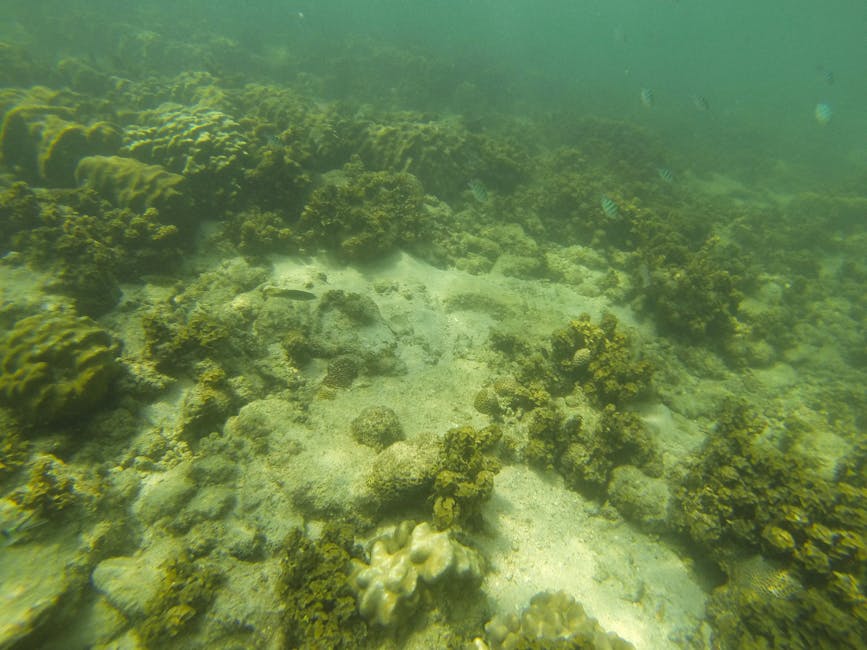
The reef flat is the shallowest section, often only one to two metres deep at high tide and exposed at low tide. It’s a high-energy environment — sun-exposed, affected by wave wash, with relatively simple coral structures that tolerate these conditions. Animals in the reef flat tend to be robust generalists: sea urchins, sea cucumbers, parrotfish grazing on the algae-covered rubble, the small damsels and wrasse that shelter in low coral formations. The reef flat rewards slow, patient looking at the substrate rather than scanning for large animals.
The reef crest is the outer edge of the reef flat, where the breaking waves arrive from open water. It’s the most physically dynamic part of the reef and hosts corals adapted to high wave energy — dense, compact growth forms rather than the branching corals that grow in calmer water. On the reef crest, look for schools of surgeonfish and snapper that feed in the surge, and for the territorial damselfish that defend patches of algae garden with surprising ferocity toward anything that enters their territory, including snorkellers.
The reef slope begins where the reef crest drops away into deeper water — typically from 3 to 20+ metres. This is where most of the structural complexity lives: branching Acropora corals, plate corals providing shelter below them, sea fans on the steeper faces, large bommies (isolated coral heads) rising from the sandy areas at the base. The reef slope is where you find the greatest fish diversity and the largest animals.
The sandy lagoon between the reef and the shore is often dismissed as featureless, which is a mistake. Sand patches between bommies harbour animals that have evolved specifically for this substrate: flatheads buried with just their eyes exposed, garden eels extending from their burrows in colonies that retract simultaneously as you approach, stingrays resting motionless on the sand and invisible until they move. Slow down on the sand and look at it.
The Art of Finding Camouflaged Animals
More than half the interesting animals on any reef are animals you initially cannot see. This is not because they’re hiding — it’s because they’ve evolved to be part of the background, and your visual system is not calibrated to find them without training.
The training is: slow down, and change what you’re looking for. Instead of scanning for things that look like animals, look for anomalies — textures or colours that are slightly wrong relative to their surroundings, shapes that don’t quite match the substrate, outlines that are almost organic but not quite.
Practical examples: a wobbegong shark is lying flat on the reef in plain sight — its patterned skin matches encrusted reef substrate so precisely that dozens of snorkellers may pass over it without recognition. A stonefish sits on rubble looking exactly like rubble. A hawkfish grips a coral branch with its pectoral fins and holds so still it could be a coral growth. A cuttlefish hovers beside a sea fan in colours that mirror the fan’s texture.
What reveals these animals: edges. The slightly-too-perfect oval outline of a flatfish against the sand. The edge of a frogfish’s body where the skin texture transitions from one camouflage pattern to another. The almost-too-still quality of an animal holding position among moving coral polyps.
The other technique: watch the behaviour of the animals you can see. Small fish hovering in a tight, nervous cluster near a section of reef are usually being held there by the presence of a predator they’re watching. Follow their gaze. A school of glassfish in a tight ball inside a coral formation is probably tight because a lionfish is in there with them.
Understanding Fish Behaviour
Fish on a reef are not decorative. They’re engaged in the same activities all animals are engaged in — feeding, defending territory, avoiding predators, reproducing — and their behaviour, once you start reading it, tells you what’s happening on the reef around you.
Cleaning stations are among the most rewarding things to find. A cleaning station is a specific spot — usually a prominent coral head or bommie — where small cleaner wrasse and shrimps set up permanent service operations, removing parasites and dead tissue from larger fish. The larger fish queue for service: they arrive, adopt a characteristic still posture with fins spread and often a pale colouration, and wait for the cleaners to work. You can identify a cleaning station by this behaviour — fish hovering in unusual postures, other fish approaching slowly from different directions.
Parrotfish feeding produces a distinctive sound: the crunching, scraping noise of parrotfish beaks removing algae (and sometimes coral) from the reef surface. If you hear a crackling sound underwater — which you will, once you know to listen for it — find the parrotfish making it. They’re almost always visually interesting: large, colourful, and in constant motion along the reef face.
Territorial damsels will charge your mask if you drift over their territory. This is worth knowing not just as a surprise-avoidance measure but as a clue: a damsel charging you means there’s a carefully maintained algae garden below you, which in turn means a section of reef substrate that’s been cleared of competing corals and maintained as a food source.
The Dive-Down
Snorkelling from the surface gives you a view. Duck-diving — holding your breath and descending two to four metres below the surface — gives you an experience.
The technique: take a deep breath, bend forward at the waist with your arms pointing downward, bring your legs up vertically above you, and let the weight of your legs drive you down. Equalise the pressure in your ears as you descend by pinching your nose and gently blowing. At two to three metres, your descent becomes self-sustaining — you’re denser than the water and will sink without effort.
At reef level, the perspective changes completely. You’re no longer looking down at the reef through several metres of water column — you’re in it, at eye level with the fish, able to look into crevices, able to see the underside of coral formations where the invertebrates cluster. The experience at two metres is qualitatively different from the surface.
Duck-diving to observe specific animals: approach from the side at shallow angle rather than from directly above. Animals on the reef surface perceive a vertical descent from above as a predator attack and leave immediately. An angled approach from the side is less alarming and produces longer, closer encounters.
The reef rewards the effort of getting closer to it. Almost everything interesting is in the bottom half of the water column, and the surface is just the beginning.