I’ve been “hypnotised” by a cuttlefish.
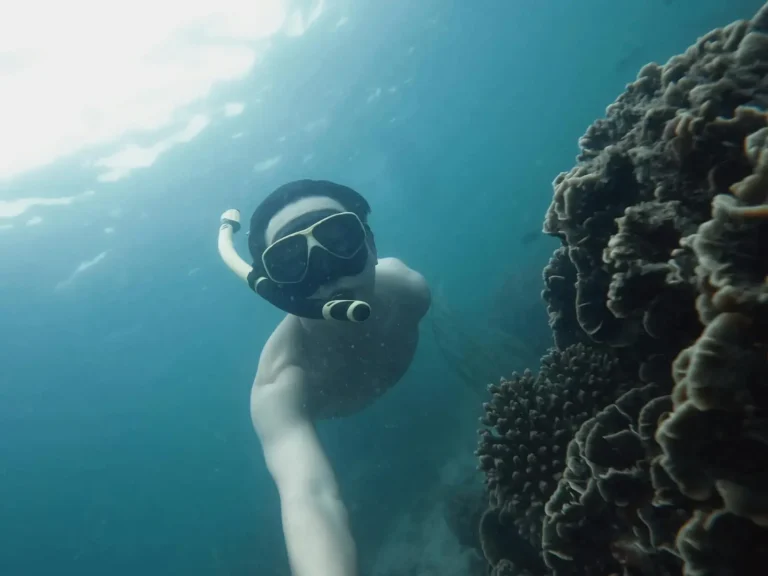
I mean this almost literally. I was snorkelling in a shallow bay near Whyalla in South Australia — home to the world’s largest aggregation of giant Australian cuttlefish during their winter spawning season — and I came face to face with a male, about forty centimetres long, hovering in the water column approximately half a metre away from me.
What happened next lasted perhaps ninety seconds. The cuttlefish changed colour. Not gradually — in pulses, waves, rapid flickering patterns that moved across its body from front to back like scrolling text. I watched bands of brown roll forward from its mantle, shift to orange, pale to cream, pulse dark again. One side of its body displayed an aggressive dark pattern toward a rival male on the left; the other side displayed a pale, calm pattern toward a female on the right — two completely different messages, delivered simultaneously, to two different recipients.
I watched this display with my face in the water, barely breathing, for the entirety of those ninety seconds. The cuttlefish never moved. It was performing something intricate and urgent. I was just the underwater furniture.
What Is a Cuttlefish?
Cuttlefish are cephalopod molluscs in the order Sepiida — related to octopuses and squid, and sharing with them the defining characteristics: a sophisticated nervous system, eight arms (plus, in cuttlefish, two additional feeding tentacles that can be retracted into pouches), chromatophores for colour change, and a level of behavioural complexity that continues to challenge our assumptions about invertebrate intelligence.
Unlike octopuses, cuttlefish have an internal shell — the cuttlebone familiar to anyone who has kept pet birds. The cuttlebone is a porous calcium carbonate structure that the cuttlefish uses as a buoyancy device, adjusting the ratio of gas to liquid in its chambers to maintain neutral buoyancy at any depth. The same structure that helps budgies with their beaks is the reason cuttlefish can hover so precisely in the water column.
There are approximately 120 recognised species of cuttlefish, found in coastal waters throughout the world with the notable exception of the Americas. The giant Australian cuttlefish (Sepia apama), at up to 50 centimetres in mantle length and weighing up to 10 kilograms, is the world’s largest cuttlefish species.
The Most Complex Communication in the Invertebrate World
The chromatophore system that cuttlefish use for colour change is broadly similar to that of octopuses — pigment cells that expand and contract under muscular control — but cuttlefish have additional elements: iridophores, which reflect light structurally and can produce iridescent colours independent of pigmentation, and leucophores, which reflect ambient light. The combination produces a dynamic colour display of extraordinary range and subtlety.
What makes cuttlefish displays remarkable is that they appear to be genuinely communicative. The patterns are not random or merely camouflage — they carry information. The Passing Cloud display (waves of dark pigment rolling across the body in sequence) appears to be used during hunting to mesmerise prey — mimicking the movements of a small invertebrate and capturing the attention of fish or crustaceans in a way that reduces their flight response long enough for the cuttlefish to strike.
During mating, males display chromatic patterns that signal their identity to females and aggression to rival males. The simultaneous two-sided display I witnessed — different patterns on each side of the body — has been documented in several cuttlefish species and appears to be specifically a response to having a rival on one side and a potential mate on the other. The neural control required to generate independent patterns on left and right body halves is not trivial.
Researchers have also documented cuttlefish “talking” to each other in patterns at low light, and recent work suggests that the polarised-light component of cuttlefish signals — invisible to most predators but detectable by other cuttlefish — may carry an additional layer of communication that we are only beginning to decode.
Intelligence and Learning
Cuttlefish have brains that are proportionally among the largest of any invertebrate. They demonstrate learning through observation, solving problems not by trial and error but by watching others first. In laboratory settings, juvenile cuttlefish that observed adult cuttlefish opening containers performed the task significantly faster than those who hadn’t observed the demonstration.
They also demonstrate self-control in ways consistent with planning and future-oriented thinking. In a study testing whether cuttlefish could delay gratification — eating a less preferred food now versus waiting for a preferred food later — cuttlefish consistently chose to wait for the better food, and those that waited longest also performed better on learning tasks. This parallels the “marshmallow test” in children and has been used to argue for executive function in cephalopod cognition.
Perhaps most strikingly, cuttlefish have a biological clock. Their feeding behaviour is time-sensitive — they adjust their eating in the hours before an anticipated feeding event, apparently anticipating a future meal. This episodic-like memory — the ability to remember what happened, where, and when — is a component of cognitive architecture once thought to be uniquely human.
The Giant Australian Cuttlefish Aggregation
Each year, between May and August, giant Australian cuttlefish migrate from offshore depths to the shallow rocky reef around Point Lowly, near Whyalla in South Australia’s Spencer Gulf, to breed. The aggregation, at its peak, involves tens of thousands of individual cuttlefish compressed into an area of reef a few kilometres long. It is the largest known spawning aggregation of any cuttlefish species in the world.
The ratio of males to females is typically four or five to one, which creates intense competition. Males range in size enormously — from large, dominant “guard” males that compete directly for females to smaller “sneaker” males that use a different strategy: disguising themselves as females. The disguise involves pale colouration, tucked arms mimicking the profile of a female, and a complete suppression of the dynamic display patterns that would identify them as male. A disguised sneaker male can approach a mating pair and, when the guard male is briefly occupied, dart in and mate with the female.
It is, by any measure, a rich and complex social environment.
The aggregation was declared an important ecological asset and efforts to protect it intensified after the population collapsed in the early 2000s — partly due to land-based industrial activities affecting water quality near the breeding site. Numbers have since partially recovered, and the aggregation is now one of the most remarkable wildlife spectacles in Australia. It is accessible to snorkellers; the water is cold (14–18°C) but shallow, and the animals are close. Wear a wetsuit. Take nothing but photographs.
Cuttlefish Hunting: The Hypnosis Theory Revisited
Return for a moment to the Passing Cloud display — the rippling dark wave that rolls forward across the body. Field observations and some controlled experiments suggest that this display, directed at fish or crustacean prey, genuinely captures their attention in a way that disrupts the normal escape response. The prey tracks the movement of the wave with its eyes, the cuttlefish creeps forward, and by the time the prey’s threat-detection system overcomes its tracking response, the two feeding tentacles have already fired.
The tentacles — stored invisibly in pouches beneath the head — can be deployed at speeds of up to 200 milliseconds. The accuracy is high: cuttlefish adjust their strike angle to compensate for the visual refraction caused by light passing from water to air at the surface. They know where the prey actually is, not where it appears to be from their position in the water. This correction for refraction requires knowledge of a basic property of optics applied to a moving hunting scenario.
This is not simple predatory behaviour. There is something going on behind those W-shaped pupils that we don’t have complete language for yet.
Where to Find Cuttlefish in Australia
Beyond Whyalla’s seasonal spectacle, giant Australian cuttlefish are found along the southern Australian coast throughout the year. Melbourne’s Port Phillip Bay, the waters around Kangaroo Island, and the rocky reefs of southern New South Wales all host resident populations that can be found by snorkellers and divers on any given dive.
Broadclub cuttlefish (Sepia latimanus) are common on tropical reefs throughout the Indo-Pacific — look for them in sand patches near reef edges at depths of 5–30 metres. Pharaoh cuttlefish (Sepia pharaonis) are abundant across the Indo-Pacific, particularly in the Coral Sea and northern Australian waters.
When you find one, slow down. Keep still. Watch what it does when it decides you’re not a threat.
It will show you things you weren’t expecting to see.