Raine Island is the most important sea turtle nesting site in the world. That sentence is not hyperbole — it’s the scientific consensus, backed by decades of monitoring data, and it describes a place that almost no recreational visitor has ever seen.
The island sits in the far northern Great Barrier Reef, 620 kilometres north of Cairns, on a remote platform reef accessible only by helicopter or vessel after a long offshore passage. It has no accommodation, no facilities for tourists, and access is strictly controlled by Great Barrier Reef Marine Park Authority permits issued almost exclusively to researchers. For the purposes of this article, I am writing about a place I have not visited — not for lack of wanting to, but because Raine Island’s conservation importance is precisely the reason it’s not open to casual tourism.
Understanding why this island matters is, I think, important context for anyone who cares about reef ecology and sea turtles.
The Scale of What Happens There
Between October and February — the green turtle nesting season — female green turtles (Chelonia mydas) arrive at Raine Island in numbers that are difficult to process. In peak seasons, up to 60,000 individual females have been recorded nesting on the island in a single season. On peak nights, thousands of turtles haul out simultaneously onto the beach, excavate nests, deposit their eggs, and return to the sea in a choreography that covers every accessible metre of the beach.
The island is approximately 32 hectares in area. When nesting is at its peak, the beach is so densely occupied by nesting females that later-arriving turtles excavate over the nests of earlier arrivals, disrupting the eggs. Hatchling mortality is high for the same reason — the sand is churned and reworked so intensively that many nests are destroyed before they can hatch.
These are not problems caused by humans. They are the consequences of biological success at extraordinary scale. Raine Island has been a green turtle rookery for thousands of years; the deep bowl of churned sand that constitutes the nesting beach has been built by the turtles themselves over generations.
The Conservation Challenge
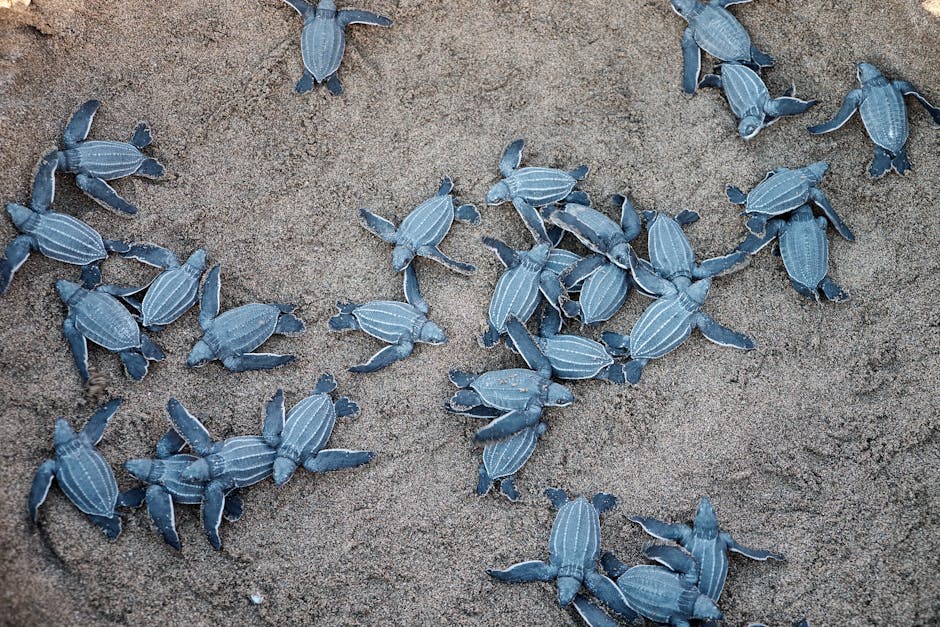
Despite its status as the world’s most significant green turtle nesting site, Raine Island has a serious and ongoing conservation problem: hatchling mortality. Research conducted from the 1980s onward identified that large numbers of hatchlings were dying before reaching the sea — not from predation, but from physical exhaustion, overheating, and entrapment in beach terrain that has become increasingly difficult to traverse.
The island’s beach is bounded on its seaward side by a rubble rampart — a ridge of broken coral rock pushed up by wave action — that hatchlings must climb and descend to reach the water. As the rampart has grown higher and steeper over decades (possibly due to changing wave climate related to sea level rise), the mortality of hatchlings attempting to cross it has increased. Many die at the base of the rampart or fall back to the beach.
The Raine Island Recovery Project — a collaboration between Rio Tinto, the Great Barrier Reef Marine Park Authority, Queensland Parks and Wildlife, and the Traditional Owners — has been working since 2014 to address this by physically modifying sections of the beach to create ramps and easier exit routes for hatchlings, and by directly rescuing hatchlings that become stranded at the rampart edge. Tens of thousands of hatchlings have been assisted to the sea as a result.
The project has also installed a permanent monitoring system — cameras, temperature loggers, and automated counting — that provides continuous data on nesting activity and hatchling success across the full season rather than the spot samples that earlier research relied on.
The Surrounding Reef
The reef platform on which Raine Island sits is also significant ecologically. The platform supports a healthy hard coral community and a reef fish biomass enhanced by the protection afforded by the island’s remote location and restricted access. The waters around Raine Island are a green turtle aggregation area throughout the breeding season — males congregating offshore waiting for nesting females, juveniles in the surrounding waters — and the density of turtles in the water on any given day is, by accounts from researchers who dive there, extraordinary.
The reef also supports populations of sharks, rays, and reef fish in condition consistent with an effectively unfished and low-disturbance site. It is, in this sense, another Coral Sea reference reef — a site whose biological richness reflects the absence of the pressures that have modified most accessible reefs.
How to Support Without Visiting
Raine Island is not a place you can go. It is, by deliberate policy, a place you support from a distance. The mechanisms for doing that are:
Donating to or volunteering with organisations participating in the Raine Island Recovery Project. Rio Tinto’s partnership with the project has funded the direct hatchling intervention and monitoring systems; ongoing operational costs depend on continued support.
Supporting Great Barrier Reef Marine Park Authority programs generally, through political advocacy for adequate GBRMPA funding and for the water quality and climate policies that affect all GBR ecosystems including Raine Island’s.
Understanding the site and its significance, which is what this article is attempting to contribute to. Raine Island’s turtles are not a footnote to GBR conservation — they are one of the central stories. A green turtle nesting on a beach in the Maldives, or a juvenile turtle in the waters off Indonesia, may have hatched at Raine Island. The island’s hatchling production disperses across the entire Indo-Pacific green turtle population. Its health matters everywhere the turtles go.
A Final Note
I want to be honest about the emotional dimension of writing about a place I’ve never been to and cannot easily visit. There is something clarifying about it. Most of the reef conservation conversation is directed at places we can go — we talk about protecting what we can see, what we can dive, what we can photograph. Raine Island is a reminder that the most important sites are not necessarily the most accessible ones, and that supporting the things that matter most sometimes means accepting that you won’t be there.
The turtles don’t need witnesses. They need the beach, the sea, and the absence of obstacles between the two.