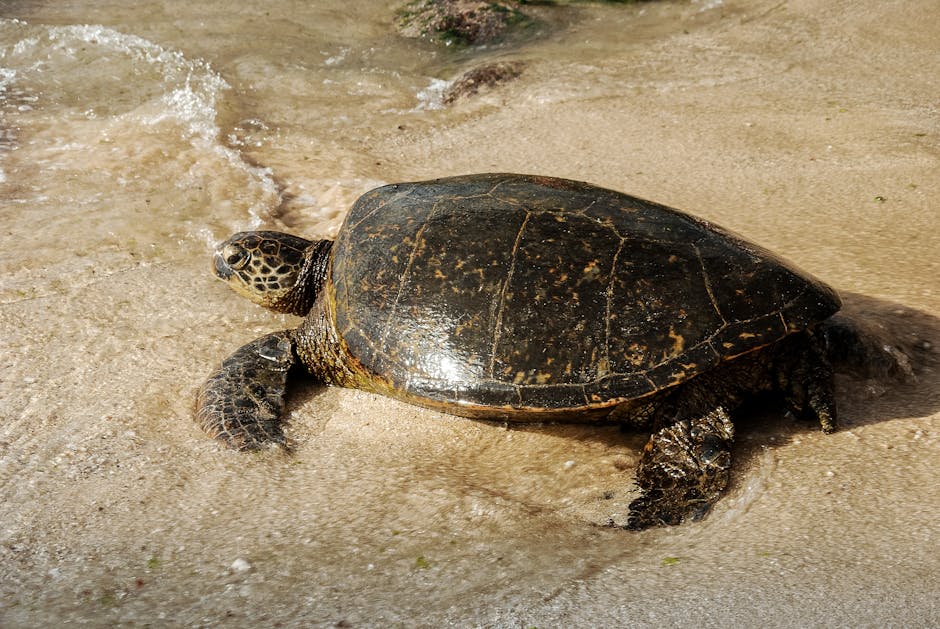
Raine Island is not easy to visit. It sits on the outer edge of the northern Great Barrier Reef, 620 kilometres north of Cairns, accessible only by boat or helicopter, and access is strictly controlled by the Queensland Parks and Wildlife Service. Most people will never see it. But what happens there every year – between October and February, when the green turtles come – is one of the most extraordinary wildlife events on the planet.
Up to 60,000 female green turtles nest on Raine Island in a single season. On peak nights, the beach is so densely packed with nesting turtles that they dig up each other’s nests – a phenomenon called “overturning” that reduces hatching success but is simply the consequence of having more turtles than beach. The island is 32 hectares. The turtles have been coming here for thousands of years.
The Nesting Process
Female green turtles return to Raine Island every 3-5 years to nest, navigating from feeding grounds that may be thousands of kilometres away using the Earth’s magnetic field as a map. Each female nests multiple times per season – typically 4-7 times, at 12-14 day intervals – laying approximately 115 eggs per clutch. The eggs incubate for about 60 days, and the hatchlings emerge at night, oriented toward the sea by the light reflected off the water surface.
The sex of hatchlings is determined by incubation temperature – warmer temperatures produce more females. As sand temperatures rise with climate change, the Raine Island population is producing increasingly female-skewed cohorts. Recent surveys have found sex ratios of up to 99% female in some cohorts – a trend that, if sustained, will eventually reduce reproductive success as males become scarce.
Conservation Challenges
Raine Island faces a specific and urgent problem: the beach is eroding. Sea level rise and storm activity have reduced the available nesting area, and in some years the beach floods during high tides, drowning eggs in the nest. The GBRMPA and Queensland Parks and Wildlife Service have been conducting active management since 2019 – building rock walls to reduce erosion, installing drainage to prevent flooding, and hand-relocating eggs from flooded nests to higher ground.
The Raine Island Recovery Project, a partnership between the GBRMPA, Queensland government, BHP, and Google, has used satellite imagery and machine learning to count nesting turtles from aerial photographs – a methodology that has produced the most accurate population estimates in the rookery’s recorded history. The data is both encouraging (the population is larger than previously estimated) and concerning (the beach is shrinking faster than previously modelled).
Raine Island is a place most people will experience only through photographs and data. But knowing it exists – that 60,000 turtles still find their way to this small island every year, navigating by magnetic fields across thousands of kilometres of open ocean – is itself a kind of sustenance. Some things are still working. The turtles are still coming.