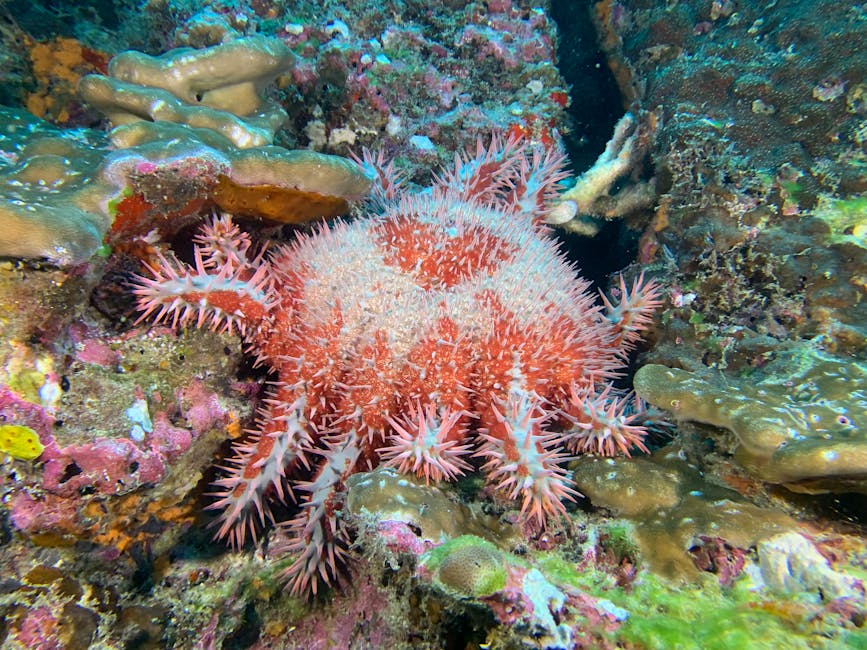
The first time I saw a crown-of-thorns starfish (Acanthaster planci) outbreak in person, I thought something had gone wrong with my eyes. The reef slope ahead of me was covered in them — fifteen, twenty, thirty of the animals visible simultaneously, each one 25 to 40 centimetres across, their upper surfaces a mosaic of sharp venomous spines in grey-green and orange, spread across the coral like a slow-moving catastrophe.
Which is exactly what it was.
Crown-of-thorns outbreaks are, alongside mass bleaching, the most significant recurring acute disturbance to Great Barrier Reef coral communities. Unlike bleaching, they are not caused by climate change — or not directly. Their causes are more complex, more human, and in some respects more tractable. Understanding them is necessary context for anyone who wants to understand the GBR.
What Crown-of-Thorns Starfish Are
Acanthaster planci is a large, multi-armed sea star found throughout the tropical Indo-Pacific. At low, background densities — fewer than one individual per hectare of reef — it is a normal component of the reef ecosystem, feeding on corals and maintaining a level of selective predation that may actually contribute to coral diversity by preventing any single fast-growing coral species from monopolising the substrate.
At outbreak densities — fifteen or more individuals per hectare — it is an ecosystem-altering plague. Crown-of-thorns feed by everting their stomachs over coral tissue, digesting the living polyps externally, and leaving behind the white carbonate skeleton. A single adult can consume up to ten square metres of coral per year. An outbreak population of several hundred thousand animals — the scale of the worst GBR outbreaks — can denude large sections of reef within months.
The starfish have a remarkable capacity for resilience: they can regenerate lost arms, they can survive for months without food, and they reproduce at extraordinary rates when conditions are right. A single large female can release up to 65 million eggs in a single spawning event.
Why Outbreaks Happen
The crown-of-thorns has been a feature of Indo-Pacific reef ecosystems for millions of years. Outbreaks, however, are a relatively recent and anthropogenic phenomenon — or at least, anthropogenic influences appear to have dramatically increased their frequency and severity.
The dominant hypothesis, supported by substantial research, involves nutrient runoff from agricultural land on the Queensland coast. Elevated nutrient levels — particularly nitrogen compounds from fertiliser — produce phytoplankton blooms in coastal waters. Crown-of-thorns larvae, which spend their first weeks as free-swimming plankton, feed on these phytoplankton blooms. Higher phytoplankton concentrations mean higher larval survival rates, which means more juveniles recruiting to the reef, which means, several years later when those juveniles reach reproductive maturity, outbreak conditions.
The link to farming practices on the catchments draining into the Great Barrier Reef lagoon is not hypothetical. Statistical modelling of COTS outbreaks on the GBR shows a clear correlation with heavy rainfall events that flush agricultural runoff into the Coral Sea. The timing and location of new outbreaks tracks rainfall and nutrient discharge patterns.
A secondary factor is the historical removal of COTS predators — giant triton snails, humphead Maori wrasse, and titan triggerfish — through fishing and shell collecting. These predators don’t control outbreak populations, but they may maintain background densities at lower levels between outbreaks, reducing the amplitude of population cycles.
The GBR Outbreak History
Major crown-of-thorns outbreaks on the GBR have been recorded since the 1960s, when the phenomenon was first systematically documented. Four major outbreaks have been identified: the mid-1960s, the late 1970s to early 1980s, the late 1980s to late 1990s, and the current ongoing outbreak that began around 2010. Each outbreak wave moves progressively southward along the reef system over years, following the prevailing currents that distribute larvae.
The cumulative coral loss attributable to COTS outbreaks across these events is estimated at roughly 42% of coral cover on the reef sections affected — comparable to the losses from bleaching and cyclone damage combined over the same period.
Management: What’s Actually Being Done
The GBR Crown-of-Thorns Control Program, funded by the Australian and Queensland governments, employs teams of divers on vessels that patrol the reef and manually inject individual starfish with bile salt or vinegar solution — both of which kill the animals within 24 hours from a single injection. The technology has improved significantly from early approaches that required cutting the animals in half (which, counterproductively, could allow individual arms to regenerate into new animals).
The current injection method is efficient: an experienced diver with an injection pole can treat 500 or more starfish per dive. The vessels patrol high-priority sections of the reef — tourist dive sites, areas of high coral cover value, known outbreak zones — on a continuous basis.
The honest assessment of the program: it keeps outbreak densities below catastrophic levels at the sites that are actively managed. It cannot control populations at the scale of the entire GBR. The reef is too large and the outbreak too widespread for manual removal to eliminate the problem. It’s a containment strategy, not a solution.
The solution — reducing nutrient runoff from agricultural land into GBR catchments — is well-understood, technically achievable, and politically contested. Water quality regulations covering agricultural practices in GBR catchments have been progressively tightened, but enforcement is inconsistent and the desired outcomes are measured in decades rather than years.
What You See on a COTS Outbreak Dive
If you’re diving on the GBR and encounter a crown-of-thorns aggregation, it’s a significant thing to see. The animals, in outbreak numbers, move across the reef with a kind of relentless slowness — each one consuming a patch of coral and moving on, leaving white skeleton behind. Healthy reef ahead, devastated reef in the wake.
The venomous spines are a genuine hazard. A COTS spine puncture is extremely painful, causes localised swelling and in some cases systemic symptoms, and can introduce infection. Don’t handle them. Don’t brush against them. If a site is heavily infected, be conscious of where the animals are relative to your body position throughout the dive.
Report aggregations to your dive operator. The COTS control program relies on dive operators, researchers, and recreational divers reporting sightings to maintain current information about where outbreaks are active. Citizen science contributions to COTS monitoring are a genuine contribution to reef management.
The reef has withstood these outbreaks before and will withstand them again — provided the other pressures on the system are managed well enough to allow recovery between events. That’s the work being done. The reef’s part is to survive long enough for it to matter.