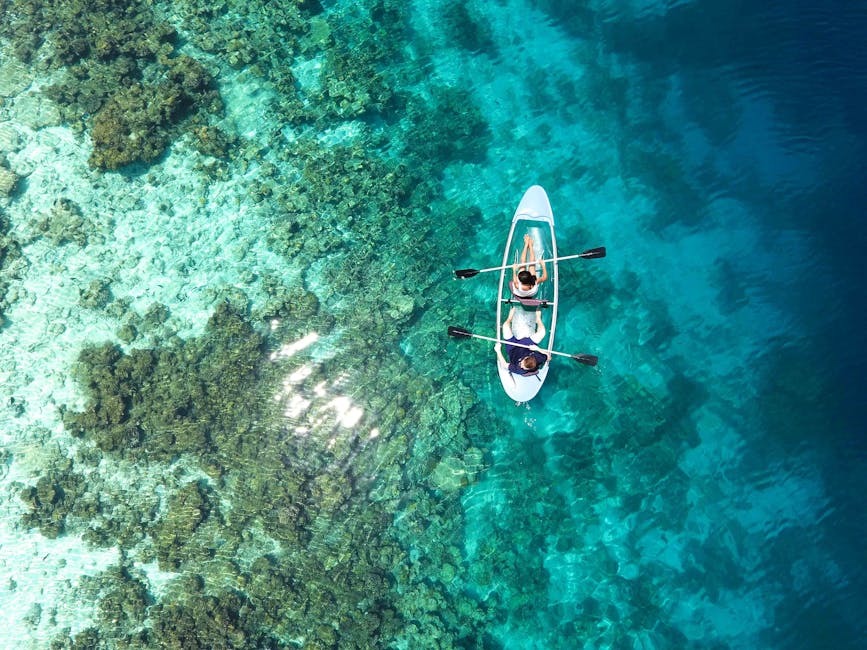
The paddle dips into flat water at 6am and the sound it makes is the only sound. There’s no wind yet. The reef crest is twenty metres to my left, visible as a line of slight turbulence where the lagoon’s calm ends and the ocean begins. A green turtle surfaces three boat-lengths ahead, breathes twice, and goes back down. The kayak moves forward at walking pace.
Sea kayaking gives you the reef at a speed and height that no other surface vessel matches. You’re low enough to the water to see through it — depth and colour and what’s below readable in the angle of your head. You’re quiet enough that the animals on the surface don’t react to your approach the way they do to a motorised boat. And you’re moving under your own effort, which imposes a pace that turns out, repeatedly, to be exactly right for observing things carefully.
Why Kayak the Reef
The argument for sea kayaking as a reef access method is primarily about quality of experience rather than practicality. Day-trip catamarans are faster, more comfortable, carry more people, and offer a wider range of activities. Kayaking offers none of those things. What it offers is a different relationship with the water and the animals in it.
From the cockpit of a sea kayak, with your hull sitting directly on the surface, you read the water in a way that elevated viewing doesn’t allow. The colour changes that indicate depth. The slight surface disturbance that means a turtle is about to surface. The shadow moving below that resolves, as you slow down, into a manta ray cruising two metres beneath you. The dugong grazing on the seagrass flat ahead, visible as a grey shape below the surface, that doesn’t flee at your approach because you arrived quietly and without a motor.
These encounters happen in ordinary kayaking conditions on good reef sites. They’re not guaranteed, but on a calm morning on the right reef, the probability of significant wildlife encounters from a kayak is higher than from a motorised vessel, because you’re moving at the wildlife’s speed and with the wildlife’s noise level.
Skill Requirements and Self-Assessment
Sea kayaking is accessible to most physically capable adults without prior experience, with appropriate instruction and on calm water. The Whitsundays, the Cairns region, and the Ningaloo coast all have guided multi-day kayaking operations that cater to beginners and provide equipment, instruction, and safety management.
The variables that determine whether a given kayak trip is within your capability are: sea state (wind and swell), distance to be covered, and the consequences of capsize in the specific environment. Paddling a protected lagoon between coral cays in calm conditions is fundamentally different from paddling open ocean channels between continental islands in a building trade wind.
For first-time sea kayakers in a reef environment, the correct approach is: guided tour with a qualified leader, calm protected water, and distances that allow for rest stops. The progression to more challenging conditions — longer crossings, exposed coasts, independent paddling — comes with accumulated time on the water.
The fitness requirement is real but modest. Sea kayaking is a sustained aerobic activity and a full day on the water will fatigue arms, shoulders, and core in people unaccustomed to paddling. One to two hours of casual kayaking is well within most adults’ capability. Six to eight hours of paddling across open water in variable conditions is not.
The Whitsundays by Kayak
The Whitsundays offer the most diverse and accessible sea kayaking in Queensland, with a range of conditions from the flat, sheltered water of the fringing island bays to the exposed passages between island groups that require experience and careful tide-window planning.
The classic multi-day Whitsundays kayak circuit covers the southern island group — Shute Harbour as the launching point, across to Molle Island, south to Lindeman Island, and back via the Whitsunday Island coastline — in three to four days of paddling with beach camping on the national park islands. This route is entirely within the capabilities of first-time sea kayakers in an appropriate guided format.
The Whitsunday Island passage — the crossing between the mainland coast and Whitsunday Island, two to three kilometres of open water — is the exposure point in most Whitsundays kayak itineraries. It needs to be done in calm conditions, typically early morning before the trade wind builds, and timed to the tidal flow.
The snorkelling on the Whitsunday kayak routes adds a dimension that the sailing charter doesn’t replicate: you beach the kayak, leave it above the tide line, and enter the water directly from the island. You’re snorkelling a reef that no motorised vessel reached this way, because the shallow lagoons and beach entries that kayaks can use are not accessible to boats. The fish in these areas are correspondingly less habituated to human presence and correspondingly more interesting to approach.
Ningaloo by Kayak
The Ningaloo coast offers a different kayaking character from the Whitsundays: the reef is closer to shore, the water is Indian Ocean blue rather than the greener Coral Sea colour, and the wildlife encounters from the kayak surface are, in whale shark season, extraordinary.
Paddling the outer edge of the Ningaloo lagoon on a calm morning in April, in the months when the whale shark aggregation is active, produces a genuine possibility of surface encounters with whale sharks moving slowly along the reef edge. These are not managed encounters — there’s no spotter aircraft, no guide positioning you — but they happen to kayakers who are in the right place at the right time with the specific low profile and quietness that kayaks provide.
Year-round, the dugong population in Ningaloo’s seagrass beds is the most accessible I’ve encountered from a kayak. The Ningaloo dugongs are accustomed to snorkel boats and tourists generally, and a kayak approaching at walking pace produces less flight response than anything motorised. Paddling above a feeding dugong at two metres of depth, watching it work the seagrass with its bristled lip, is a specific quality of encounter that I’ve had nowhere else.
Practical Equipment Notes
For guided kayak tours, all equipment is provided. For independent paddling in reef environments, the minimum useful kit: a sit-on-top kayak (easier to remount after capsize than a sit-inside), a personal flotation device that fits and is actually worn, a waterproof chart of the area, a paddle float and bilge pump, sun protection (hands, forearms, and the back of the neck burn faster in a kayak than anywhere else), and reef-safe sunscreen for the inevitable water time.
A dry bag or waterproof kayak hatch keeps camera gear, food, and emergency items dry. The camera worth having from a kayak is one you can use one-handed while the other hand holds the paddle — small, lightweight, waterproof.
The best kayaking hours: dawn to mid-morning, when the wind is calm and the light is good. Most coastal locations develop a sea breeze by mid-morning to early afternoon that makes paddling harder and less pleasant. The morning hours are the reef hours.