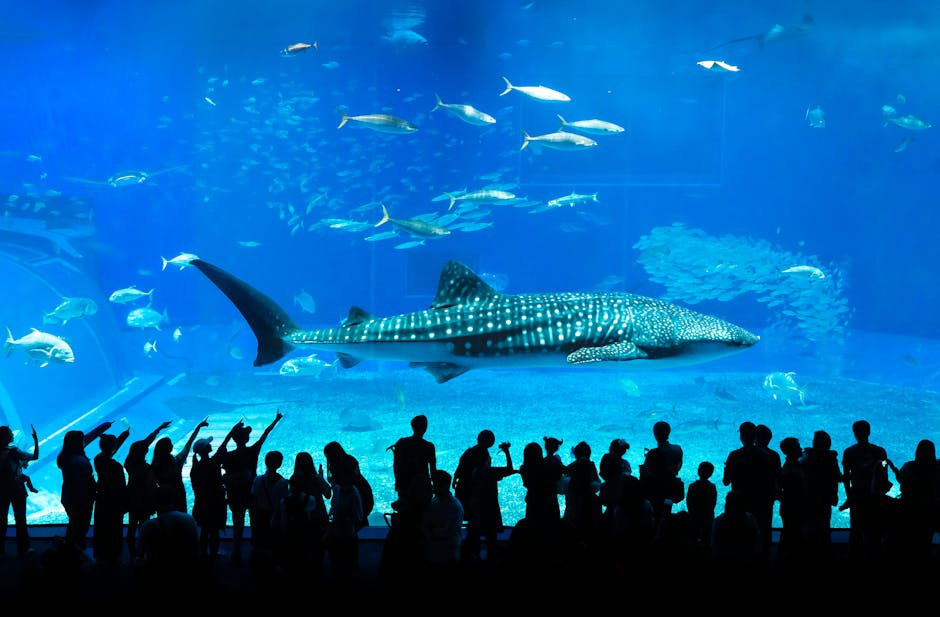
There is a specific protocol for swimming with a whale shark that every operator will brief you on before you enter the water, and one of the rules is: no touching.
This rule exists for conservation reasons — human contact disturbs the animals and can damage their skin — but it also exists, I suspect, because some fraction of people in the water would otherwise attempt to grab onto a nine-metre fish by the dorsal fin, because human beings in the presence of very large animals occasionally lose their better judgement. I understand this impulse. Standing on the bow of a vessel watching a whale shark fin-tip breaking the surface thirty metres ahead, I have felt something very close to the urge to jump in and wrap both arms around something that has no awareness of my existence.
What actually happens when you’re in the water beside one is something more useful than a hug: you understand, in a way that no photograph communicates, what nine metres of animal looks like when it’s moving through your visual field.
Whale Sharks: The Practical Reality
The swim-with-whale-shark experience, done properly, involves a spotter aircraft, a chase boat, timing, and physical effort that most promotional imagery doesn’t fully prepare you for.
The aircraft locates the shark — visible from the air as a dark shape just below the surface, usually moving slowly into the current. The boat accelerates ahead of the shark’s path and deposits a group of swimmers — typically ten people plus a guide — in the water in the shark’s projected course. The swimmers have approximately thirty seconds to organise themselves into a line before the shark arrives.
When the shark reaches the group, it does not stop. It continues at its own pace — typically two to three kilometres per hour, which is a fast fin-kick for an average snorkeller. You swim alongside it for as long as you can keep up, maintaining the operator’s required distance (usually three metres from the body, four from the tail). When the shark dives, or when it accelerates beyond what the group can match, the boat collects everyone and the process begins again.
On a good day, you’ll have three to five swim-with encounters, each lasting one to four minutes. On a difficult day, the shark may dive immediately on each encounter, and you’ll have brief but genuine interactions. On exceptional days, the shark is slow and cooperative and you stay alongside it for six or eight minutes and surface in a state of something approaching euphoria.
The physical demands: you need to be able to sprint-swim for sustained periods. Fins help enormously, as does a calm, efficient technique. Snorkellers who thrash and churn make the approach noisier and may contribute to the shark changing course. Smooth, powerful swimming keeps you alongside the shark without disturbing it.
Reading the Whale Shark’s Mood
Whale sharks aren’t all the same in their response to snorkellers. Some are genuinely indifferent — they maintain their course and speed regardless of how many people are alongside them. Some are slightly wary — they adjust course incrementally away from the group, which experienced guides read and communicate by repositioning the line. A few, particularly at busier sites, have clearly had enough and respond to swimmer presence by diving or accelerating.
The cues that indicate a relaxed shark: consistent speed and direction, horizontal body position, steady fin beats, no sudden acceleration. A shark that’s veering away from the group, changing depth rapidly, or moving with increased urgency is communicating something. Read the guide’s positioning — they’ll move to maintain the optimal angle — and follow their lead rather than trying to self-navigate around the animal.
Manta Rays: A Different Encounter Character
Manta ray encounters have a fundamentally different character from whale shark swims, and for many people they’re the more satisfying experience.
The difference is the manta’s relationship to time and space. A whale shark moves through you — it arrives, you try to keep up, it leaves. A manta ray at a cleaning station hangs in the water column and, if you approach correctly, stays. You can be in the water above a manta for two or three minutes while it completes a cleaning cycle, watching the cleaner wrasse working its gill plates, close enough to see its eyes and the movement of its cephalic fins.
The approach to a manta is important. Come in from the side or below, not from directly above — descending from above mimics predator behaviour. Approach slowly and at an oblique angle, let the manta register your presence, and stop moving if it adjusts its position in response. Stationary snorkellers are much less alarming than moving ones.
At cleaning stations — identifiable by the manta hovering motionless in a current-exposed position while small fish work around its gill plates — the correct behaviour is to settle at the surface above the station and watch. Don’t dive down to the manta; the station is the manta’s space and it’s doing something specific there. Float. Breathe slowly. The manta may complete several cleaning cycles before moving on.
Feeding mantas — barrel-rolling at the surface in plankton concentrations, mouth agape — behave differently. They’re not stationary, but they’re predictable: they continue rolling in the same area as long as the food is there. Getting into the water in the periphery of the feeding area and staying still as the manta’s orbit brings it close to you is more effective than swimming toward it directly.
The Sites in Australia
Lady Elliot Island is the most reliable manta ray snorkelling in Australia. The resident population and the predictable cleaning stations make encounters consistent rather than conditional. The shallow water — cleaning stations at 8 to 12 metres accessible by duck-diving — means snorkellers can get genuinely close.
Ningaloo Reef for whale sharks from March to July. The Exmouth operators have refined the encounter protocol over decades, and the population here is the most studied whale shark aggregation in the world. The encounters are regulated, the guides experienced, and the conditions in the Ningaloo channel — calm and clear — are about as good as the whale shark swim gets anywhere.
The Maldives and Hanifaru Bay specifically — a bay in Baa Atoll that concentrates feeding mantas in extraordinary numbers during the southwest monsoon — are the peak snorkelling-with-mantas experiences available anywhere. On exceptional days, dozens of mantas feed simultaneously in a bay small enough to observe the whole spectacle from the surface without swimming anywhere.
A Word on Etiquette
Neither whale sharks nor manta rays are obliged to be present for your swim. They’re wild animals in their natural habitat, doing whatever they were doing before the boat arrived. The way you behave in the water — whether you contribute to an interaction that the animal experiences as neutral, or one it experiences as stressful enough to leave — affects not just your individual encounter but the experience of everyone who comes after you.
Move slowly. Don’t touch. Don’t chase. Stay calm when the animal comes close — the instinct to reach out is understandable, but it’s an instinct worth overriding. And if the shark dives, let it go. The ocean is not a zoo, and nothing that happens underwater should make the animal wish it hadn’t been there.
That restraint, consistently practised, is what keeps these encounters possible.