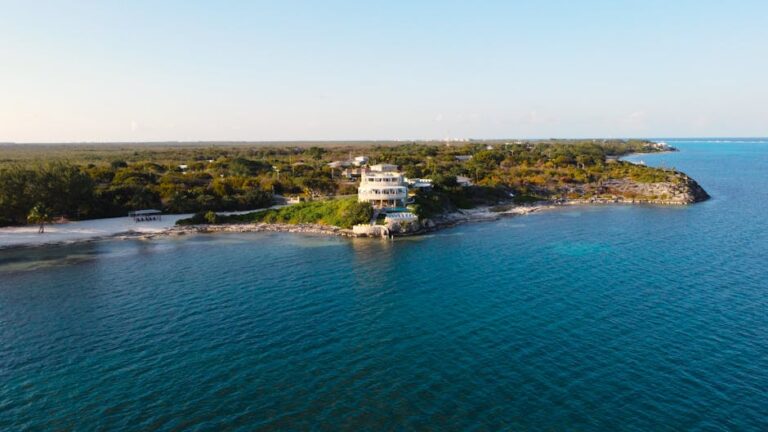
Most Australians have never heard of the Coral Sea Islands Territory, which is understandable — it has no permanent population, no tourist infrastructure, no accommodation, and no way to visit it except on a liveaboard or a vessel capable of an open-ocean passage. It is, in the most literal sense, a territory without residents: a scattering of tiny cays and reefs in the Coral Sea, administered from Canberra, inhabited primarily by seabirds and the occasional visiting scientific expedition.
It is also home to some of the most extraordinary reef diving in the world.
What the Territory Is
The Coral Sea Islands Territory comprises all islands, reefs, and atolls in the Coral Sea east of Queensland and north of the Tropic of Capricorn, excluding the Great Barrier Reef. In practice, the significant structures are: Osprey Reef, Bougainville Reef, Holmes Reef, Marion Reef, the Lihou Reefs, Mellish Reef, and several smaller structures including Cato Island and Frederick Reefs.
These are oceanic structures — seamounts, submerged banks, and atolls that rise from abyssal depths — rather than continental shelf reefs. Their distance from the Queensland coast, their depth, and the clarity of the Coral Sea water that surrounds them produces a diving environment categorically different from the inshore and mid-shelf GBR.
I’ve written elsewhere about Osprey, Bougainville, and Holmes reefs in the context of liveaboard diving. Here I want to focus on two less-discussed sites: Cato Island and Mellish Reef.
Cato Island
Cato Island is a small sand cay — perhaps 150 metres long at high tide — on a reef platform 490 kilometres northeast of the Queensland coast. It is one of the most remote structures in the Coral Sea Islands Territory accessible to diving vessels and one of the least visited by recreational divers.
The platform reef surrounding the cay drops away on its outer edges to oceanic depths, and the diving on these walls is, in the accounts of the few liveaboard operators who visit, exceptional. The fish biomass — particularly shark biomass — reflects the near-complete absence of fishing pressure that characterises remote Coral Sea locations. Grey reef sharks, silvertips, and occasional hammerheads are reported on every dive; the density is described by operators who have dived both Cato and Osprey as comparable to, or greater than, the North Horn at peak conditions.
The island itself supports a significant seabird colony — frigatebirds, masked boobies, brown boobies — and is a green turtle nesting site. The combination of essentially undisturbed seabird colony and pristine surrounding reef gives Cato an ecological completeness that heavily visited sites can’t replicate.
Mellish Reef
Mellish Reef sits at approximately the same latitude as Townsville but 870 kilometres to the east — deeper into the Coral Sea than any regularly visited dive destination from the Queensland coast. It is a true atoll, with a lagoon, an outer reef wall, and a pass that allows water exchange between the lagoon and the open ocean.
Very few recreational divers have been to Mellish. The journey from Cairns takes the better part of two days on a fast liveaboard, which limits the site to operators running extended Coral Sea itineraries of ten days or more. The operational challenges — fuel, weather windows, the distance from any assistance in an emergency — further restrict access.
What’s there, according to the small number of accounts that exist: wall diving in visibility of 40 to 50 metres, shark populations of extraordinary density, and a lagoon coral garden in the kind of condition that suggests decades without any diving pressure whatsoever. The fish, reportedly, show no fear response to divers — a characteristic of reef populations that have never been subjected to spearfishing or significant disturbance.
Willis Islets
The Willis Islets, a small group of sand cays near the northern edge of the Coral Sea Islands Territory, are perhaps best known as a meteorological station location — there has been a weather observation station on one of the cays since 1921. The diving around the Willis group is covered in accounts from research vessel visits and occasional liveaboard expeditions, and the description is consistent: exceptional clarity, dense reef fish populations, and regular encounters with large pelagic species.
The Problem of Access
All of the Coral Sea Islands Territory destinations described here share a fundamental access constraint: they are only reachable by capable offshore vessels, the passage is exposed oceanic sailing, and the departure opportunity depends on weather windows that can be unpredictable.
The liveaboard operators who routinely visit Osprey, Bougainville, and Holmes have developed the route management and vessel capability to make those trips reliably. The more distant sites — Cato, Mellish, Willis — require operators willing to commit to longer voyages with less predictable commercial returns, which limits the frequency of visits.
For divers determined to reach the more remote Coral Sea structures, the practical options are: joining the occasional extended liveaboard itinerary specifically designed for Coral Sea exploration (these exist but are rare and expensive), or — for those with sailing or passage-making experience — private voyage on a suitable vessel.
Why These Places Matter
The significance of the remote Coral Sea Islands extends beyond their diving quality. They are, in ecological terms, reference sites — intact reef systems that provide data on what undisturbed reef ecology looks like. Scientists studying reef response to climate change need these baseline comparisons to understand how degraded reefs have diverged from healthy baselines.
The protection of these sites — their current status as part of the Coral Sea Marine Park, one of the world’s largest marine protected areas — is consequential in the same way that old-growth forests are consequential. Their value is not in their use, though the diving is superb. Their value is in their existence.
They are the ocean’s long-term memory. That’s worth protecting rigorously and visiting with care.